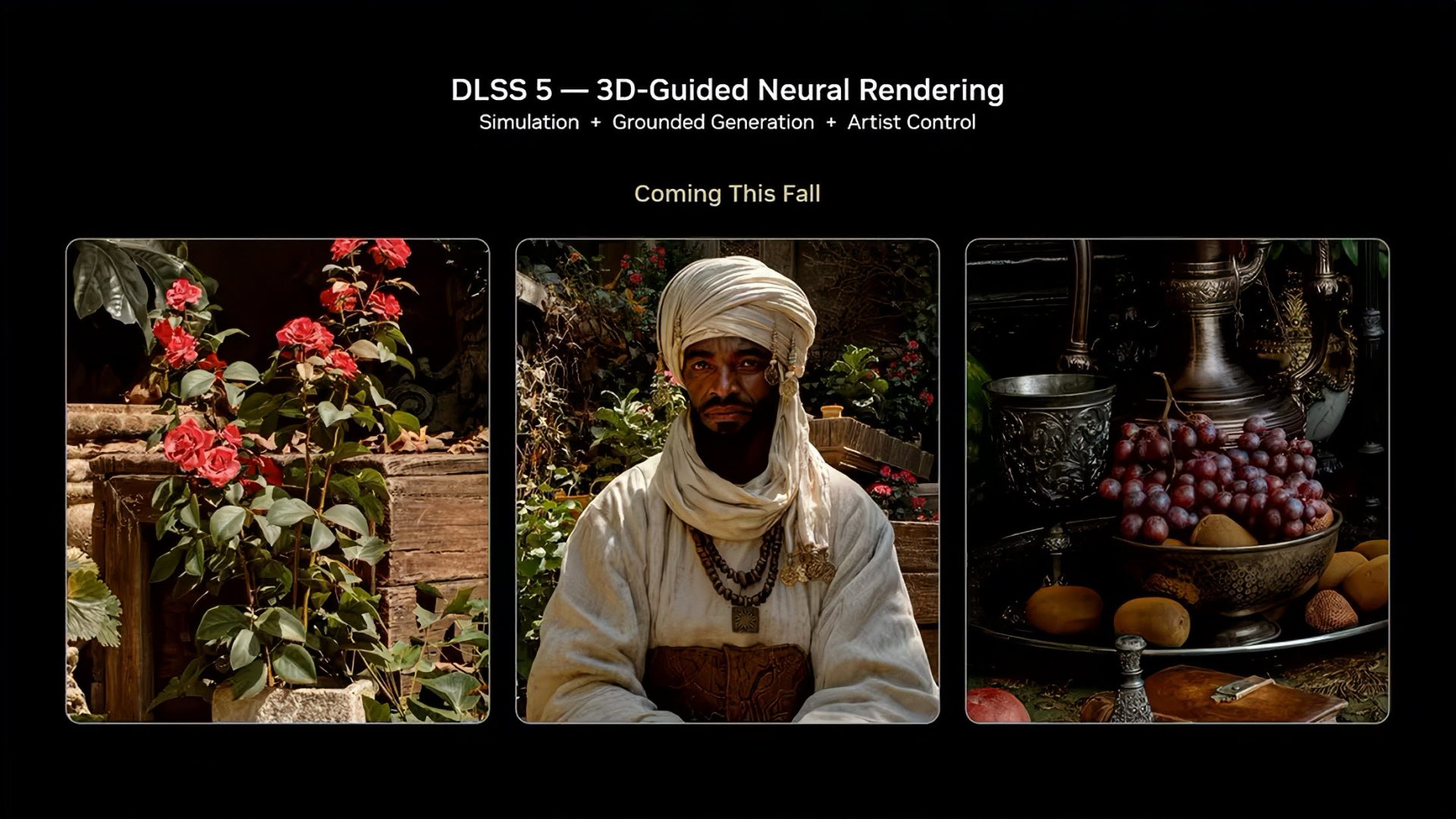
NVIDIA DLSS 5 aims to enhance game graphics with AI, not replace artists
NVIDIA is once again putting DLSS 5 in the spotlight, and this time the company is focusing on one major question: does AI-powered rendering respect the original artistic vision of a game?
After DLSS 5 was first shown at GTC 2026, the technology immediately drew attention for its dramatic visual improvements. Early comparisons between DLSS off and DLSS on showed scenes transformed with richer lighting, more detailed materials, and a noticeably more realistic presentation. However, the impressive leap in image quality also sparked concern. Some viewers worried that AI was not simply improving graphics, but changing the work created by artists and developers.
NVIDIA is now working to clear up that misunderstanding. At SIGGRAPH, the company is explaining DLSS 5 in more detail and emphasizing that the technology is not designed to replace original assets with AI-generated content. Instead, NVIDIA describes DLSS 5 as a way to expand graphics through neural rendering while keeping developers in control.
The message is simple: DLSS 5 is not “AI replacing graphics.” NVIDIA wants it to be understood as “AI expanding graphics.”
The company says DLSS 5 is built around preserving artistic integrity. That means the characters, environments, materials, lighting direction, and overall style of a game should remain aligned with the creator’s intent. The AI model is not meant to reinvent a scene or generate a different version of it. Its purpose is to enhance what is already there.
The roots of DLSS 5 go back much further than its public reveal. NVIDIA says the idea began forming around the launch of Turing RTX GPUs in 2018, when the first version of DLSS arrived. From the beginning, the company believed that graphics rendering and artificial intelligence would eventually need to work together to reach truly photorealistic visuals.
Since then, DLSS has evolved significantly. The technology started as an AI upscaling solution and has grown into a broader suite of rendering tools. With newer RTX GPUs, improved Tensor Cores, ray tracing, path tracing, Ray Reconstruction, and frame generation, NVIDIA has continued pushing toward more realistic game visuals.
Even with modern path-traced games, NVIDIA argues that real-time graphics are still not indistinguishable from reality. Traditional rendering remains heavily dependent on artists and developers manually building scenes, authoring materials, simulating light, calculating reflections, and framing the final image. This process has produced incredible results, but it also has limits.
Generative AI models, on the other hand, can learn from huge amounts of real-world data. These models can understand how light behaves, how materials react, how shadows fall, and how physical details appear in natural environments. The problem is that large generative models are often slow, inconsistent, and too complex for real-time gaming.
DLSS 5 is NVIDIA’s attempt to combine the strengths of both approaches. It uses the structure and reliability of traditional game rendering, then applies AI to improve realism in a controlled and consistent way.
One of the biggest challenges NVIDIA had to solve was preserving artistic intention. Generative AI can create convincing images, but it is often unpredictable. Ask a typical AI model to generate the same face, object, or scene multiple times, and the results may vary. That kind of behavior is unacceptable in a real-time game, where consistency matters from one frame to the next.
For example, if a game character’s face looked slightly different every time DLSS was enabled or every time the scene refreshed, it would break immersion and undermine the artist’s work. NVIDIA says DLSS 5 is specifically designed to avoid that issue.
Rather than using a text prompt or generating assets from scratch, DLSS 5 works from the frame already rendered by the game engine. That frame becomes the foundation. The AI model does not treat it as a loose suggestion. It treats it as the source that must be respected.
To make this possible, NVIDIA trains the model using data already available inside the renderer. This can include surface normals, lighting information, motion data, material properties, and other internal buffers. By using these signals, DLSS 5 can better understand what the engine intended to draw and enhance the image without changing the core asset or art direction.
According to NVIDIA, this approach allows the model to improve the realism of a scene while staying within clear boundaries. It can enhance details such as subsurface scattering, material response, light transmission, hair, foliage, contact shadows, and environmental lighting. These improvements can make a scene look more natural and cinematic, but the original asset remains intact.
In other words, DLSS 5 is not replacing a developer’s model with a new AI-generated version. It is improving the way that model is presented on screen.
NVIDIA compares this kind of progress to earlier milestones in graphics technology. Shader models, tessellation, ray tracing, and path tracing all changed how games looked, but they did not remove artists from the process. DLSS 5 is being positioned in the same way: as another rendering tool that gives creators more visual power.
The second major challenge is real-time frame-by-frame consistency. Many generative AI systems process images or video in chunks, looking across multiple frames before producing an output. That approach does not work well for interactive games, where every action from the player must be reflected instantly on screen.
DLSS 5 must react immediately as the player moves the camera, turns a character, fires a weapon, drives a vehicle, or changes direction. Any delay, flicker, or inconsistency would be obvious.
To solve this, NVIDIA relies on information from the game engine, including motion vectors. Motion vectors help the AI understand how objects and pixels are moving across the screen. This means DLSS 5 does not need to guess motion from scratch. It can use the engine’s own data to keep frames stable and coherent.
NVIDIA says this helps prevent common visual problems associated with AI video generation, such as shimmering, drifting, or unstable details that appear to “swim” across the image. The goal is to make the enhanced output feel like a natural part of the game’s rendering pipeline, not like an AI layer added on top.
The third major hurdle is performance. DLSS 5 is designed for real-time 4K gaming, high frame rates, low latency, and single-GPU operation. That is a difficult target because the technology must deliver better image quality without slowing down gameplay.
NVIDIA’s DLSS ecosystem has already moved far beyond simple upscaling. Features like Ray Reconstruction and Multi Frame Generation show how AI can improve both image quality and performance. DLSS 5 builds on that direction by aiming to bring more advanced neural rendering into the real-time pipeline.
For gamers, the promise is clear: sharper visuals, more realistic lighting, richer materials, and smoother performance. For developers, the promise is more control over how AI is used in their games.
That control is important because many of the early concerns around DLSS 5 came from the fear that AI would override the creative process. NVIDIA is now making the opposite argument. The company says DLSS 5 is designed to give developers tools that preserve their artistic standards while raising visual fidelity.
If NVIDIA can deliver on that promise, DLSS 5 could become one of the most important steps yet in AI-assisted game rendering. It represents a future where neural rendering does not replace traditional graphics, but works alongside them.
The key difference is control. DLSS 5 is not being presented as an AI system that invents new art on behalf of the developer. It is being presented as a rendering technology that understands the existing frame, respects the game engine’s data, and enhances the final image in ways that support the original vision.
That distinction may determine how developers and players respond to DLSS 5 when it eventually becomes widely available. AI in gaming remains a sensitive topic, especially when it touches art, animation, characters, and visual design. But NVIDIA’s latest explanation makes its position clear: the future of DLSS is not about removing artists from graphics. It is about giving them more powerful tools to make games look closer to reality.NVIDIA DLSS 5 aims to bring real-time AI rendering closer to photorealistic 4K gaming
NVIDIA is preparing DLSS 5 as its next major step in AI-powered graphics, with a clear goal: make high-quality 4K gaming more realistic, more responsive, and more practical on modern hardware. While current visual technologies such as path tracing can deliver stunning results, they also demand enormous GPU power. DLSS 5 is being designed to help bridge that gap by using neural rendering to enhance image quality without relying only on traditional rendering methods.
Unlike large generative AI models that can be slow and heavy, DLSS 5 is built as a real-time renderer. That means it needs to be compact, fast, and efficient enough to work during gameplay, not after the fact. NVIDIA says it achieved this by distilling larger models that understand how the world should look into a much smaller model focused on one specific task: transforming rendered frames into more realistic images in real time.
The result is a “one-step pixel space diffusion transform” model designed for 4K, high-frame-rate, low-latency gaming. In simpler terms, DLSS 5 is built to improve what players see on screen while keeping performance smooth enough for actual gameplay.
One of the biggest questions around DLSS 5 has been hardware requirements. Early demonstrations were shown using a dual RTX 5090 setup, which raised concerns about whether the technology would require extreme GPU configurations. NVIDIA has now reaffirmed that DLSS 5 is intended to run on a single GPU.
The company also says the model is designed to be efficient with VRAM, although it has not shared exact performance numbers or memory usage yet. Those details are expected to arrive closer to launch as NVIDIA continues optimizing DLSS 5 for both gamers and creators.
A major part of DLSS 5 is not just how it improves graphics, but how much control it gives developers and artists. NVIDIA showed a toolset built to let content creators decide how DLSS 5 affects different parts of a scene, rather than applying one fixed visual style across an entire game.
In one example, DLSS 5 was applied to a character model. The original assets, geometry, and structure remained intact, but the final image gained more realistic effects such as improved subsurface scattering, stronger ambient occlusion, better contrast, contact shadows, and more convincing reflections. The character’s face looked more natural while still respecting the original render frame created by the game engine.
This is important because developers do not want AI rendering to overwrite their artistic direction. DLSS 5 is being positioned as a controllable enhancement tool, not a one-button replacement for traditional game art.
NVIDIA is also giving developers multiple DLSS 5 models to choose from. These models, currently described as A, B, and C, are trained with different parameters and can produce different visual results. A studio can choose the model that best matches the look of its game.
Even better, developers are not locked into a single model. They can mix and match different models depending on the scene, character, object, or environment. This could allow one game to use different DLSS 5 behavior for faces, foliage, props, lighting, or cinematic scenes.
DLSS 5 also includes global controls that let developers fine-tune how strong the AI enhancement should be. Two of the main sliders are Structure Intensity and Tone Intensity.
Structure Intensity affects high-frequency detail. This includes elements such as ambient occlusion, subsurface scattering, sharper surface definition, and reflections. Increasing this setting can make details appear richer and more grounded in the scene.
Tone Intensity affects lower-frequency visual information, especially lighting and color. Adjusting this setting can change how light interacts with characters and environments, including the warmth, softness, and realism of the final image.
These controls give artists the ability to decide whether they want a subtle improvement that stays close to the original render or a more dramatic visual uplift that pushes the image closer to a cinematic, photorealistic look.
Another key feature of DLSS 5 is automasking. The model can understand the semantic structure of a scene, meaning it can identify what it is looking at. For example, it can recognize a base character and apply DLSS 5 enhancements only to that character while leaving the rest of the frame untouched.
This allows developers to raise or lower the DLSS 5 effect on specific subjects. At a lower intensity, the result stays close to the original rendered frame. At a higher intensity, the visual improvement becomes much more noticeable, adding richer lighting, stronger depth, and more lifelike material behavior.
DLSS 5 also supports engine-side masking. Instead of relying only on the AI model to detect elements in a scene, the game engine can tell DLSS 5 exactly which objects should be enhanced. NVIDIA demonstrated this with objects such as bottles, grapes, and other props. Developers can choose whether specific objects receive improved translucency, metal reflections, lighting, or other visual effects.
This level of control is especially useful for game studios because not every object in a scene should receive the same treatment. A reflective bottle, a piece of fruit, a metal weapon, and a human face all require different visual handling. DLSS 5 is being designed to let developers make those decisions carefully.
NVIDIA also showed how DLSS 5 can improve environments, including foliage. In one example, a ray-traced reference render already looked good, but NVIDIA described it as somewhat plastic-like. With DLSS 5 enabled, the foliage gained more natural lighting and subsurface scattering, helping leaves and plants appear more organic and lifelike.
The key point is that DLSS 5 can enhance specific visual qualities without changing everything else in the frame. For developers, that could mean better-looking forests, characters, interiors, and props without the huge performance cost of rendering every effect through traditional methods.
Traditional rendering techniques can achieve impressive realism, but they are often expensive on hardware, especially at 4K resolution with ray tracing or path tracing enabled. DLSS 5 takes a different approach by using neural rendering to generate a more refined final image faster and more efficiently.
NVIDIA says the current toolset is only an early look at what DLSS 5 will offer. The company is working with developers and partners to gather feedback and expand the available controls before launch. Because DLSS 5 is designed to integrate closely with game engines, it could lead to deeper collaboration between NVIDIA and game studios.
That could also help grow the DLSS ecosystem even further. DLSS is already widely used across many PC games and creative applications, and DLSS 5 appears to be NVIDIA’s next push toward making AI rendering a central part of game development.
NVIDIA is expected to launch DLSS 5 this fall, with more technical details, performance data, and supported titles likely to be revealed closer to release.
However, NVIDIA is not claiming that DLSS 5 has fully solved real-time photorealism. The company acknowledges that true photorealistic rendering remains a long-term challenge, especially when it comes to animation. While DLSS 5 can significantly improve appearance, lighting, materials, and surface detail, lifelike motion and animation still require major advances.
Even so, DLSS 5 shows how quickly AI graphics technology is evolving. By combining deep learning, real-time rendering, and developer-controlled tools, NVIDIA is aiming to make next-generation visuals more accessible without demanding impossible levels of hardware power. If the final version delivers on its promise, DLSS 5 could become one of the most important technologies for 4K gaming, path-traced graphics, and real-time neural rendering.


