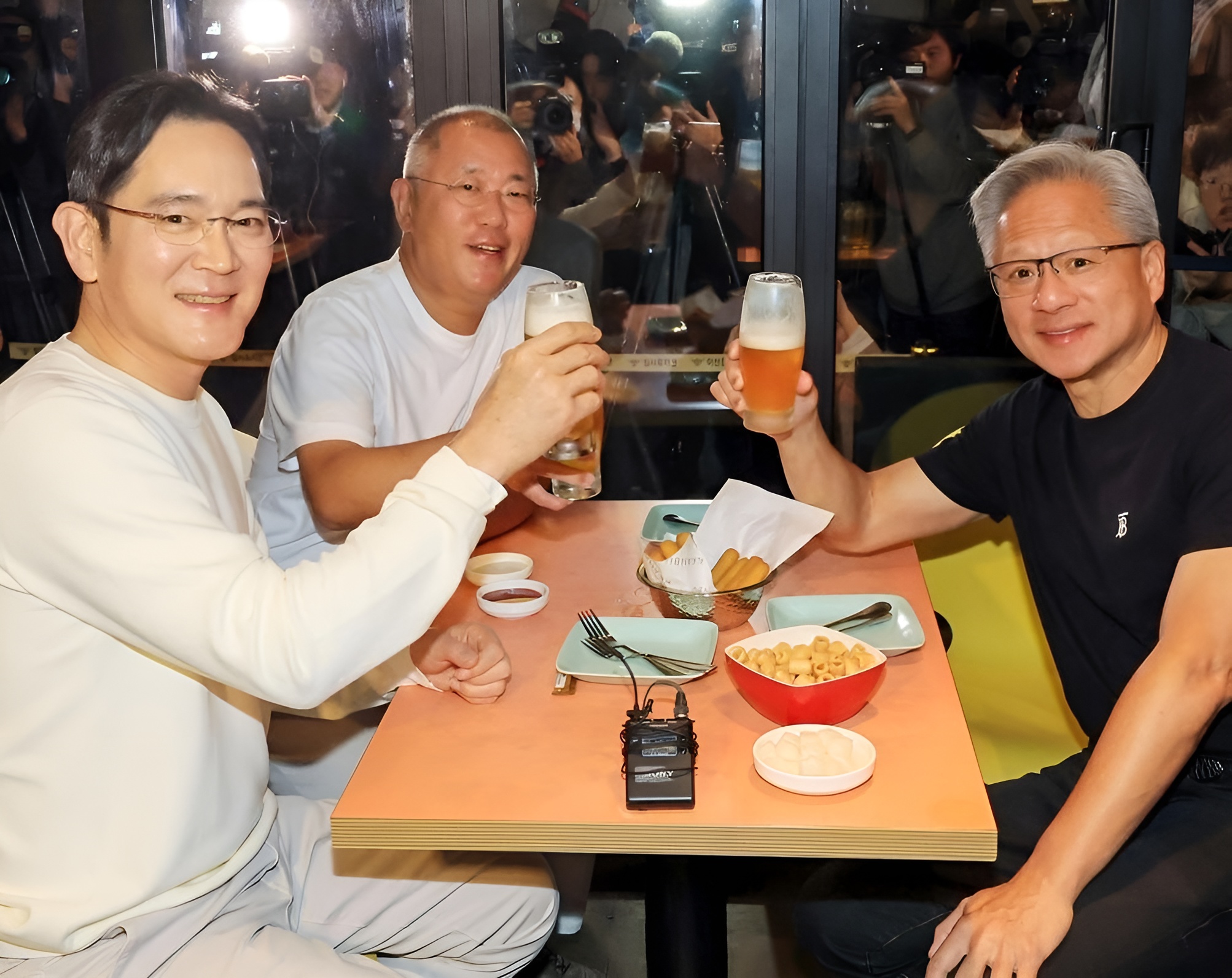
NVIDIA’s Jensen Huang touched down in South Korea fresh off his GTC 2025 keynote, turning a high-stakes week into a whirlwind of diplomacy, deal-making, and a little local flavor. While in town for the APEC summit, the CEO met with Samsung Chairman Lee Jae-yong and Hyundai Motor President Chung Eui-sun, underscoring how critical Korea has become to NVIDIA’s AI, autonomous driving, and semiconductor strategy. Photos circulating online even showed Huang serving Korean fried chicken and sharing celebratory shots with executives—an unexpected glimpse of the industry leader letting loose after a monumental year that saw NVIDIA’s valuation touch the $5 trillion mark.
Behind the lighter moments, the business agenda was serious. NVIDIA, Samsung, and Hyundai are deepening ties around autonomous driving and advanced driver-assistance systems. NVIDIA brings the AI compute, software platforms, and training infrastructure; Hyundai contributes automotive expertise and deployment at scale; and Samsung is fast becoming a cornerstone supplier across memory and manufacturing. Samsung recently secured a key HBM3E certification from NVIDIA, and its foundry has been added to the NVLink ecosystem alongside other major players—clear signs that their collaboration is expanding across both memory and advanced semiconductor production.
APEC’s gathering of global leaders provided the perfect stage for these conversations, bridging East–West priorities at a moment when AI infrastructure is straining under unprecedented demand. With high-bandwidth memory now the lifeblood of modern AI data centers, NVIDIA’s need for a diversified, high-capacity supply chain is more urgent than ever. That is where Samsung’s role grows pivotal—not only on the DRAM side with HBM3E, but also through foundry partnerships and advanced packaging that can help deliver faster interconnects, better efficiency, and more reliable availability for future AI chips.
Industry chatter points to a potential “big partnership” in the works, and the recent moves make the speculation plausible. By aligning on HBM roadmaps, NVLink interoperability, and scalable manufacturing, NVIDIA can shore up supply for next-generation accelerators, while Samsung strengthens its leadership in premium memory and leading-edge silicon. For automakers like Hyundai, this cooperation could accelerate timelines for safer ADAS features and more capable autonomous systems, powered by robust AI compute and a dependable component pipeline.
From the GTC 2025 stage to APEC’s boardrooms and Seoul’s late-night restaurants, Huang’s visit captured the moment: AI is now a global industrial priority, and the companies that master supply chains as well as silicon will shape its future. Expect more announcements as these partnerships solidify—and watch the HBM and NVLink ecosystems closely, because that’s where the next wave of AI performance and availability will be decided.