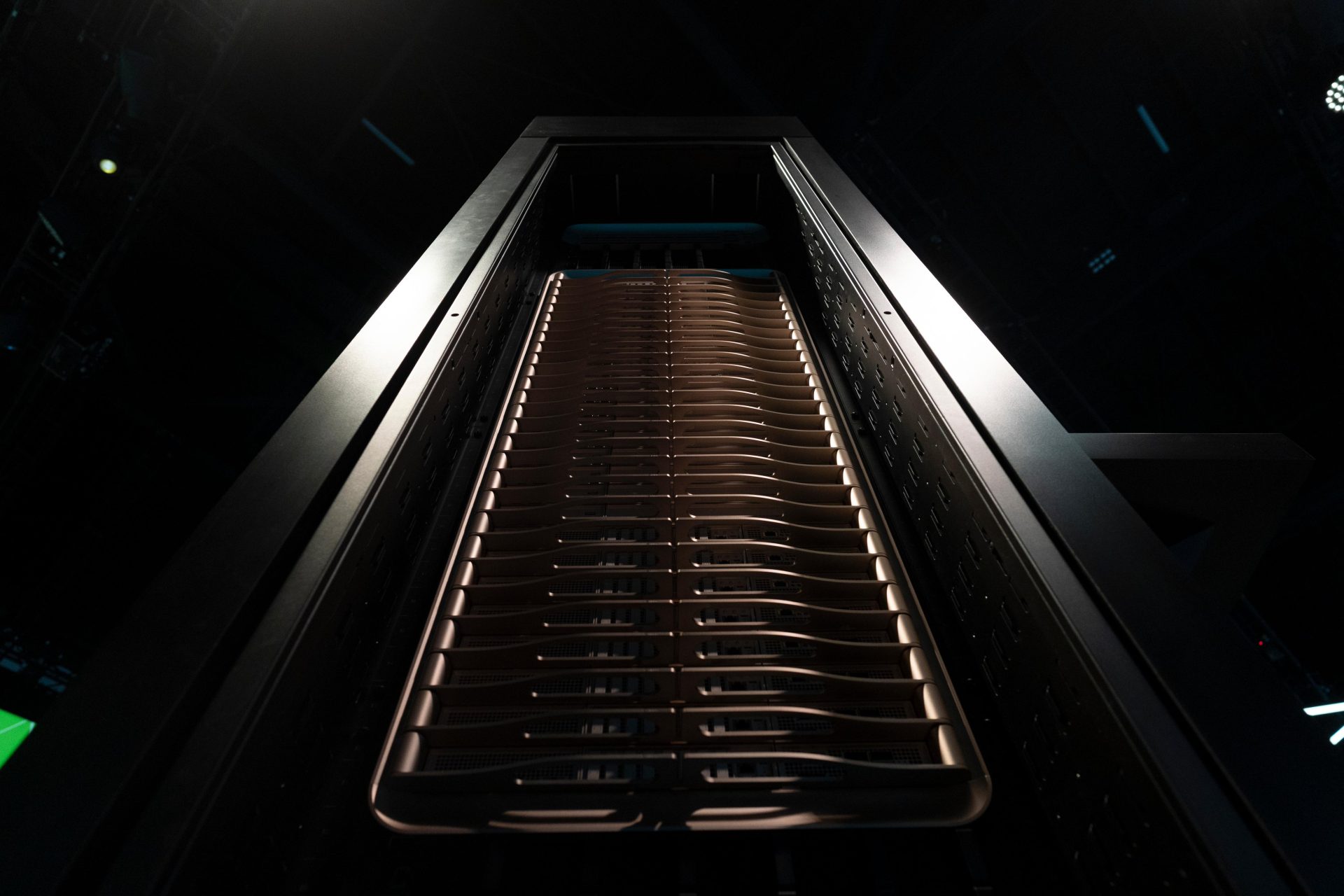
NVIDIA is moving quickly to bring 800 VDC power architecture into the AI data center era, with Google, Microsoft, and a broad industry ecosystem supporting the shift. The goal is clear: help next-generation AI factories overcome rising power limits while delivering more electricity directly to GPUs and accelerators.
As artificial intelligence workloads expand, data centers are consuming more energy than ever. Traditional power systems are becoming a major bottleneck because modern AI clusters require enormous amounts of electricity to run dense racks packed with GPUs, networking hardware, cooling systems, and storage. For companies building large-scale AI infrastructure, improving power delivery is no longer optional. It is becoming one of the most important factors in scaling performance.
That is where 800 VDC, or 800-volt high-voltage direct current, comes in.
Today, most data centers rely heavily on AC power. While AC infrastructure is mature and widely deployed, it comes with a major drawback for AI computing: power often needs to be converted multiple times before it reaches the GPUs. Every conversion step creates losses, adds complexity, and generates heat. In smaller systems, those losses may be manageable. In massive AI factories, they can become a serious obstacle.
NVIDIA’s 800 VDC approach is designed to reduce those conversion stages and send power more efficiently to the hardware that needs it most. By using higher-voltage DC distribution, more usable power can reach GPUs and accelerators, helping improve rack density, energy efficiency, and overall compute performance.
NVIDIA describes this as a way to break through the “power wall,” a growing challenge where AI performance is limited not by chip capability alone, but by the ability of data center infrastructure to deliver enough power safely and efficiently.
To support the transition, NVIDIA has introduced DSX reference designs intended to help AI factories move from traditional AC systems toward native 800 VDC deployments. The company is working with Google and Microsoft through the Open Compute Project to develop what it says is one of the industry’s first major 800 VDC architectures for AI infrastructure.
The effort is not limited to a handful of companies. More than 80 equipment and infrastructure partners are reportedly involved in building products based on the new specifications. These platforms are expected to begin rolling out in the second half of 2026.
Vladimir Troy, vice president of data center infrastructure at NVIDIA, said 800 VDC enables the compute performance and power density needed for AI at scale. He also emphasized that the work being done through the Open Compute Project is meant to provide a practical path forward for AI factory operators, not just a long-term concept.
The timing is important. Data center electricity consumption is rising rapidly, driven in large part by AI. Recent energy estimates suggest data center power usage grew sharply in 2025, with AI facilities accounting for a significant portion of that increase. Global data center electricity demand could approach 950 TWh by 2030, nearly doubling from current levels.
Meeting that demand will require massive investment. Industry projections suggest global AI and data infrastructure spending could reach around $9 trillion through 2040. However, the facilities best positioned to benefit from that investment will likely be the ones that solve their power architecture challenges early.
NVIDIA, Google, Microsoft, and their infrastructure partners are working to make 800 VDC ready before power delivery becomes an even larger constraint for AI operators.
One of the first major platforms expected to use this architecture is NVIDIA’s Rubin MGX system. According to industry reports, Rubin MGX platforms based on 800 VDC power delivery are already in production and are planned for release in the second half of 2026.
A key advantage of the 800 VDC MGX rack approach is that it does not require data center operators to completely abandon existing AC infrastructure. Instead, the new DC-based platforms can be integrated into current environments, allowing companies to adopt the technology gradually.
This makes the transition more realistic for large data center operators that have already invested heavily in AC power systems. Rather than rebuilding everything from scratch, they can use 800 VDC where it makes the most sense, based on workload demands, deployment schedules, and future AI compute requirements.
The approach offers several practical benefits. Operators can continue using existing AC infrastructure, avoid major supply chain disruption, and move toward DC power in phases. This gradual adoption model could be critical for hyperscale cloud providers, enterprise AI facilities, and colocation data centers that need to expand quickly without risking downtime or operational complexity.
However, DC power also introduces new engineering and safety challenges.
Unlike AC power, which naturally crosses zero during each cycle, DC power does not have a natural zero crossing. This makes DC faults more difficult to interrupt and can result in sustained fault currents. In simple terms, when something goes wrong in a DC system, the current can continue flowing more aggressively unless specialized protection systems stop it quickly.
Fault energy is another concern. AC systems benefit from current oscillation, which helps breakers and fuses clear faults. DC systems require faster and more robust interruption methods because the energy flow is continuous.
Shock hazards also differ. AC shocks are dangerous and can cause muscle contraction or heart fibrillation depending on frequency and exposure. DC shocks can cause continuous muscle contraction and may make it harder for a person to let go, increasing the importance of careful safety design.
Protection devices for DC power are more specialized than standard AC circuit breakers and fuses. Ground fault detection can also be more difficult in DC systems, requiring advanced monitoring. Arcing is another major issue. AC arcs tend to extinguish more easily because of zero crossings, while DC arcs can persist and become harder to stop. This makes arc flash mitigation especially important in high-voltage DC data center designs.
Because of these factors, 800 VDC AI factories will require advanced protection systems, improved monitoring, specialized equipment, and strict safety standards. The move to DC power is not simply about efficiency; it also requires a full ecosystem of components designed for reliable high-voltage operation.
NVIDIA is also preparing another major piece of its DC power roadmap: a row power center. This system is designed to act as a centralized power station for an entire row of AI racks. It would use an overhead 800 VDC busway to distribute power across multiple rack rows and support up to 2 MW of power per row.
This row-level power architecture is expected in 2027 and could become an important part of future AI factory designs. It is also expected to scale to upcoming NVIDIA platforms, including Rubin Ultra and Feynman systems on Kyber racks.
The bigger picture is that AI infrastructure is entering a new phase. GPU performance continues to increase, but without better power delivery, data centers may struggle to support the next generation of AI models and workloads. The transition to 800 VDC is one of the clearest signs that the industry is rethinking the foundation of data center design.
By reducing AC conversion losses, improving power density, and delivering more electricity directly to GPUs, 800 VDC could help unlock larger and more efficient AI systems. NVIDIA’s early Rubin MGX platforms are expected to mark the beginning of this transition in the second half of 2026, while larger row-based DC power systems could follow in 2027.
For AI data centers, the message is simple: compute performance is no longer just about faster chips. It is also about building power infrastructure capable of feeding those chips efficiently, safely, and at massive scale.