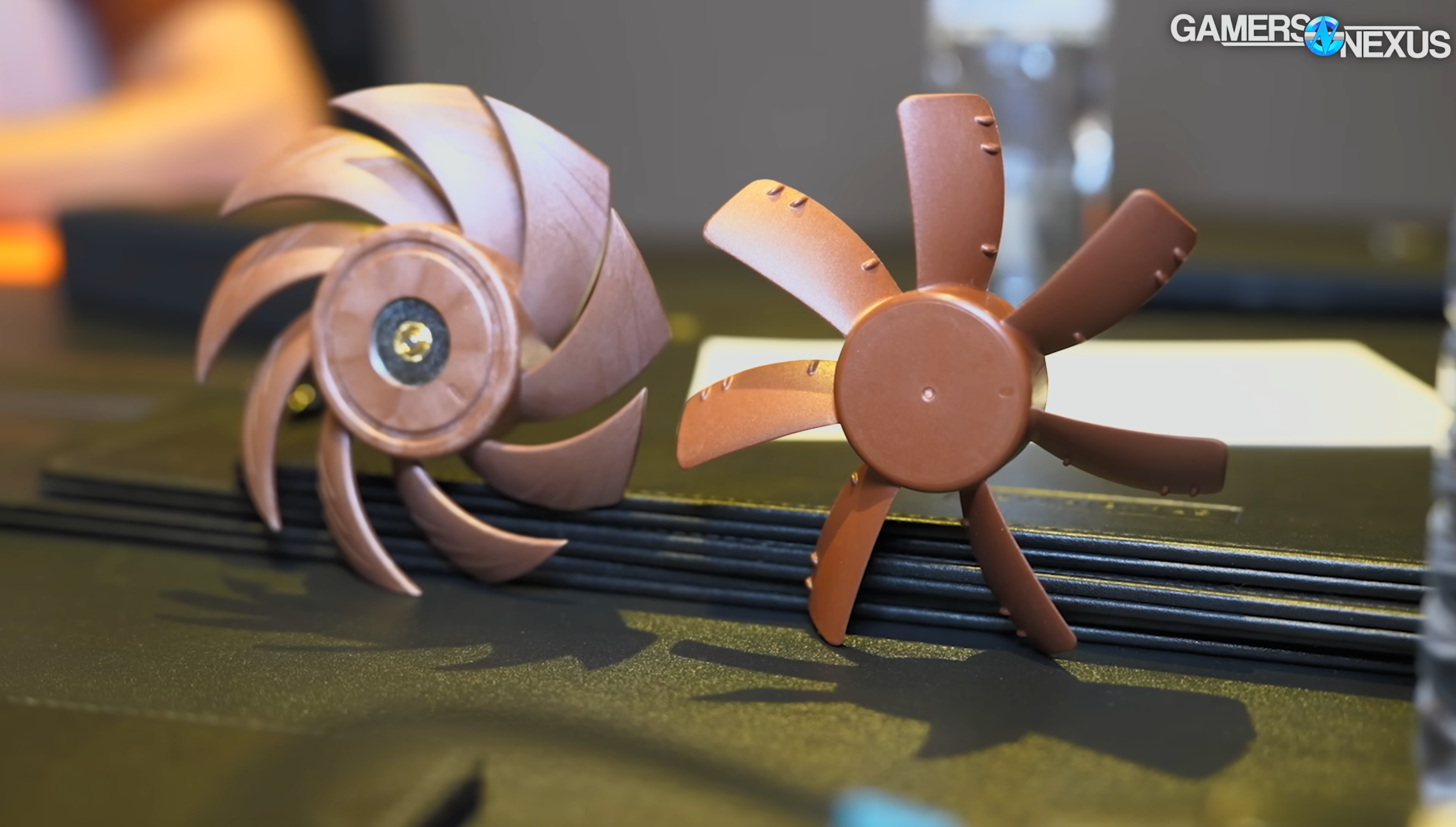
Noctua is pushing the boundaries of fan design, focusing on the intricacies of blade and airflow dynamics. Dellinger, a key figure in their engineering team, explains the nuances of “blade angle,” which is the tilt of the fan blade relative to its rotation plane, and “angle of attack,” the aerodynamic interaction with incoming air. These angles shift from the hub to the tip to align with rotational speeds. Larger angles can enhance airflow per rotation but risk stalling and increased noise. Even a minor adjustment of just 1° can significantly affect performance and noise levels.
The number of fan blades is another crucial factor in noise and performance. Fewer blades can reduce noise by lowering the blade passing frequency, but this comes at a cost. For instance, a seven-blade fan at 2000 RPM emits a more accommodating 233Hz tone compared to 300Hz from a nine-blade fan. However, fewer blades may compromise pressure and stiffness, requiring compensatory measures like larger blades or increased RPM, which might negate noise benefits. Noctua prefers nine-blade designs for their 120mm fans, finding them to be the ideal balance of airflow, pressure, and noise.
Heatsink design also plays a significant role in fan noise and cooling efficiency. More fins mean better heat dissipation, but increased fin density can cause more airflow resistance. This resistance pressures fans to operate near stall points, causing turbulence and tonal issues. Heat transfer varies along the fins, peaking at the leading edge then dropping. Noctua strives to match fan characteristics with appropriate heatsink resistance to maintain optimal airflow.
Looking to the future, advancements in fan design are more likely to stem from new materials rather than changes in geometry. Noctua’s shift to liquid crystal polymer (LCP) from PBT and ABS plastics has allowed for tighter tolerances and reduced vibration, improving high-speed performance. While metal or composite blades could further enhance performance, they might also increase noise and production costs. Some improvements are achieved through innovative techniques like the centrifugal turbulator hub structure in Noctua’s G2 fans.
Dellinger remains cautious about revolutionary breakthroughs in fan technology, noting that most possibilities have been thoroughly explored within current material and use case constraints. While concepts like low blade count or finless designs are intriguing, practical limitations in airflow, turbulence, and cost keep them largely theoretical for now.