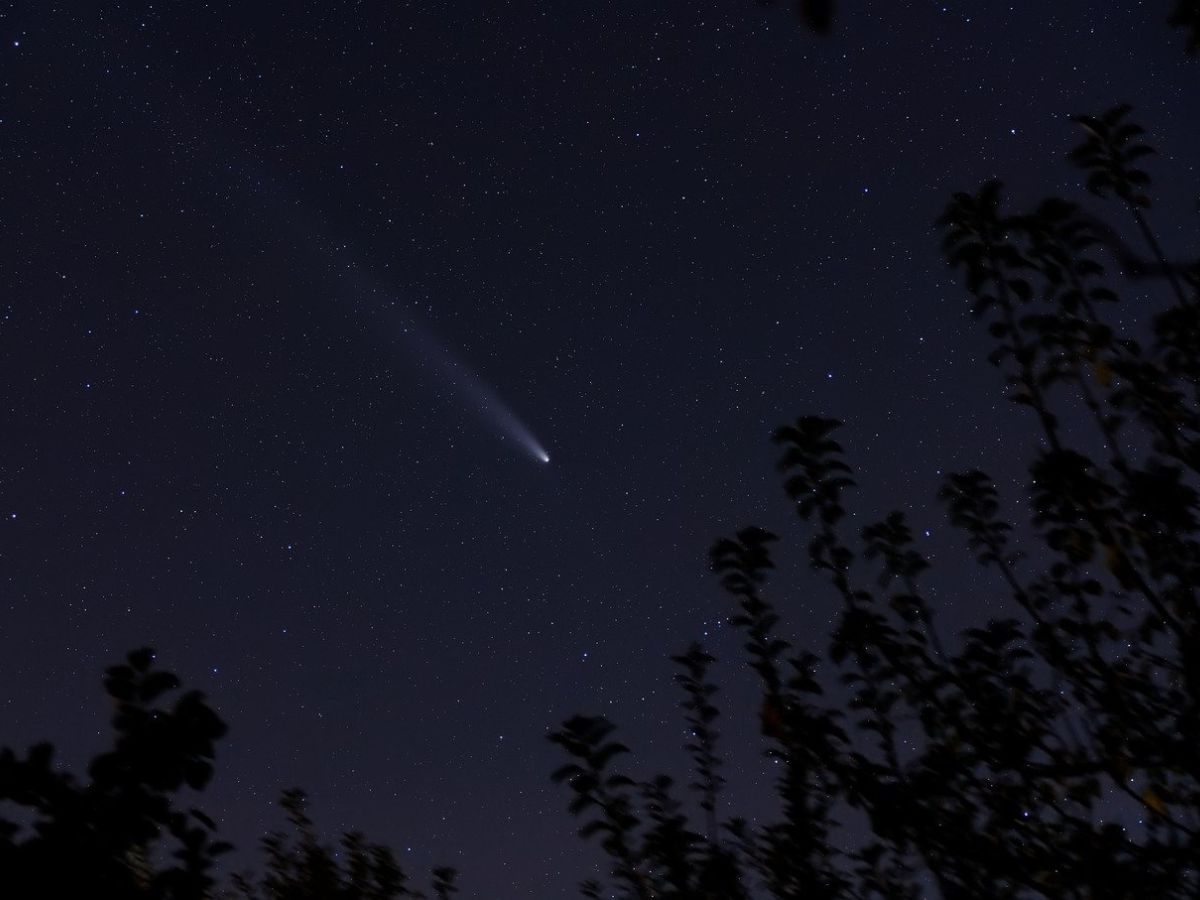
C/2025 K1 (ATLAS) was never destined to become a long-term visitor to our skies. This rare, non-periodic comet—meaning it likely won’t return—was discovered in May 2025 by the ATLAS sky-survey system and traced back to the distant Oort cloud, a vast reservoir of icy bodies surrounding our solar system. Its journey toward the inner solar system delivered a dramatic ending: after swinging close to the Sun on October 8, 2025, the comet didn’t survive the encounter, breaking apart into multiple fragments.
Like many comets, C/2025 K1 (ATLAS) was essentially a fragile mix of ice and dust. That “dirty snowball” structure can be spectacular when a comet warms up and releases gas and dust, but it also makes these objects vulnerable. During its close pass by the Sun, the comet faced intense solar heating, powerful solar wind, and the Sun’s immense gravitational forces. Those extreme conditions proved too much, and the nucleus began to come apart—an event astronomers are always eager to catch because it offers a rare look at what these ancient objects are really made of.
The breakup didn’t go unnoticed. On November 11, 2025, astronomers at the Asiago Observatory in Italy reported spotting two fragments where a single comet nucleus had been expected. Soon after, Gianluca Masi of the Virtual Telescope Project observed three fragments and suggested there may have been a fourth piece as well, based on the evolving structure of the disintegrating comet.
The most striking confirmation arrived later. On January 28, 2026, newly released images shed fresh light on the comet’s collapse. The images—captured on November 11 and again on December 6—show the comet clearly separated into four distinct pieces, with notable brightness in each fragment. Seeing such a clean multi-part breakup documented across dates gives scientists valuable evidence of how fragmentation unfolds over time, rather than as a single moment.
While the comet’s destruction may sound like a loss, it’s exactly the kind of event that can deepen scientific understanding. Objects from the Oort cloud are thought to be incredibly numerous—potentially billions—so a breakup like this is not a one-off curiosity. Each disintegrating comet helps researchers refine models of comet structure, composition, and motion, improving predictions about how these icy bodies behave as they plunge toward the Sun and interact with the harsh environment of the inner solar system.
In other words, C/2025 K1 (ATLAS) didn’t just burn out—it left behind clues. And the next similar traveler from the Oort cloud may bring even more answers about the oldest building blocks still roaming our cosmic neighborhood.