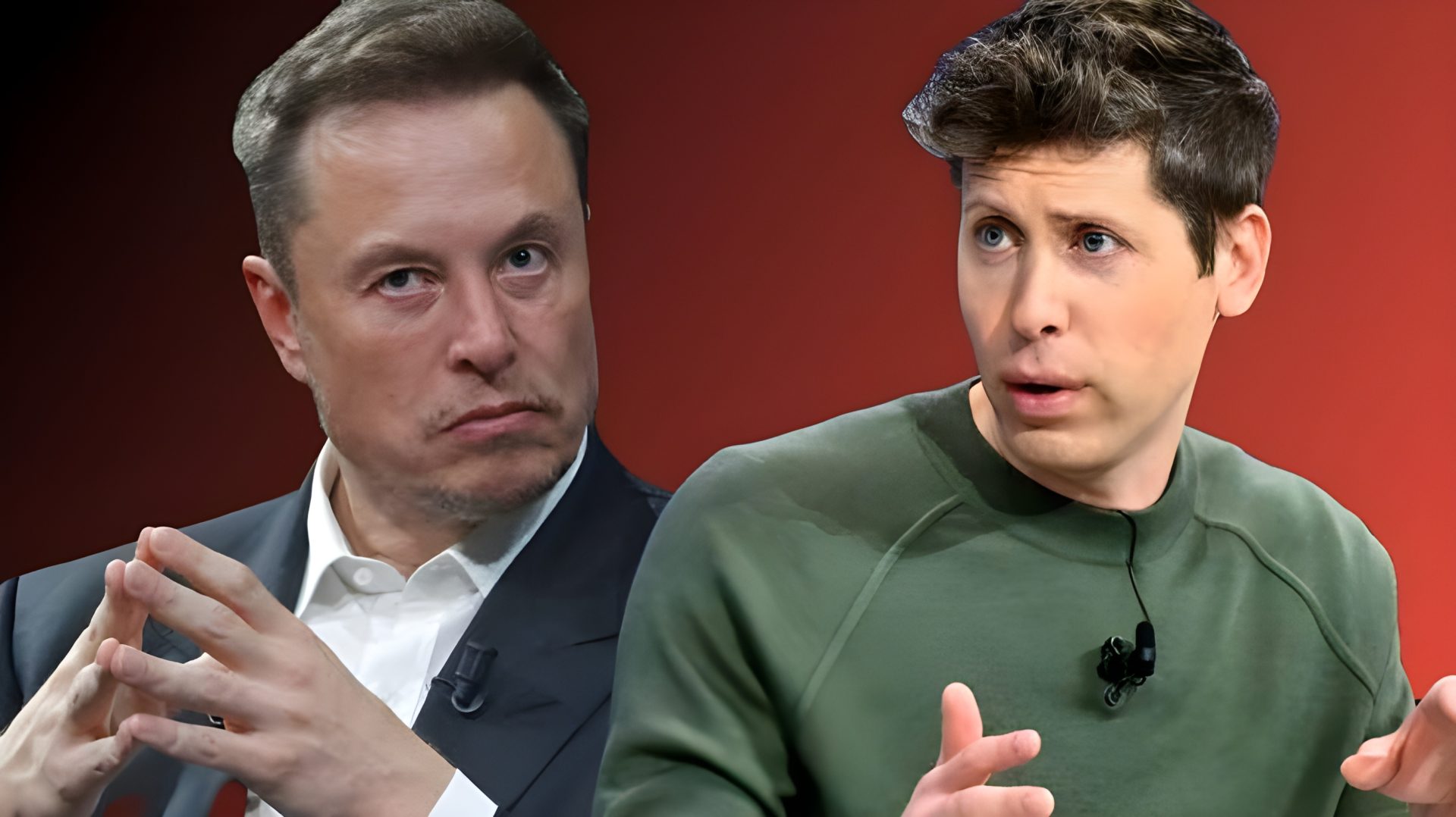
Elon Musk has once again turned his long-running feud with Sam Altman into a public spectacle, this time using Apple’s reported legal clash with OpenAI as fresh fuel for the fire. The Tesla and SpaceX chief did not miss the chance to take aim at the OpenAI CEO, delivering a sharp response on social media while also teasing major plans for SpaceX’s future in artificial intelligence infrastructure.
The latest exchange reportedly began after Apple filed a lawsuit against OpenAI, accusing the AI company of misusing proprietary technology, including circuit designs, hardware concepts, and component architecture tied to future consumer-focused AI devices. The lawsuit has drawn major attention across the tech industry, not only because of the companies involved but also because of the sensitive nature of Apple’s hardware development process.
According to the claims, Apple alleges that more than 400 of its former employees eventually joined OpenAI. One former Apple design executive, Tang Tan, is said to have played a key role in encouraging Apple workers moving to OpenAI to bring physical hardware components and samples for internal demonstrations. These allegations, if proven, could intensify scrutiny around OpenAI’s push into AI-powered consumer devices.
For Elon Musk, the controversy offered an opening to criticize Altman, with whom he has shared years of public tension. Musk accused Altman of taking things to a “whole new level,” while Altman fired back by suggesting Musk was promoting short-term space-based data centers to public market investors.
Musk then responded with one of his most pointed remarks yet, saying SpaceX would begin flying its AI-focused satellites next year. He also mocked Altman by implying that the OpenAI chief might need approval from a parole officer to attend a launch. Musk further accused Altman of first taking control of what he described as an open-source AI charity and then allegedly stealing Apple’s phone technology.
Beyond the personal attack, Musk’s comment revealed an important detail about SpaceX’s artificial intelligence ambitions. He said SpaceX expects to begin deploying its AI1 satellites as soon as next year, signaling that the company’s plan for orbital AI compute infrastructure may be moving closer to reality.
SpaceX recently introduced its AI1 satellite design, built specifically to support artificial intelligence workloads in orbit. The satellite is designed to handle up to 150kW of peak compute payload and includes liquid radiators, meteorite shielding, a centralized compute module, and deployable solar arrays. Production is expected to take place at SpaceX’s Gigasat facility in Texas.
The concept of space-based AI data centers is attracting growing interest as artificial intelligence systems demand enormous computing power and energy. By moving parts of AI infrastructure into orbit, companies like SpaceX could explore new ways to power, cool, and scale high-performance compute systems beyond traditional terrestrial data centers. Musk’s comments suggest that SpaceX may see satellite-based computing as a future extension of its Starlink and space infrastructure businesses.
The Musk-Altman rivalry goes back to the earliest days of OpenAI. Musk was one of the organization’s original backers when it was founded as a nonprofit focused on developing artificial intelligence for the benefit of humanity. However, tensions grew as Musk reportedly became dissatisfied with OpenAI’s pace and direction.
In 2018, Musk attempted to gain greater control over OpenAI, but Sam Altman and the board rejected the move. Musk later left the organization, and the relationship between the two tech leaders deteriorated further as OpenAI shifted toward a more commercially driven structure.
Musk later sued OpenAI and Altman over the company’s move away from its original nonprofit mission. However, OpenAI and its leadership secured a legal win after the court found that Musk had waited too long to pursue some of his claims.
Now, with Apple reportedly targeting OpenAI in a separate legal battle, Musk appears determined to keep the pressure on Altman. At the same time, he is using the moment to spotlight SpaceX’s AI satellite program, which could become one of the more ambitious projects in the growing race to build the next generation of artificial intelligence infrastructure.
The clash brings together several of the biggest forces in technology: Apple’s tightly guarded hardware ecosystem, OpenAI’s rapid expansion into AI products, Musk’s space-based computing ambitions, and the personal rivalry between two of the most influential figures in artificial intelligence. As the legal and public relations battles continue, the next major development may come not from a courtroom, but from a SpaceX launchpad.


