Elon Musk Says Starlink V4 Could Create a Space-Based Internet Backbone Strong Enough to Rival Undersea Cables
Elon Musk believes SpaceX’s next generation of Starlink satellites could do far more than improve home internet speeds. According to Musk, Starlink V4 may become a massive, redundant internet backbone in Low Earth Orbit, offering a space-based alternative to the undersea cables that currently carry most of the world’s data.
The idea is ambitious: build a satellite network so large and so heavily interconnected that it becomes extremely difficult for hostile actors, natural disasters, or regional conflicts to disrupt global internet traffic at scale. Musk has suggested that around 100,000 Starlink V4 satellites could provide enough redundancy to create a resilient orbital communications layer for the planet.
The key upgrade is laser communication.
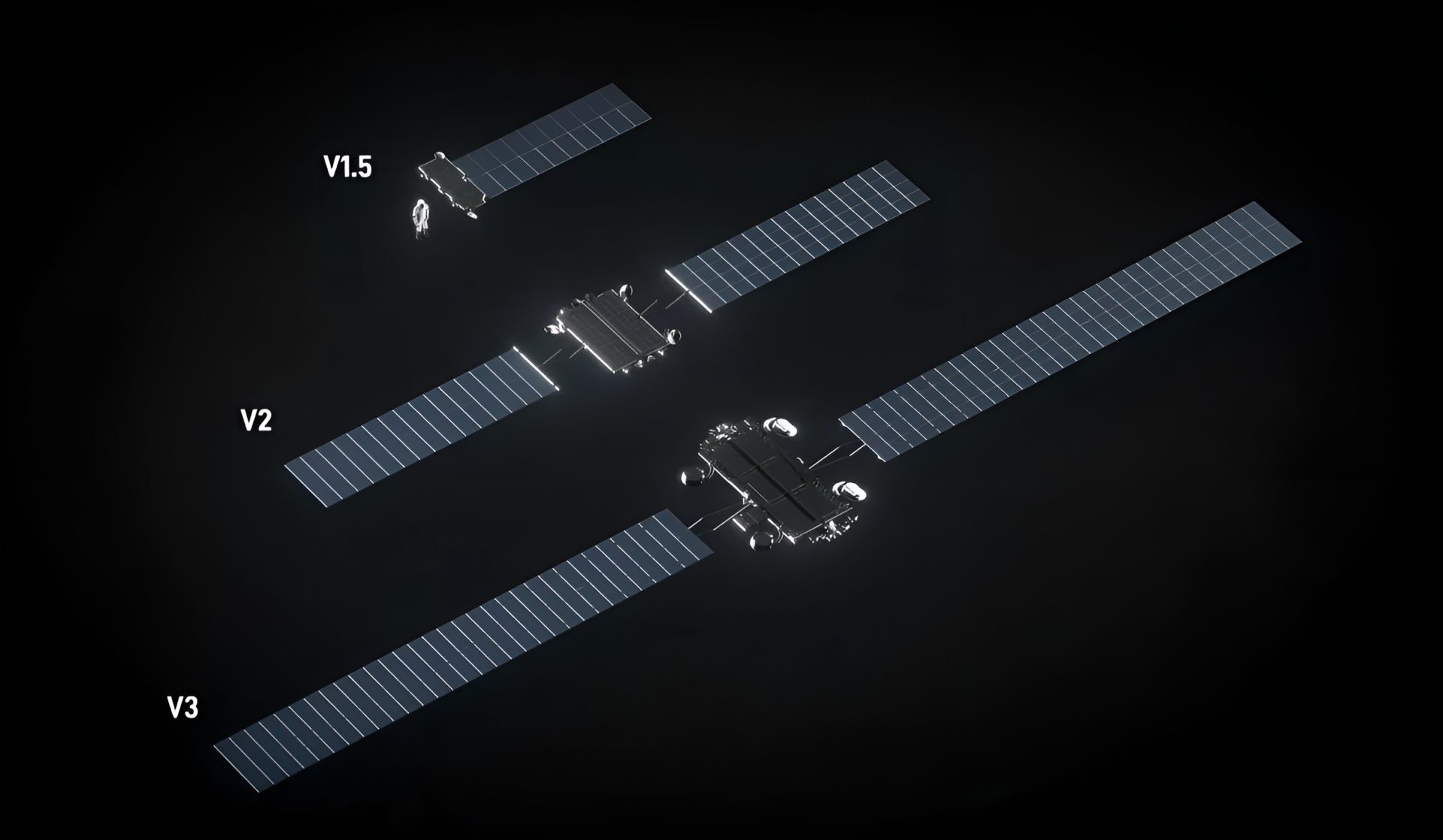
Musk recently said that Starlink version 4 will offer roughly 10 times the capability of Starlink V3, which itself is expected to be about 10 times more capable than the current V2 generation. The biggest leap will come from long-distance laser links between satellites. These optical links are designed to move data through space at extremely high speeds, allowing satellites to communicate directly with one another without needing to route everything through ground stations.
Musk has stated that next-generation Starlink laser links could operate at more than 10 terabits per second each. He later added that future satellites may carry roughly 100 lasers per satellite, each capable of operating above 10 Tbps.
If SpaceX were to deploy more than 100,000 Starlink V4 satellites with that level of capability, the total theoretical capacity would be enormous. A constellation of that scale could offer around 100 million terabits per second, or about 100,000 petabits per second, in combined laser throughput.
For comparison, the global network of undersea telecommunications cables is estimated to provide around 6.4 petabits per second of total bandwidth. That means, on paper, a full Starlink V4 constellation could dramatically exceed the capacity of today’s submarine cable network.
Musk has also pointed out another important advantage: the speed of light is faster in space than through fiber-optic cables. He noted that light travels about 40 percent faster in space than in cable, and satellites can create more direct paths between distant locations. Undersea cables often follow coastlines, seabeds, and geopolitical routes, which can make the actual data path much longer than a straight line between two points.
This could make Starlink V4 especially valuable for long-distance data transmission, financial networks, cloud computing, global communications, and regions where undersea cables are vulnerable or limited.
Before V4 arrives, SpaceX is preparing to scale production of its V3, also known as Gen3, Starlink satellites. These satellites already represent a major jump over earlier versions.
Each V3 satellite is expected to weigh around 2,000 kg, far heavier than the approximately 575 kg Gen2 model. The increased mass allows for more powerful hardware, larger solar arrays, improved antennas, upgraded onboard computers, and stronger communications systems.
The V3 satellites are designed for Very Low Earth Orbit, or VLEO, at an altitude of about 350 km. Operating closer to Earth can help reduce latency and improve network performance, although it also requires more precise station-keeping and orbital management.
Compared with previous Starlink generations, V3 is expected to deliver a 10-fold increase in downlink capacity, reaching around 1 Tbps per satellite. Uplink capacity could rise by roughly 22 times, reaching around 160 to 200 Gbps. Combined radio-frequency and laser backhaul capacity may reach about 4 Tbps per satellite.
The satellites will use advanced phased-array antennas, electronic beam steering, optical inter-satellite links, and dynamic power control. These technologies are important for managing spectrum, reducing interference, and allowing the network to handle traffic efficiently across different regions.
Because of their size and weight, the V3 satellites are expected to rely on SpaceX’s Starship for launch. Starship’s larger payload capacity is central to SpaceX’s plan to deploy bigger, more powerful satellites in large numbers.
The V4 generation would push that strategy much further.
If SpaceX succeeds, Starlink V4 could transform satellite internet from a consumer broadband service into a global communications infrastructure layer. Instead of simply connecting rural homes, ships, aircraft, and remote businesses, the network could become a major part of how internet traffic moves around the world.
That goal has taken on new relevance as concerns grow over the vulnerability of undersea cables. These cables are critical to global connectivity, but they are also difficult to protect. They run across oceans, through narrow maritime chokepoints, and near regions affected by military tension.
Recent geopolitical concerns have highlighted how disruptive attacks or sabotage against submarine cables could be. Several major cables pass through sensitive areas such as the Strait of Hormuz, where damage to infrastructure could affect communications across multiple regions. Reports of vessels operating near key subsea cable routes have added to worries that these systems could be mapped, monitored, or targeted during future conflicts.
A large, laser-linked satellite network would not eliminate the need for fiber infrastructure on Earth, but it could provide a powerful backup. If one route is damaged, traffic could be redirected through space. If a region loses cable access, satellites could help restore connectivity. If geopolitical risks increase, a distributed orbital network could make the internet harder to disrupt.
That is the core of Musk’s vision: not just faster satellite internet, but a redundant, space-based backbone for global data.
The challenge, however, is massive. Building and operating 100,000 advanced satellites would require extraordinary manufacturing scale, launch capacity, regulatory coordination, orbital traffic management, and long-term maintenance. SpaceX would also need to address concerns about space debris, astronomy interference, and the complexity of managing such a dense orbital network.
Still, SpaceX has already changed expectations for satellite internet. Starlink has grown from an experimental network into one of the most widely used satellite broadband systems in the world. With V3 and eventually V4, the company is aiming for something much larger: a high-speed orbital mesh that could compete with, supplement, and protect the physical internet infrastructure that runs beneath the oceans.
If Musk’s projections prove accurate, Starlink V4 could become one of the most important communications projects of the next decade. It could reshape how data moves globally, reduce dependence on vulnerable undersea cables, and bring the world closer to a truly resilient internet built across both Earth and space.