MSI Unveils MEG X and New AI-Powered OLED Gaming Monitors at Computex 2026
MSI used Computex 2026 to introduce a major refresh of its monitor lineup, and the spotlight was firmly on OLED gaming displays. The company revealed several new models built around Tandem QD-OLED technology, 5K display options, and a new flagship monitor called the MSI MEG X.
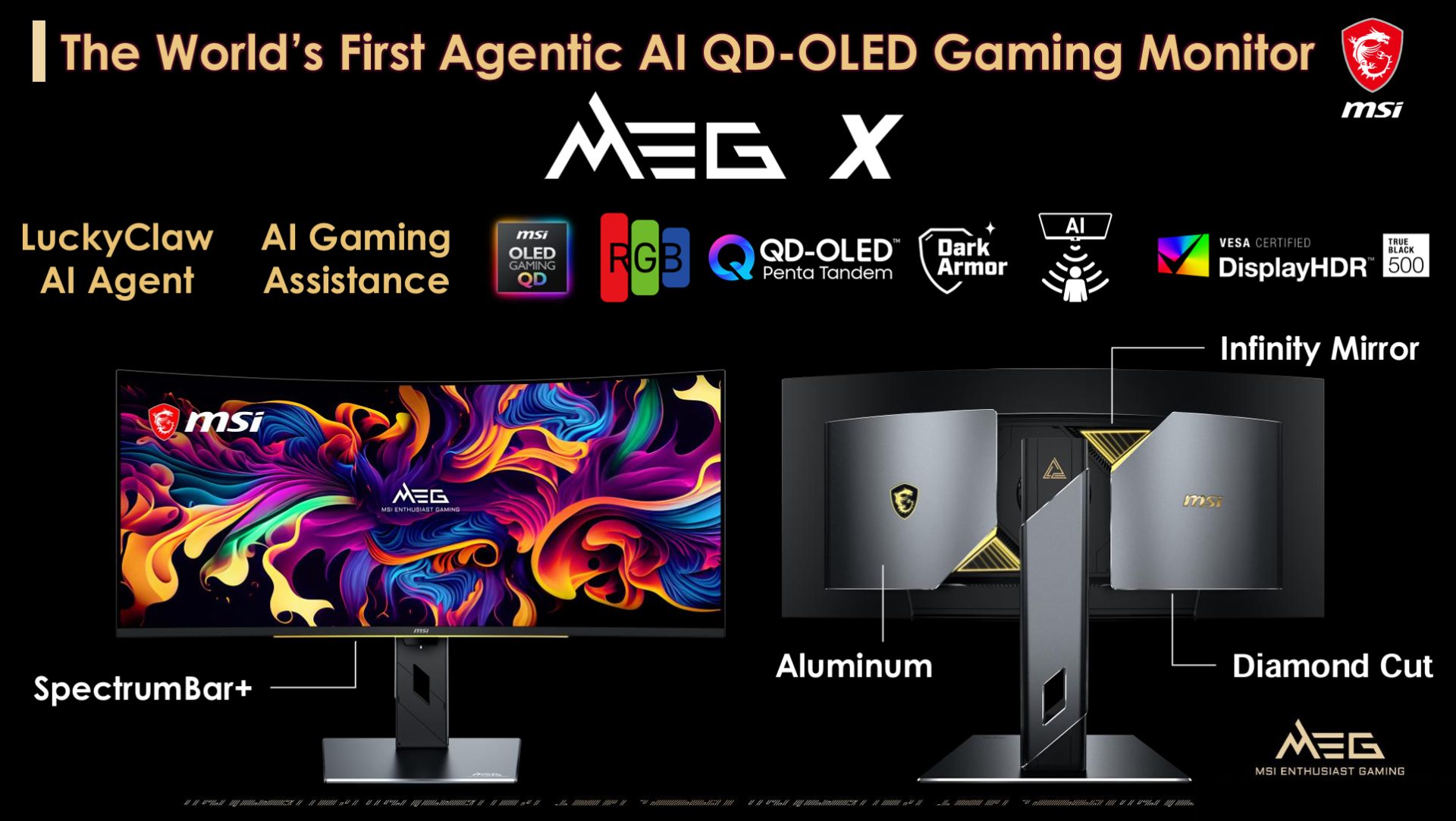
The MEG X is especially notable because MSI is positioning it as the world’s first Agentic AI QD-OLED gaming monitor. Beyond its high-end panel specifications, the monitor introduces a built-in AI system called LuckyClaw, designed to make display settings smarter, faster, and more personalized.
MSI MEG X: A flagship 360Hz ultrawide QD-OLED gaming monitor
The MSI MEG X is built around a 5th-generation Penta Tandem QD-OLED panel. It features a 34-inch ultrawide display with a 3440 x 1440 resolution and a blazing-fast 360Hz refresh rate, making it a serious option for competitive gamers who want both speed and premium image quality.
One of the key upgrades is the use of RGB Stripe subpixels, which should help improve text clarity compared with some earlier OLED layouts. That makes the MEG X more practical not only for gaming, but also for productivity, browsing, and everyday desktop use.
As expected from a modern OLED gaming monitor, the MEG X includes features aimed at protecting the panel and improving long-term reliability. These include proximity sensing and burn-in prevention technologies. However, the biggest change is the addition of MSI’s new AI-driven LuckyClaw system.
LuckyClaw brings AI control directly into the monitor
LuckyClaw is MSI’s new self-learning AI agent built into the MEG X. Instead of relying only on traditional on-screen display menus, MSI wants LuckyClaw to act as a more intelligent control layer for the monitor.
The idea is simple: the monitor should be able to recognize what you are doing and adjust itself automatically. LuckyClaw can be accessed through a sidebar and is designed to learn from user behavior over time. MSI describes this as a move toward a more seamless and personalized display experience.
Two of the key features powered by LuckyClaw are AI Scene and AI Audio Scene.
AI Scene can detect the type of content currently being shown on the screen and automatically switch to the most suitable display profile. For example, the monitor may adjust differently for a game, a movie, desktop work, or other content types.
AI Audio Scene works alongside AI Scene by changing the audio equalizer settings to match the active visual profile. Users can also define their own EQ preferences for different types of content, allowing the monitor to adapt not just visually, but also acoustically.
MSI is also adding AI Vision+, an improved version of its brightness and image-enhancement technology. Instead of relying only on traditional algorithms, AI Vision+ uses AI-powered pixel-level detection to adjust brightness curves and image visibility more intelligently.
AI Super Resolution improves image sharpness without loading the GPU
Another major feature in the MEG X is AI Super Resolution, also called AI SR. This technology is designed to upscale and sharpen content directly on the monitor rather than relying on the graphics card.
That could be useful for gamers who want a sharper image without adding extra workload to the GPU. AI-based upscaling built into a monitor may also improve lower-resolution content, older games, videos, or specific areas of the screen.
MSI’s implementation appears to offer more customization than a basic upscaling system. Users may be able to choose certain regions of the display for AI upscaling instead of applying it across the entire screen.
This becomes especially interesting when combined with MSI’s Optix Scope+ feature. AI Super Resolution can reportedly be applied only to the area inside the on-screen scope overlay. In theory, this could create a focused zoom-like effect with enhanced sharpness, giving players better visibility in supported scenarios.
AI Gauge turns the monitor’s light bar into a useful gameplay tool
The MSI MEG X also includes a light bar along the bottom edge of the display, but MSI is giving it a practical purpose beyond visual style.
With the new AI Gauge feature, the SpectrumBar+ light bar can mirror certain on-screen user interface elements, such as health, stamina, or other in-game indicators. Instead of being limited to ambient lighting, the bar can become a quick-glance status display during gameplay.
This could make the feature more useful for immersive gaming, especially in fast-paced titles where players want to track key information without constantly looking away from the action.
MSI expands its Tandem QD-OLED monitor lineup
While the MEG X is the flagship model, MSI also introduced several more accessible OLED gaming monitors at Computex 2026. The company appears to be making a strong push into Tandem QD-OLED technology for both premium and mainstream buyers.
One of the most important new models is the MSI MAG OLED 271QPX32. MSI says this will be the first Tandem QD-OLED monitor to reach the market.
The MAG OLED 271QPX32 features a 27-inch 1440p panel with a 320Hz refresh rate. It uses a 4th-generation QD-OLED panel and is aimed at the mainstream OLED gaming monitor segment.
Key highlights include a 2560 x 1440 resolution, a 320Hz refresh rate, a 27-inch display size, and MSI’s DarkArmor display coating. The coating is designed to improve contrast and durability. MSI also claims the monitor offers strong display uniformity and color volume compared with Tandem WOLED alternatives.
For gamers who want sharp visuals, deep blacks, vibrant color, and high refresh rates without moving to a large ultrawide screen, the MAG OLED 271QPX32 could become one of MSI’s most important OLED models.
MSI MAG OLED 321UPX18 brings 4K QD-OLED to a 32-inch format
MSI also revealed the MAG OLED 321UPX18, a 32-inch 4K monitor using 4th-generation Tandem QD-OLED technology.
This model offers a 3840 x 2160 resolution with a 180Hz refresh rate. That positions it as a strong choice for players who prefer higher pixel density and sharper 4K visuals over ultra-high refresh rates.
The MAG OLED 321UPX18 appears to target the mainstream premium OLED space rather than the ultra-enthusiast segment. However, unlike the 27-inch MAG OLED 271QPX32, this 32-inch model does not appear to use the same DarkArmor coating.
MSI introduces new 27-inch 5K dual-mode monitors
MSI also expanded beyond OLED with two new 27-inch 5K monitors offering dual-mode refresh rate configurations.
The first is the MSI MAG 271KRAW18. This monitor can run at 5K resolution at 180Hz or switch to 2K resolution at 330Hz. That gives users the option to prioritize either maximum sharpness or maximum speed depending on the game or workload.
The MAG 271KRAW18 also features a glossy coating and 2304 dimming zones, giving it true HDR capability. With Mini-LED local dimming, high resolution, and dual-mode flexibility, this model could appeal to gamers and creators who want strong HDR performance without moving to OLED.
The second model is the MSI MAG 271KPD7. It also supports dual-mode operation, offering 5K at 75Hz or 2K at 300Hz. However, this model does not use Mini-LED, which means it does not deliver the same true HDR experience as the MAG 271KRAW18.
PRO MAX 341QPXW14G targets productivity and Mac users
MSI also introduced the PRO MAX 341QPXW14G, a productivity-focused ultrawide QD-OLED monitor. It appears to use a panel similar to the flagship MEG X, but with features aimed more at professionals and MacBook users.
The PRO MAX 341QPXW14G features a 34-inch ultrawide display with a 3440 x 1440 UWQHD resolution. It uses a 5th-generation Tandem QD-OLED panel with RGB Stripe subpixels, which should help with text clarity and desktop readability.
The monitor also includes DarkArmor and VisiClarity technologies for improved reflection handling and better visibility. For connectivity, it supports DisplayPort Alt Mode over USB-C and up to 98W USB Power Delivery, making it suitable for laptop setups.
MSI is also adding the M-Mate app for MacBook users, which includes color calibration controls. That could make the PRO MAX 341QPXW14G appealing to creators, designers, and productivity users who want OLED image quality in a Mac-friendly setup.
MSI’s 2026 monitor lineup focuses on AI, OLED, and flexibility
MSI’s Computex 2026 monitor announcements show a clear direction: smarter displays, faster OLED panels, and more flexible screen modes for different users.
The MEG X stands out as the most ambitious product, combining a 360Hz ultrawide 5th-gen QD-OLED panel with built-in AI features such as LuckyClaw, AI Scene, AI Audio Scene, AI Vision+, AI Super Resolution, and AI Gauge. If these features work well in real-world use, the MEG X could represent a major step toward monitors that automatically adapt to games, media, and productivity tasks.
At the same time, MSI’s new MAG OLED models bring Tandem QD-OLED technology into more mainstream gaming monitor categories, while the 5K dual-mode displays offer flexibility for users who want both high resolution and high refresh rates.
Pricing and release details are expected to follow later. For now, MSI’s new monitor lineup suggests that 2026 could be a big year for OLED gaming monitors, AI-enhanced displays, and high-resolution gaming screens.