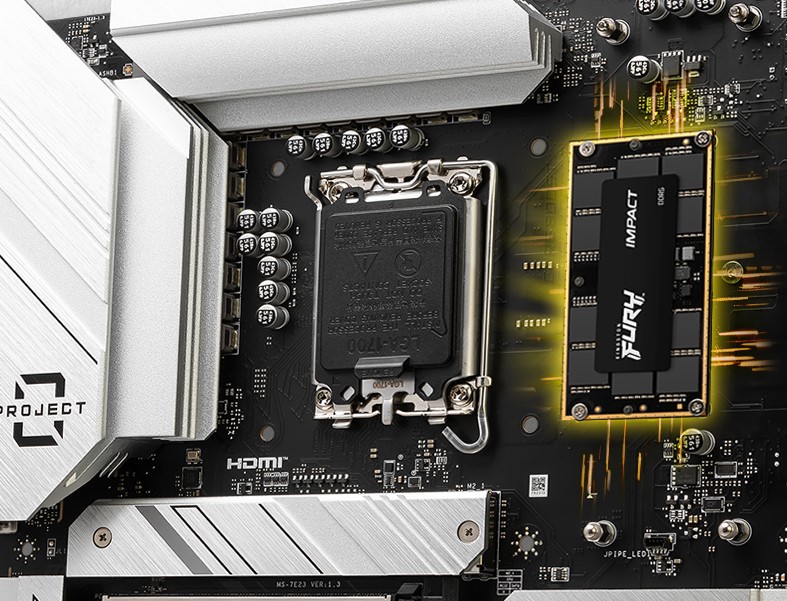
MSI is stepping up to revolutionize desktop PC memory by introducing the world’s first motherboard supporting the latest CAMM2 DDR5 RAM, set to be showcased at the upcoming Computex event. The move aligns with the evolving landscape of RAM form factors, transitioning from the traditional SO-DIMM to the more advanced and standardized CAMM2 format.
Dell initially sparked interest in the CAMM (Compression-Attached Memory Modules) technology with its Dell Precision 7000-series laptops, prompting the industry to take note of its potential for upgrading the existing SO-DIMM standard. This led to the formal standardization of CAMM2 by JEDEC in December 2023. Lenovo has since started equipping certain laptop models like the ThinkPad P1 (Gen 7) with LPDDR5 CAMM2 memory, marking a significant step away from soldered solutions. Looking ahead, the DDR6 and LPDDR6 standards are anticipated to adopt the CAMM2 form factor around 2026.
Despite its increasing adoption in laptops, bringing CAMM2 DDR5 to desktop PCs poses its unique challenges due to the need for motherboard layout alterations. MSI, however, has navigated these challenges and is ready to present its innovative solution to the world. The anticipated Z790 Project Zero Plus motherboard, an Intel-based platform, has been teased as being compatible with Kingston’s FURY Impact DDR5 CAMM2 prototype modules. Its reveal alludes to MSI’s potential for future AMD motherboard compatibility as well.
Interestingly, the previously released images hint at the presence of a single CAMM2 module on the motherboard. This design choice reflects the need for layout modifications to accommodate multiple modules, which might require an overhaul with the introduction of next-gen DDR6 modules. Despite this, it’s worth noting that even a singular DDR5 CAMM2 module is capable of supporting memory configurations of up to 128 GB, illustrating the impressive capacity of this new standard.
For now, Kingston and ADATA are the notable manufacturers investing resources into CAMM2 modules. However, as next-generation DDR standards are projected to roll out exclusively in CAMM2 formats, it’s evident that wider industry adaptation is on the horizon. MSI is pioneering this shift without the need for immediate layout changes – a promising sign of seamless transitions to come.
CAMM2 RAM technology not only benefits laptops by doing away with the need for soldering but also introduces enhancements for desktop systems. Although desktop PCs have historically not struggled with upgradability issues, the CAMM2 form factor’s compact design may unlock new opportunities for higher memory capacities, especially in space-constrained mini PCs.
The impending showcase at Computex promises to offer a glimpse into the future of desktop memory, as MSI paves the way for other motherboard manufacturers to integrate this advanced technology. The compact, high-capacity nature of CAMM2 could pave the way for more powerful, yet smaller desktop setups, marking a significant advancement in PC hardware design.


