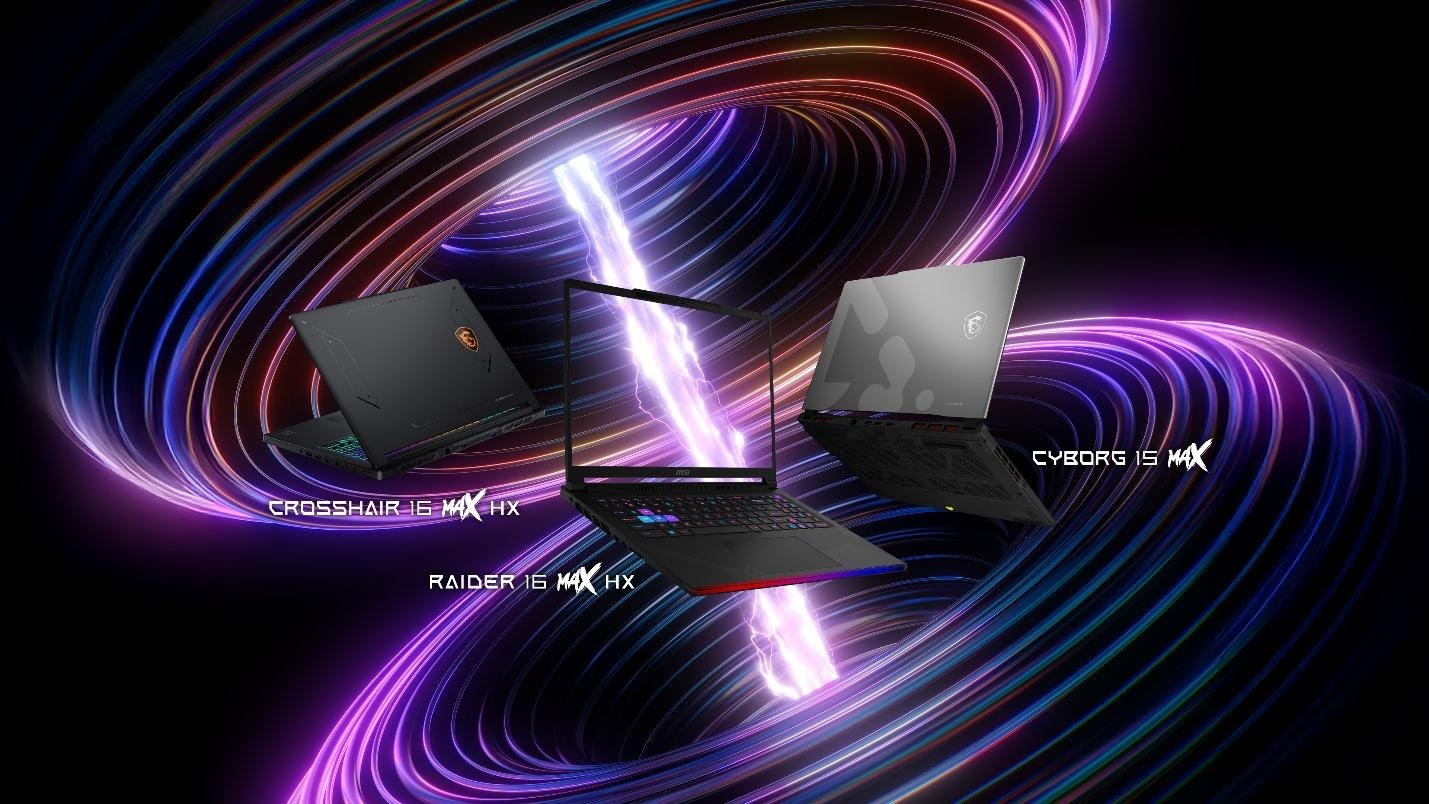
MSI is refreshing its gaming laptop lineup with new Raider and Crosshair models that pair Intel’s latest Core Ultra 200HX processors with NVIDIA’s new GeForce RTX 50 series laptop GPUs. The goal is simple: push higher frame rates for demanding games while also delivering strong performance for creators and power users who need serious CPU and GPU muscle.
In the Raider family, MSI is rolling out the Raider 16 and the more powerful Raider 16 Max. These machines are built for high-wattage performance, with the Raider 16 rated around 215–250W and the Raider 16 Max reaching up to 300W for even more headroom under load. Graphics options scale as you move up the stack. The Raider 16 is expected to come with GeForce RTX 5070 Ti or RTX 5080 configurations, while the Raider 16 Max expands the lineup with RTX 5070 Ti, RTX 5080, and up to the flagship GeForce RTX 5090 laptop GPU for maximum gaming performance.
While MSI hasn’t spelled out every CPU SKU used in the standard Raider 16 configurations, both Raider 16 variants are positioned around Intel’s high-end Core Ultra 200HX platform. Across the two models, the shared feature set is aimed at enthusiasts: support for up to 128GB of DDR5 memory, dual M.2 SSD slots for storage upgrades, and a fast 2560×1600 display running at 240Hz for smooth competitive gameplay. MSI is also expanding the number of available configurations versus earlier options, giving buyers more choices across RTX 50 series tiers.
The Crosshair lineup is also being updated with the Crosshair 16 and Crosshair 16 Max. MSI is leaning into display choice here, offering options that include an OLED panel topping out at 165Hz for users who care about deep blacks and vivid, accurate colors, alongside high-refresh IPS options for those prioritizing the fastest motion clarity. That makes the Crosshair range appealing both for esports-style play and for entertainment or content viewing where OLED contrast can make a big difference.
On the performance side, the Crosshair 16 Max moves to Intel Core Ultra 200HX processors and pairs them with NVIDIA GeForce RTX 5060 or RTX 5070 laptop GPUs. The standard Crosshair 16, however, doesn’t make the same CPU jump. Instead, it’s set to use Intel’s Core i7-14650HX or Core i9-14900HX, combined with GeForce RTX 5050, RTX 5060, or RTX 5070 laptop graphics. MSI also highlights upgrade flexibility, including up to 96GB of memory and two M.2 SSD slots with support spanning PCIe Gen 4.0 and Gen 5.0 depending on configuration.
MSI isn’t limiting the refresh to new midrange and high-end models. The Titan 18 and Stealth 18 lines are also getting updated with Intel Core Ultra 200HX processors. For display tech, these models are set to feature a 4K 240Hz mini LED panel, targeting users who want high resolution without sacrificing refresh rate, plus the high contrast benefits mini LED is known for.
For shoppers looking for something more affordable, MSI is also introducing the Cyborg 15 Max aimed at the budget gaming segment. It’s designed to deliver up to 100W of GPU TGP, and up to 130W when paired with Intel Core 200H processors. MSI is also updating the standard Cyborg 15 with improved connectivity, including three USB-A ports, a USB-C port with 100W power delivery, and a DisplayPort option for easier external monitor setups. The Cyborg models focus on mainstream GPUs such as the RTX 5050, RTX 5060, and RTX 5070 laptop lineup rather than the top-end parts found in Raider and Titan systems.
With these updates, MSI is clearly positioning its 2025-era gaming laptops around the new Core Ultra 200HX and GeForce RTX 50 series combinations—scaling from budget-friendly Cyborg systems to high-wattage Raiders and flagship-grade Titan configurations—so buyers can choose the right mix of display tech, upgradeability, and performance for gaming, streaming, and creative workloads.