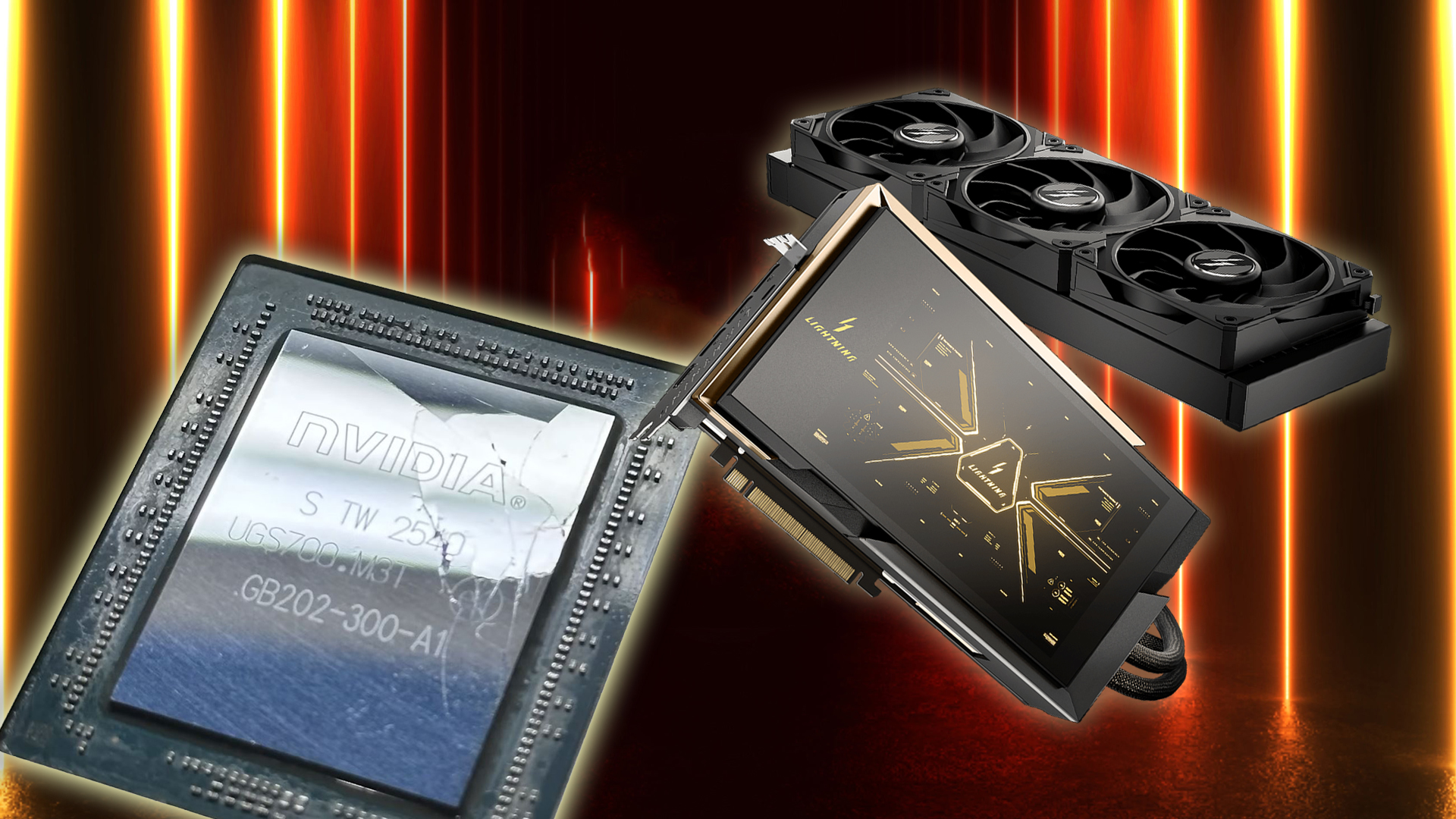
Extreme GPU overclocking can deliver brag-worthy benchmark numbers, but it can also end in the most expensive way possible: a dead graphics card. That’s exactly what happened when enthusiast overclocker Alva Jonathan pushed an MSI GeForce RTX 5090 32G Lightning Z so hard that the GPU core cracked, killing a card that reportedly cost around $5,000 (about 100 million Rupiah).
The MSI RTX 5090 Lightning Z is built for a very specific crowd: people who care less about everyday gaming and more about squeezing out record-breaking performance. Even at stock settings, it’s designed to sustain high clock speeds comfortably. Where it gets truly wild is in its power tuning options. Out of the box, the card supports 800W and 1000W TDP profiles, already far beyond what most flagship GPUs draw under normal use.
But the real danger zone is the 2500W XOC BIOS, a special high-risk firmware intended for extreme overclockers who accept that hardware failure is a possibility. With liquid nitrogen cooling in play, Alva chased higher and higher frequencies, which requires feeding the GPU core hefty voltage.
In testing, the card hit a strong 3.42 GHz at nearly 1 kW of power and around 1.12V—roughly 1 GHz above the default boost clock of a standard reference model. Impressively, even at that power level, temperatures were kept under 10°C. Pushing beyond that wasn’t straightforward, though. Sustaining clocks over 3.5 GHz became difficult if temperatures rose above 20°C, and it was also challenging to hold high clocks when temperatures dipped below 0°C.
Still, the effort paid off in benchmark results. Using GPUPI, the GPU reportedly reached 3.6 GHz. And at around 3.5 GHz, the card delivered a massive Geekbench 5 Compute score of 683,433 points—claimed as a world-record result listed on HWBot at the time.
Then came the attempt to go even further. When the 2500W XOC BIOS was used, it allegedly pushed close to 1.2V to the GPU core due to being an early revision. That spike was enough to cause catastrophic physical damage: the GPU core cracked, and the card died.
It’s also worth noting that this kind of damage typically isn’t covered by warranty. Unlocking extreme power limits and running an XOC BIOS is generally considered misuse, and it’s precisely the sort of modification that voids protection.
The takeaway is simple: extreme BIOS flashing and ultra-high power profiles are not “normal overclocking.” If a 2500W XOC BIOS ends up being used on a standard RTX 5090 that wasn’t engineered for this type of power draw (often far closer to 600W), the risk of permanent failure skyrockets. For most users, chasing record-setting benchmarks with extreme voltages just isn’t worth turning a high-end GPU into a very expensive paperweight.