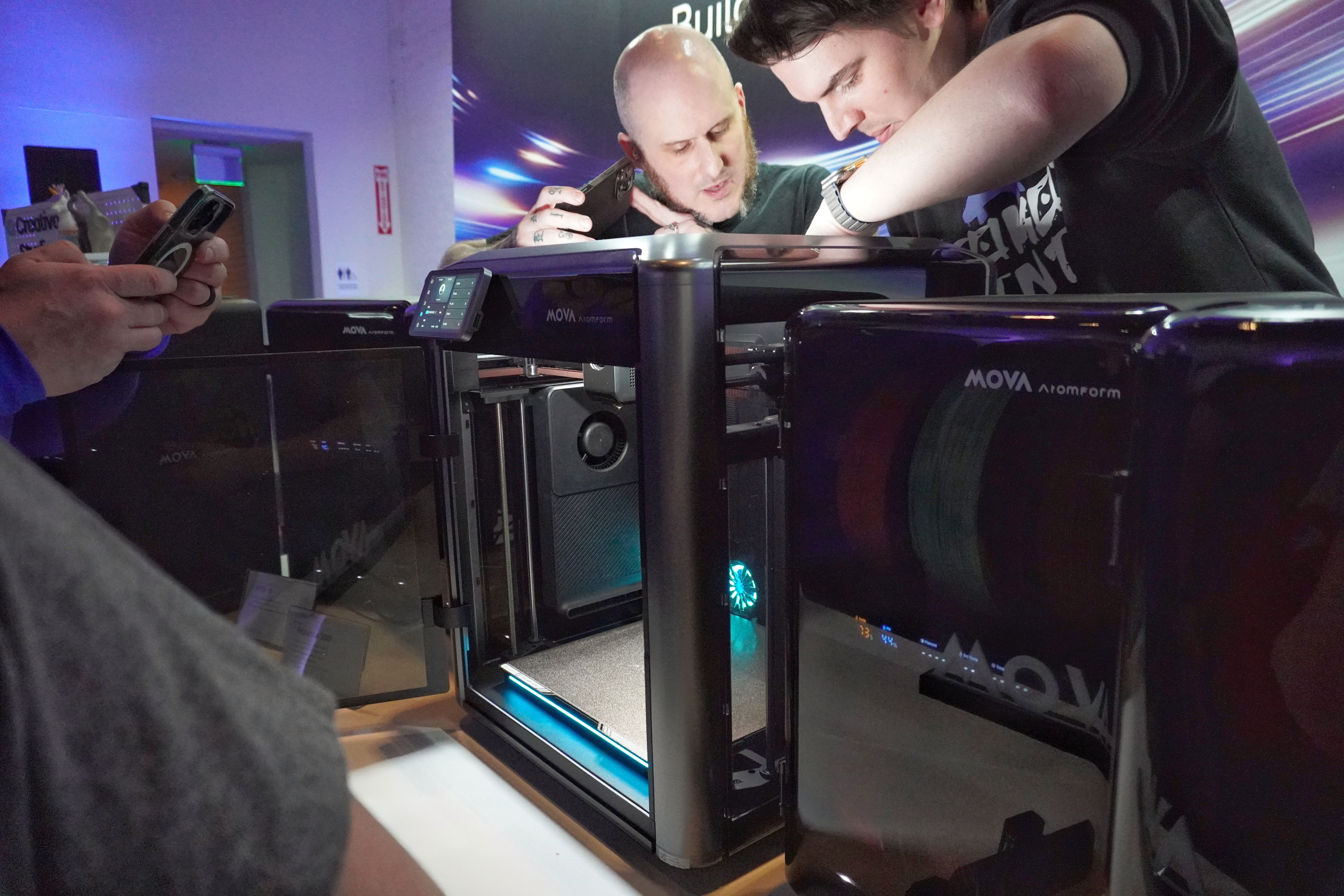
MOVA recently pulled the curtain back on its newest 3D printer, the AtomForm Palette 300, at a hands-on launch event in San Jose—and the reaction from creators in the room made one thing obvious: this is a release many makers have been waiting for. With a hot-swapping revolver-style nozzle system, support for up to 36 colors, and a fresh software ecosystem designed to simplify the entire workflow, the Palette 300 is aiming straight at the top end of the prosumer 3D printing market.
The headline feature is the Palette 300’s nozzle carousel, a CNC-inspired setup that rotates through multiple nozzles automatically. Instead of relying on a single nozzle to handle everything, the printer can switch as needed during a job. MOVA says the system supports up to 36 color options and can run as many as 12 different filament types in a single print without the user having to pause, intervene, or babysit the process. During the event’s panel discussion, well-known 3D printing creators highlighted this tool-changing approach as the standout feature—not just for flashy multicolor prints, but for practical reliability. One creator noted that if a nozzle clogs, the ability to swap to another nozzle can save both the print and the time it would normally take to troubleshoot, clean, and restart.
Beyond color and material flexibility, MOVA is also positioning the AtomForm Palette 300 as a printer built to reduce waste. According to the engineering team, the printer uses a mix of sensors, computer vision, and environmental controls to catch problems early and prevent failed prints. That matters because failed prints aren’t just frustrating—they’re expensive and wasteful. Stanford design professor Berry Katz summed up the benefit in plain terms: less waste. For owners, that ultimately means buying less filament over time.
Automation is another major part of the pitch. Those same sensors aren’t only there to rescue prints—they’re also intended to cut down on the repetitive, technical chores that can make 3D printing feel intimidating. Calibration, tweaking settings, and dialing in consistency are often the biggest barriers for new users. Education-focused creator Joel Telling emphasized how this kind of automation can lower the entry threshold for beginners and students, especially younger makers learning introductory tools like TinkerCAD. If the printer can handle more of the “setup struggle,” it opens more time for what people actually want to do: design, experiment, and create.
MOVA didn’t stop at hardware. Alongside the Palette 300, the company revealed AtomForm Studio and AtomVerse—two software offerings meant to help users go from a 3D idea to a finished object with as little friction as possible. AtomForm Studio is designed to streamline core tasks like auto-slicing and calibration, while AtomVerse is being framed as a free, centralized library for downloadable prints with a focus on accessibility, crediting artists properly, and helping makers share and connect through their projects.
Of course, the AtomForm Palette 300 isn’t being positioned as a budget-friendly machine. MOVA calls it a premium prosumer device, with an estimated price around $2,000 for the printer and filament housing. The company also hasn’t locked in what it will cost to fully unlock the complete 36-color capability. And while it offers broader features than many typical home printers, MOVA has been clear that it’s not meant to be a commercial production workhorse.
Even with those limitations, the Palette 300 is already turning heads for its ambitious approach to multicolor, multi-material printing and its focus on saving prints before they fail. Pre-orders are live with a $50 deposit, and MOVA is targeting an early Q2 2026 release window. For creators who want high-end features without stepping into full industrial 3D printing territory, the AtomForm Palette 300 is shaping up to be one of the most talked-about 3D printers heading into 2026.


