Monocab Self-Balancing Rail Shuttle Begins Testing on New Campus Track
The Monocab self-balancing rail vehicle has taken an important step forward. A new campus rail test system is now operating in Lemgo, Germany, giving researchers a fresh way to explore how compact, automated rail mobility could work beyond abandoned railway lines.
The project was originally designed around a bold idea: using disused railway tracks and allowing small autonomous vehicles to travel on a single rail, with one rail assigned to each direction. This approach could bring new life to old rail corridors while offering a low-footprint mobility solution for rural areas, campuses, and local transport routes.
Now, researchers are testing another version of the concept. Instead of relying only on existing railway infrastructure, the new campus system uses a purpose-built single rail. This gives planners more freedom when designing routes and avoids some of the early technical hurdles linked to converting older railway lines.
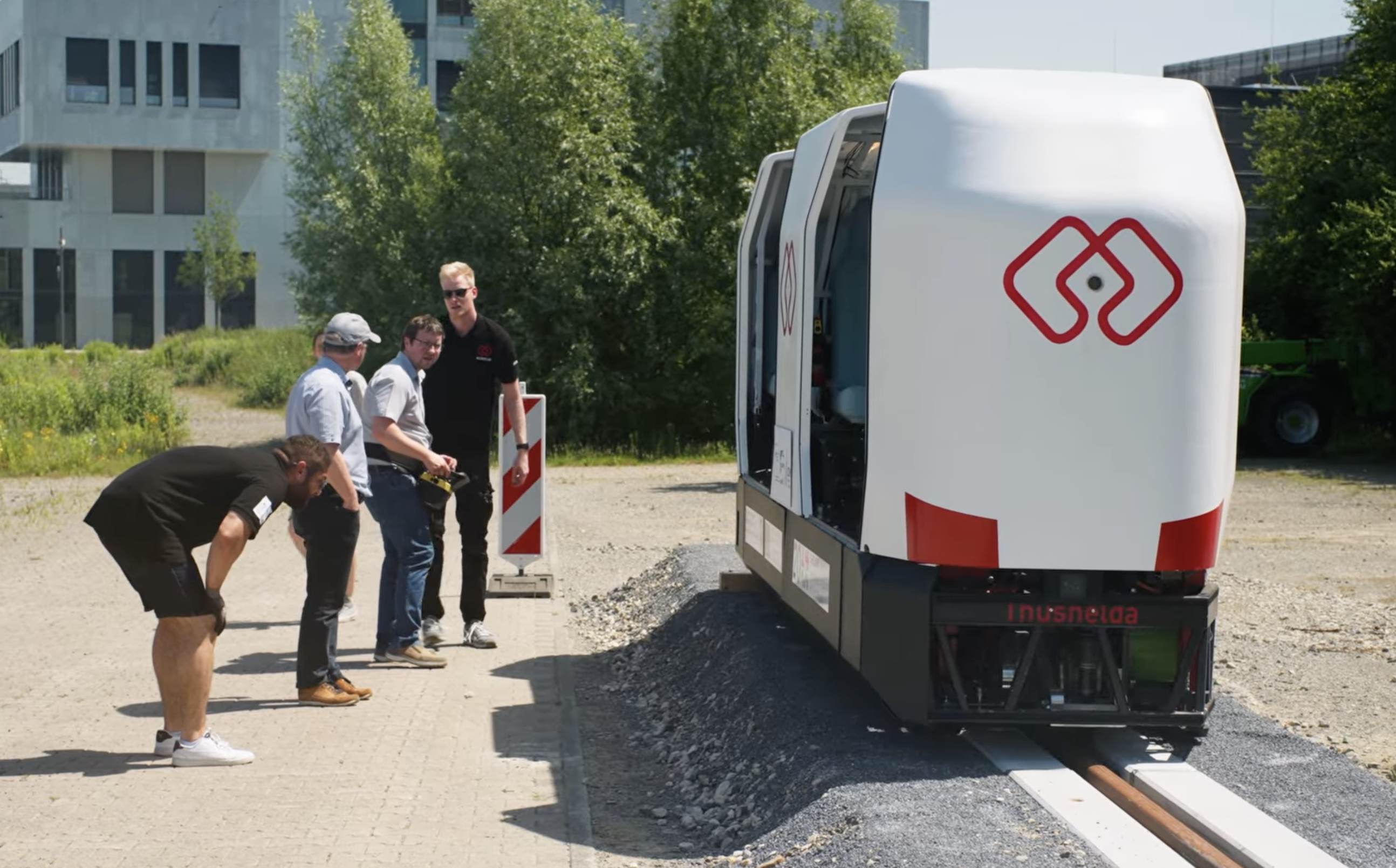
The first Monocab vehicle, named Thusnelda, is already running on a 20-meter test track at the Innovation Campus Lemgo of the Ostwestfalen-Lippe University of Applied Sciences and Arts, also known as TH OWL. While the current test section is short, it marks a meaningful milestone for the project. A longer 300-meter route is planned for completion by the end of the year, with construction expected to begin in the fall. That expanded track is set to include curves and gradients, allowing the team to study how the vehicle performs under more realistic operating conditions.
One of the main advantages of the newly built campus rail approach is flexibility. A dedicated track can be placed where it is needed, without being limited by the layout of old railway corridors. It also allows the vehicle to operate on a compact system that could eventually serve campuses, industrial sites, exhibition grounds, or controlled urban environments.
However, several major challenges remain. One key issue is rail switching. For Monocab to become more than a simple shuttle running back and forth, it will need reliable ways to change tracks, manage intersections, and support more complex routes. Research has identified switches as one of the most difficult technical obstacles for this type of self-balancing rail system.
Fraunhofer IOSB-INA is involved in the campus rail research and has shared further details about the project. The initiative has received approximately $5.12 million in funding, with one of its goals being to demonstrate Monocab-specific track and rail switching by the end of November 2026. If successful, this could significantly expand the possible use cases for the technology.
The Monocab system is currently listed at Technology Readiness Level 5, meaning it has reached the stage of a test setup in an operational environment. Earlier research between 2021 and 2023 already showed that the basic concept is feasible, including a vehicle traveling on one rail. The next target is Technology Readiness Level 6, which would involve a prototype operating in a real-world environment. The campus test track could become the platform for that next phase.
The broader roadmap is still somewhat uncertain. The team is pursuing multiple development paths at the same time. One track focuses on the newly built campus rail system, while another continues the original goal of operating Monocab on a disused railway line in Extertal. The project aims to reach a high level of operational maturity there around 2028, although publicly available targets vary between Technology Readiness Level 8 and Level 9.
There are also plans for Monocab to appear at major public and transport-focused events. The system is expected to be shown at InnoTrans 2026 in Berlin, and it has also been linked to operation at the International Garden Exhibition, which begins in April 2027. Whether the project can meet these timelines will likely depend on progress with switching, track changes, and vehicle turnaround solutions.
Turnaround capability is another unresolved question. Because of the Monocab vehicle’s asymmetrical design, it may require a turning loop or turntable for certain bidirectional operations, especially on disused railway lines. The design allows the vehicle to use as much of the available railway clearance as possible, but only on one side. This becomes especially important when two vehicles need to pass each other within the loading gauge of a conventional railway corridor.
Despite these challenges, the new campus test system gives the Monocab project a valuable development platform. It allows researchers to study vehicle stability, route design, rail geometry, switching technology, automation, and passenger transport potential in a controlled setting.
If the technology continues to advance, Monocab could become a new form of compact rail mobility for areas where traditional trains, buses, or trams are too large, too expensive, or too difficult to operate. Its small footprint and ability to use either new single-rail tracks or potentially revived railway infrastructure make it an unusual but promising concept in the future of sustainable transport.