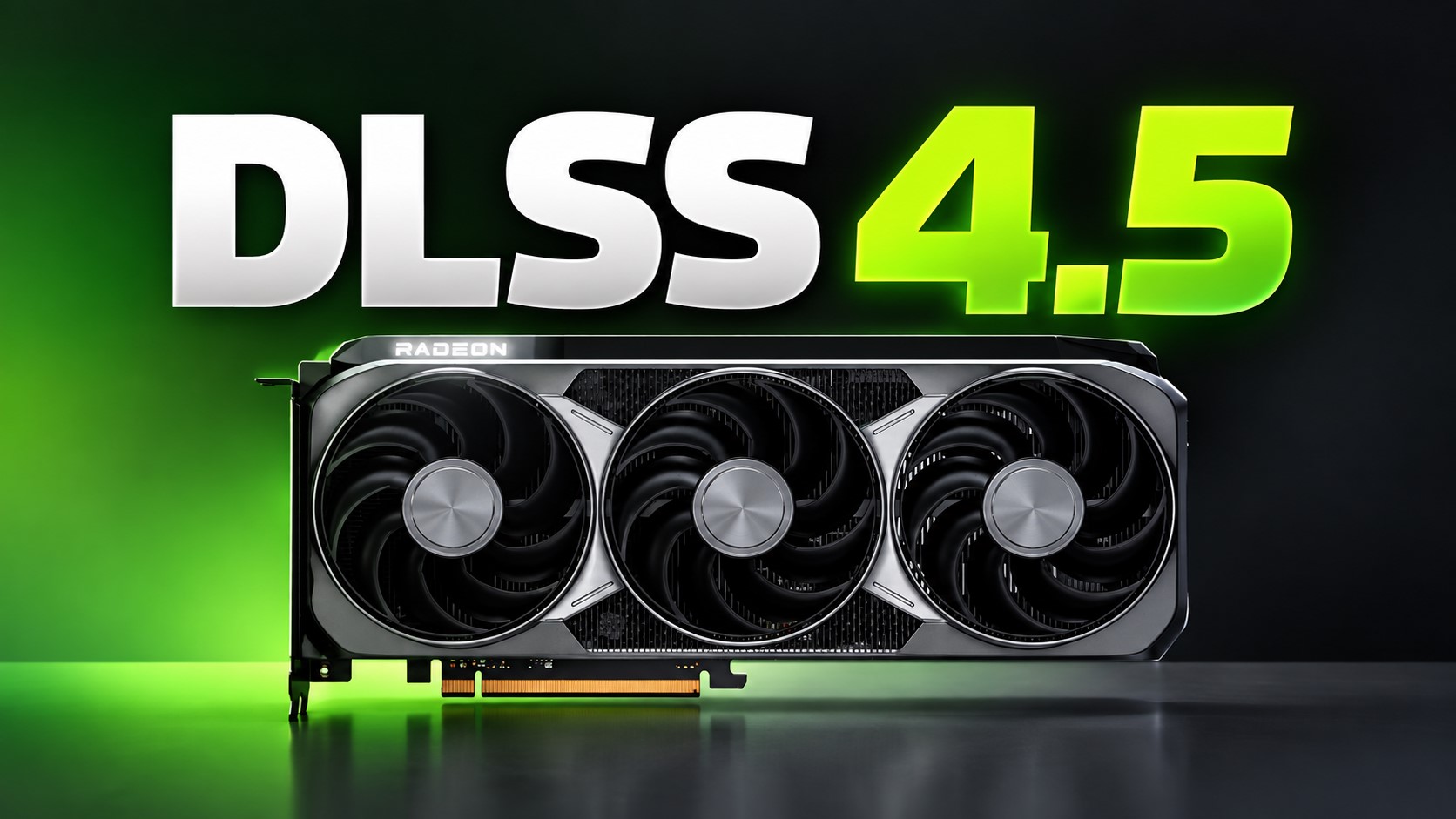
NVIDIA DLSS 4 and DLSS 4.5 Experimentally Run on AMD Radeon RX 9000 GPUs Through d4r
A new update to the d4r project has brought experimental support for NVIDIA DLSS 4 and DLSS 4.5 to AMD’s latest Radeon RX 9000 series graphics cards. While DLSS is officially built for GeForce RTX GPUs, this development shows that AMD RDNA 4 hardware may be capable of running NVIDIA’s newest upscaling models through a custom software approach.
The update was introduced by developer countervolts, who has been working on d4r as a proof-of-concept project for running DLSS on Radeon graphics cards. With the latest release, d4r can now build native DLSS 4 and DLSS 4.5 kernels for AMD RDNA 4 GPUs, including models in the Radeon RX 9060 and Radeon RX 9070 series.
One of the most interesting technical details is that RDNA 4 GPUs can handle FP8 calculations natively. This matters because newer DLSS models make use of FP8 operations. On older or unsupported hardware, those calculations may need to be converted to FP16, which can add extra overhead and reduce performance. Since Radeon RX 9000 series GPUs can process FP8 directly, d4r may be able to reduce the performance penalty when running DLSS on AMD’s latest cards.
However, this does not mean Radeon users should expect a polished DLSS experience just yet. The project is still highly experimental, and real-world testing on RDNA 4 hardware remains limited. Although the current release lists cards such as the Radeon RX 9070 XT and RX 9070 as supported targets, the developer notes that runtime behavior and performance on actual RDNA 4 hardware have not yet been fully verified.
So far, the Radeon RX 7700 XT appears to be the main GPU tested with the project. That card is based on AMD’s RDNA 3 architecture, and the developer has already shown that using native kernels can improve performance compared to relying only on translated code.
The d4r project works by running NVIDIA’s official DLSS library through a Linux and Proton-based software stack. It uses ZLUDA to translate CUDA workloads so they can run on AMD GPUs, while also adding custom RDNA 3 and RDNA 4 kernels for certain DLSS operations. This approach allows AMD Radeon cards to access DLSS features that are normally restricted to NVIDIA GeForce RTX hardware.
At the moment, d4r supports DLSS 3, DLSS 4, and DLSS 4.5, making it one of the more ambitious attempts to bring NVIDIA’s AI upscaling technology to non-NVIDIA GPUs. Still, it should be viewed as an experimental compatibility layer rather than a practical replacement for AMD FSR.
For gamers, this development is exciting because it highlights the flexibility of modern GPU architectures and the growing interest in cross-vendor upscaling solutions. DLSS remains one of NVIDIA’s strongest gaming features, while AMD continues to push FSR as an open alternative. Projects like d4r sit somewhere in between, showing what may be possible when developers experiment beyond official hardware boundaries.
For now, Radeon RX 9000 owners should not expect plug-and-play DLSS 4 support in games. Stability, performance, image quality, and compatibility still need deeper testing. But the fact that DLSS 4 and DLSS 4.5 kernels can now be built for RDNA 4 GPUs is an important step forward for the project.
In short, NVIDIA DLSS running on AMD Radeon GPUs is still far from mainstream, but d4r’s latest update makes the idea more realistic than before. If future testing confirms strong performance on Radeon RX 9000 series cards, this could become a fascinating option for enthusiasts who enjoy pushing GPU technology beyond its official limits.


