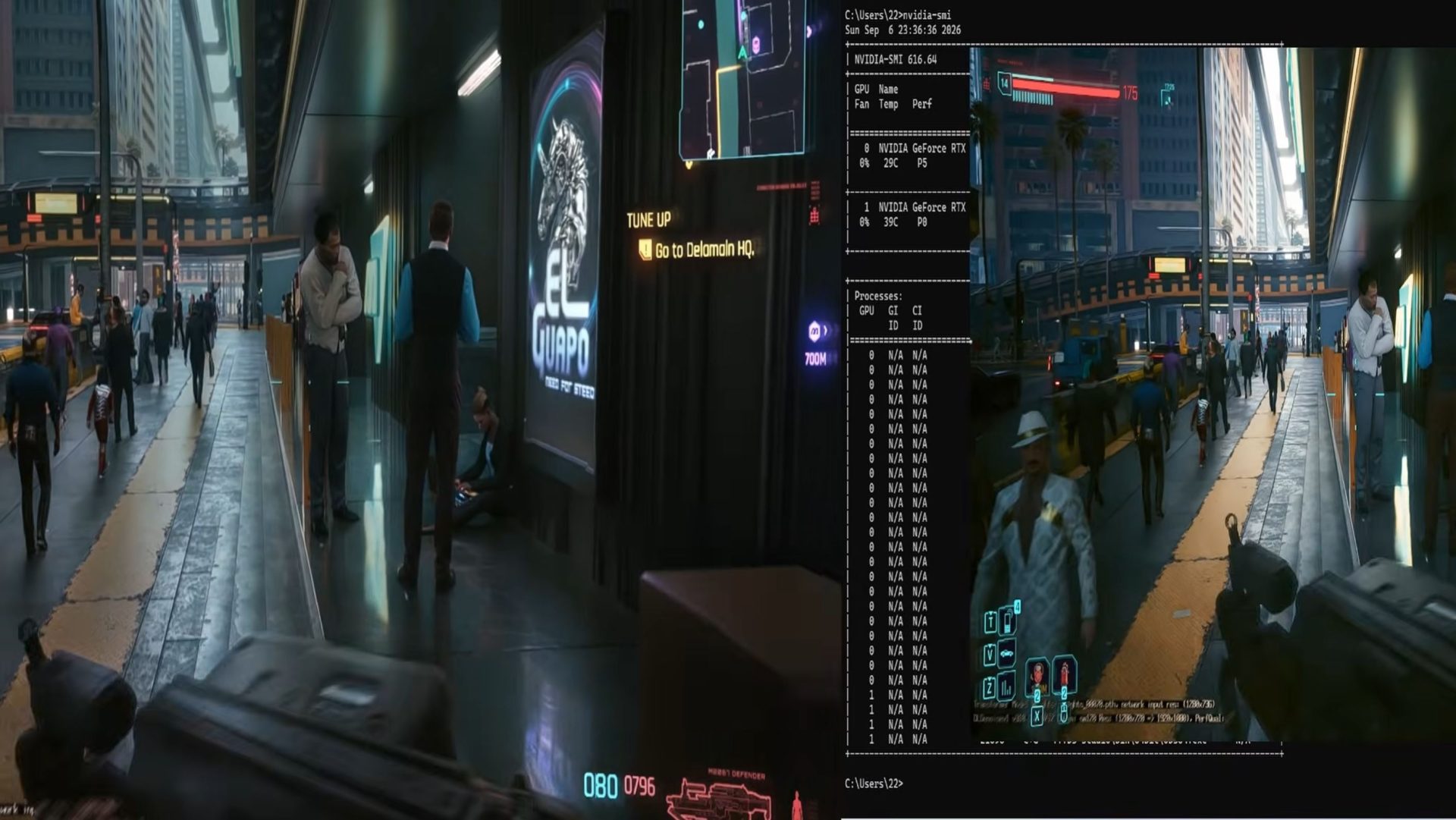
MGPU Bridge Lets DLSS 5 Neural Rendering Run on a Second GPU, Boosting Performance in Early Tests
NVIDIA’s DLSS 5 Neural Rendering is already becoming a major point of interest for PC gamers, and modders are wasting no time experimenting with what it can do beyond its official limits. A new ReShade add-on called MGPU Bridge has now shown that DLSS 5 workloads can be shifted to a second graphics card, allowing one GPU to handle game rendering while the other processes the neural rendering stage.
The result is an experimental dual-GPU setup that can recover a large amount of lost performance when DLSS 5 Neural Rendering is enabled.
DLSS 5 Neural Rendering has recently been seen running unofficially across a wider range of games and hardware than initially expected. Modders have already managed to get the feature working on older NVIDIA RTX cards and even on competing GPU hardware in certain cases. Now, the latest breakthrough focuses on multi-GPU performance, bringing back an idea that many PC enthusiasts thought had largely disappeared from modern gaming.
The demonstration comes from a setup using two GeForce RTX 5060 Ti 16 GB graphics cards. With MGPU Bridge, the primary GPU renders the game as usual, while the second GPU takes over the DLSS 5 Neural Rendering workload. Since Neural Rendering is applied near the end of the frame pipeline, the add-on captures the completed frame, sends it to the second GPU for processing, and then outputs the final image to the display.
This approach helps prevent the main graphics card from being overloaded by both game rendering and neural processing at the same time.
In testing, the performance gains were significant. In The Blood of Dawnwalker at 1080p, enabling DLSS 5 Neural Rendering on the main rendering GPU caused a noticeable frame rate drop. In DLAA mode, performance fell from around 67–70 FPS to just 44 FPS. However, when the DLSS 5 workload was moved to the second GPU, performance climbed back to the original 67–70 FPS range.
The improvement was even more dramatic in Performance mode. With DLSS 5 running on the primary GPU, the game reached about 59 FPS. After shifting Neural Rendering to the second RTX 5060 Ti, performance jumped to roughly 106–107 FPS.
Here are the reported results from the test:
DLAA mode:
DLSS 5 off: 67–70 FPS
DLSS 5 on the render GPU: 44 FPS
DLSS 5 on the second GPU: 67–70 FPS
Quality mode:
DLSS 5 off: 98–99 FPS
DLSS 5 on the render GPU: 54–55 FPS
DLSS 5 on the second GPU: 91 FPS
Performance mode:
DLSS 5 off: 127–131 FPS
DLSS 5 on the render GPU: 59 FPS
DLSS 5 on the second GPU: 106–107 FPS
Ultra Performance mode:
DLSS 5 off: 172 FPS
DLSS 5 on the render GPU: 69–71 FPS
DLSS 5 on the second GPU: 157 FPS
The add-on has also been tested in Cyberpunk 2077, suggesting that the concept may work across more than one DirectX 12 title. However, this is still an early and experimental project, not a plug-and-play solution for mainstream users.
One of the most interesting side effects of this dual-GPU method is lower temperature on the primary card. According to the developer, moving the DLSS 5 Neural Rendering workload to the second GPU resulted in a temperature reduction of around 21°C. That could be especially useful in demanding games where both performance and thermals are major concerns.
Still, there are several important limitations. At the moment, MGPU Bridge only works with DirectX 12 games. It also requires two RTX 50-series graphics cards, and the current setup needs two monitors, with one connected to each GPU. The developer has not tested mixed RTX 50-series models, so it is unclear whether two different cards would work properly together. The add-on also does not support RTX 40-series or older GPUs in its current form.
While NVIDIA moved away from traditional multi-GPU gaming support years ago, this experiment shows that dual-GPU systems may still have a future in a different form. Instead of rendering alternate frames like older SLI setups, one GPU can focus on the game while the second handles AI-based image processing. As modern graphics technologies become more dependent on neural rendering, frame generation, and AI upscaling, offloading these tasks to dedicated hardware could become increasingly useful.
For now, MGPU Bridge remains a modding experiment aimed at enthusiasts with very specific hardware. But the early numbers are promising. If the technique continues to improve, it could open the door to a new kind of multi-GPU gaming setup, where extra graphics cards are used not for traditional rendering, but for accelerating advanced AI visual features like DLSS 5 Neural Rendering.