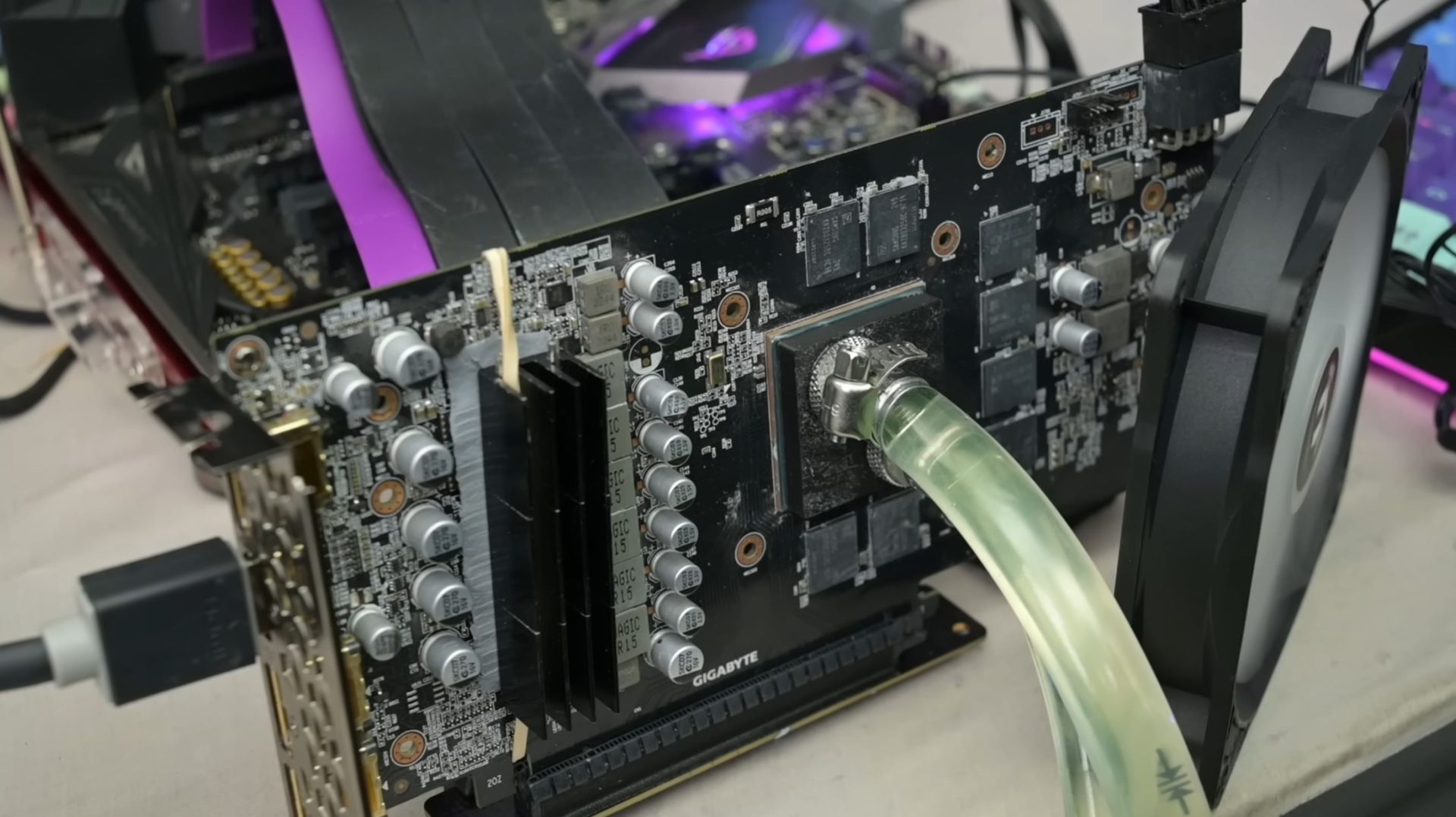
Modder Cools a Running RTX 2060 by Pumping Water Directly onto the GPU Die
A hardware modder has pushed GPU cooling into risky territory with an unusual direct-water experiment on a running GeForce RTX 2060. Instead of relying on a traditional heatsink, fan, or even a standard all-in-one liquid cooler, the setup sends water straight onto the exposed GPU silicon.
The result was impressive, but definitely not something most PC builders should attempt at home.
The experiment began after the modder found the stock RTX 2060 cooler underwhelming. In a typical benchmark run using Unigine Heaven, the graphics card reached around 70°C with its original heatsink installed. That is not unusual for a mid-range GPU under load, but the goal here was to see how far temperatures could be pushed down using a much more extreme cooling method.
Before trying the idea on a working graphics card, the modder tested the concept on a dead GeForce RTX 3060. That was a smart first step, because pouring or pumping water directly onto a GPU die is extremely dangerous. If water reaches the substrate, PCB, or surrounding components, the card can short out instantly.
To make the setup work, a custom 3D-printed plastic block was placed around the GPU die. Epoxy was then used around the substrate area to help seal the surface and reduce the chance of leaks. Early attempts were not successful, as water managed to escape through the plastic plate and around the contact area. After several adjustments, the seal became good enough to continue testing.
Once the leakage test looked stable, the modder repeated the process on a GeForce GTX 980. After proving the method could be replicated, the experiment moved to the GeForce RTX 2060, where the cooling results were much more meaningful because stock cooler temperatures were already measured.
For the RTX 2060, the modder created another custom plastic block, secured the tubing, and used a pump to pull water from a container. Instead of transferring heat through a metal cold plate, the water was aimed directly at the GPU silicon.
The temperature drop was dramatic. The RTX 2060 went from around 70°C on the stock cooler to just 28°C using direct-water cooling. The GPU hotspot temperature reportedly reached only 41°C, which is remarkably low for a graphics card under load.
For comparison, the modder also tested the RTX 2060 with a 360mm all-in-one liquid cooler before switching to the direct-water approach. That setup performed well, keeping the GPU at around 36°C. However, the direct-water method still managed to go even lower, showing how effective direct contact with moving water can be when everything is sealed properly.
The same cooling concept was later tested on an Intel Core i5-7600K processor, but in that case, it did not outperform the all-in-one cooler. This suggests that while direct-water cooling can produce eye-catching results on certain GPU setups, it is not automatically better for every chip or every cooling scenario.
As fascinating as the RTX 2060 experiment is, it comes with major risks. Direct-water cooling a GPU requires careful sealing, custom parts, leak testing, and a strong understanding of electronics and cooling behavior. One small mistake can permanently destroy the graphics card and potentially damage other PC components.
For most users, a quality air cooler, a properly mounted GPU heatsink, or a conventional liquid cooling loop remains the safer and more practical option. Still, this experiment is a striking example of how creative PC modding can push hardware beyond normal limits, delivering extremely low GPU temperatures through a method that is as risky as it is impressive.