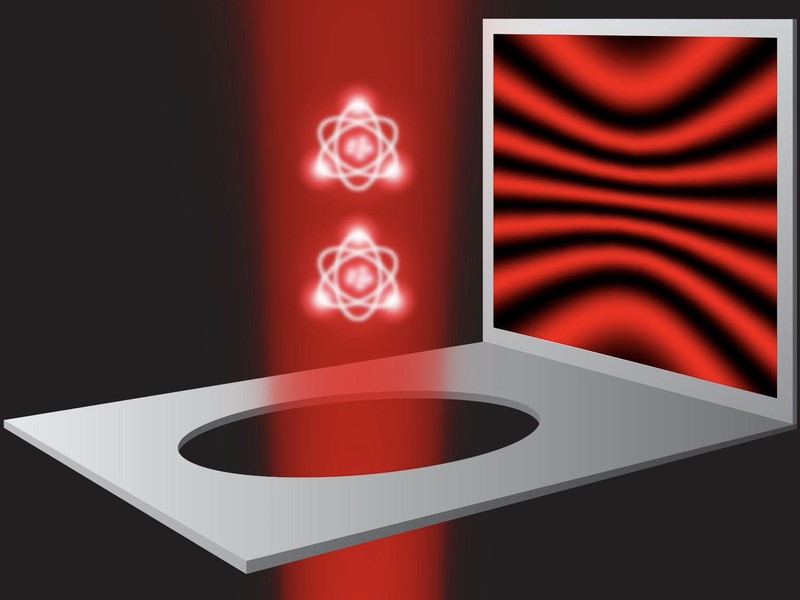
A groundbreaking revelation in quantum mechanics has emerged from MIT, where physicists have resolved a long-standing debate between Albert Einstein and Niels Bohr. Their recent experiment offered concrete evidence that Einstein’s perspective was incorrect concerning the dual nature of light.
The MIT team revisited the iconic double-slit experiment to demonstrate light’s dual identity as both a particle and a wave. The crucial finding was that these characteristics cannot be observed simultaneously.
This debate dates back to 1927 when Einstein proposed the possibility of detecting which slit a photon passed through while also observing its wave-like pattern. Bohr, however, countered with the quantum uncertainty principle, arguing that this was impossible.
Professor Wolfgang Ketterle and his team at MIT breathed new life into this historic discussion by crafting a laboratory setup that emulated Einstein’s thought experiment. Instead of using a screen with slits, they employed laser beams to position over 10,000 super-cooled atoms into a precise lattice, with each atom functioning as an individual slit.
By directing weak light beams through these atomic ‘slits,’ the team meticulously measured and analyzed how light’s particle and wave properties interplay. Their findings, now published, strongly validate Bohr’s stance: as more information is obtained about a photon’s particle-like trajectory, its wave-like interference diminishes.
In Professor Ketterle’s words, the experiment serves as an idealized Gedanken (thought) experiment, something neither Einstein nor Bohr could have envisioned. This discovery arrives just in time for the United Nations’ 2025 celebration of the International Year of Quantum Science and Technology, marking a century since the theory’s inception.