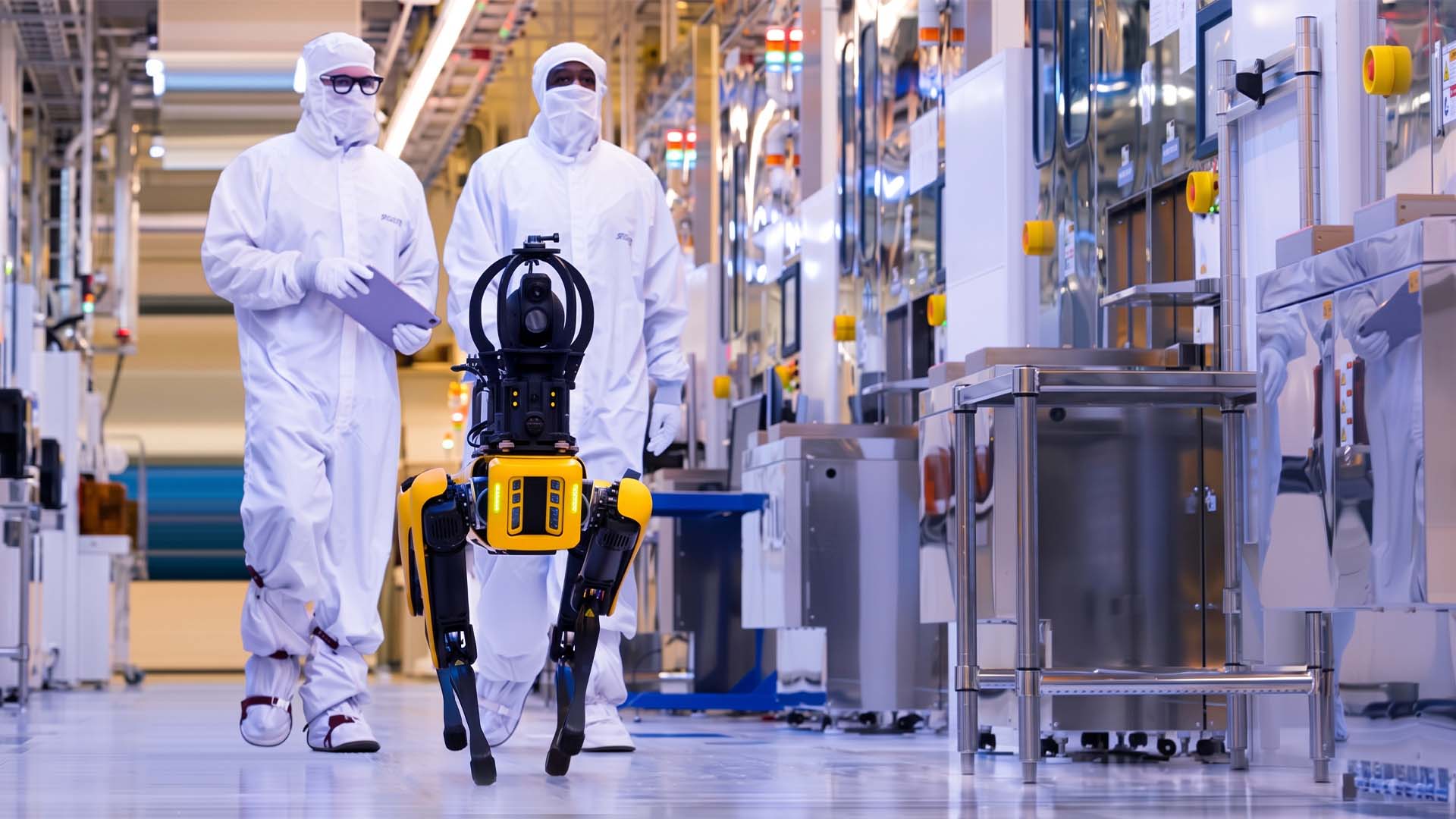
Micron’s Edge Inference Memory Could Push Humanoid Robots Toward a 2028 Breakthrough
Generative AI may not stay confined to chatbots, image tools, and cloud-based software for much longer. The next major leap could be physical AI, where artificial intelligence moves into humanoid robots capable of observing the world, understanding their surroundings, and making decisions in real time.
A key technology that could help make this possible is Micron’s Edge Inference Memory, also known as EIM. This memory technology is being designed to combine the low-power advantages of LPDDR memory with the high bandwidth and low latency typically associated with HBM. If development stays on track, EIM could reportedly move toward commercialization as early as 2028.
That timeline is important because humanoid robots are expected to require a very different type of memory performance than today’s industrial and service robots. Most current robots in factories or controlled environments follow repeated, pre-programmed movements. They are effective at specific tasks, but they do not truly adapt in the way future AI-powered humanoids are expected to.
Humanoid robots will need to process far more complex information. Instead of simply repeating instructions, they may need to respond to visual cues, recognize sounds, interpret weight and texture, understand objects, and react to unpredictable situations. That kind of proactive behavior requires fast AI inference directly at the edge, meaning the robot must make decisions locally without constantly depending on cloud servers.
This is where Edge Inference Memory could become a major advantage. By improving bandwidth and reducing latency while keeping power consumption low, EIM may allow AI robots to operate for longer periods while still making quick decisions. For humanoid robots, battery life and heat management are just as important as computing power. A robot with advanced AI capabilities will not be practical if its memory system drains too much energy or creates too much thermal stress.
EIM is said to work by stacking LPDDR memory on top of a logic die. This makes it different from traditional Processing-in-Memory designs, though the goal is similar: bring memory and processing closer together to reduce energy use and improve data handling. In AI workloads, moving data between memory and compute units can consume a significant amount of power. Reducing that movement can help improve efficiency, especially in compact robotic systems.
Micron has not yet revealed the full computational structure or performance details of EIM. However, the concept is drawing attention because it could address one of the biggest challenges facing physical AI: giving robots enough memory bandwidth to run advanced AI models without relying on power-hungry stacked HBM.
Today’s AI robots typically use models with around 1 billion to 2 billion parameters, which means LPDDR memory is still sufficient for many current applications. However, future humanoid robots are expected to use more advanced Vision Language Models. These models can convert live video and sensory information into meaningful input, helping robots better understand their environment and make smarter decisions.
As these models grow more capable, LPDDR memory could become a bottleneck. Higher-resolution camera feeds, real-time object detection, speech recognition, movement planning, and environment mapping all place heavy demands on memory bandwidth. If humanoid robots are expected to operate smoothly in homes, warehouses, hospitals, and factories, they will need memory systems that can keep up with continuous AI processing.
Micron has previously suggested that future AI robots may eventually need up to 200GB of RAM and several terabytes of NAND storage. That would be a massive increase compared to many service robots used today, which may rely on around 12GB of RAM and 256GB of storage. The jump highlights how much more demanding next-generation physical AI systems could become.
Another important detail is that EIM may also be adopted in LPDDR6 memory. If that happens, it could bring a major performance boost to future mobile, edge AI, and robotics platforms without requiring the same level of power consumption associated with HBM. This could make advanced AI hardware more practical for compact machines that need to move, react, and operate for extended periods.
The potential arrival of Edge Inference Memory in 2028 could become an important milestone for humanoid robot development. While AI software has advanced rapidly, hardware still needs to catch up before physical AI can become widely available. Faster, more efficient memory could be one of the missing pieces that helps transform humanoid robots from experimental machines into practical, intelligent assistants.
If Micron’s EIM delivers on its promise, the next wave of AI may not just live in data centers or smartphones. It could walk, see, listen, and act in the real world.