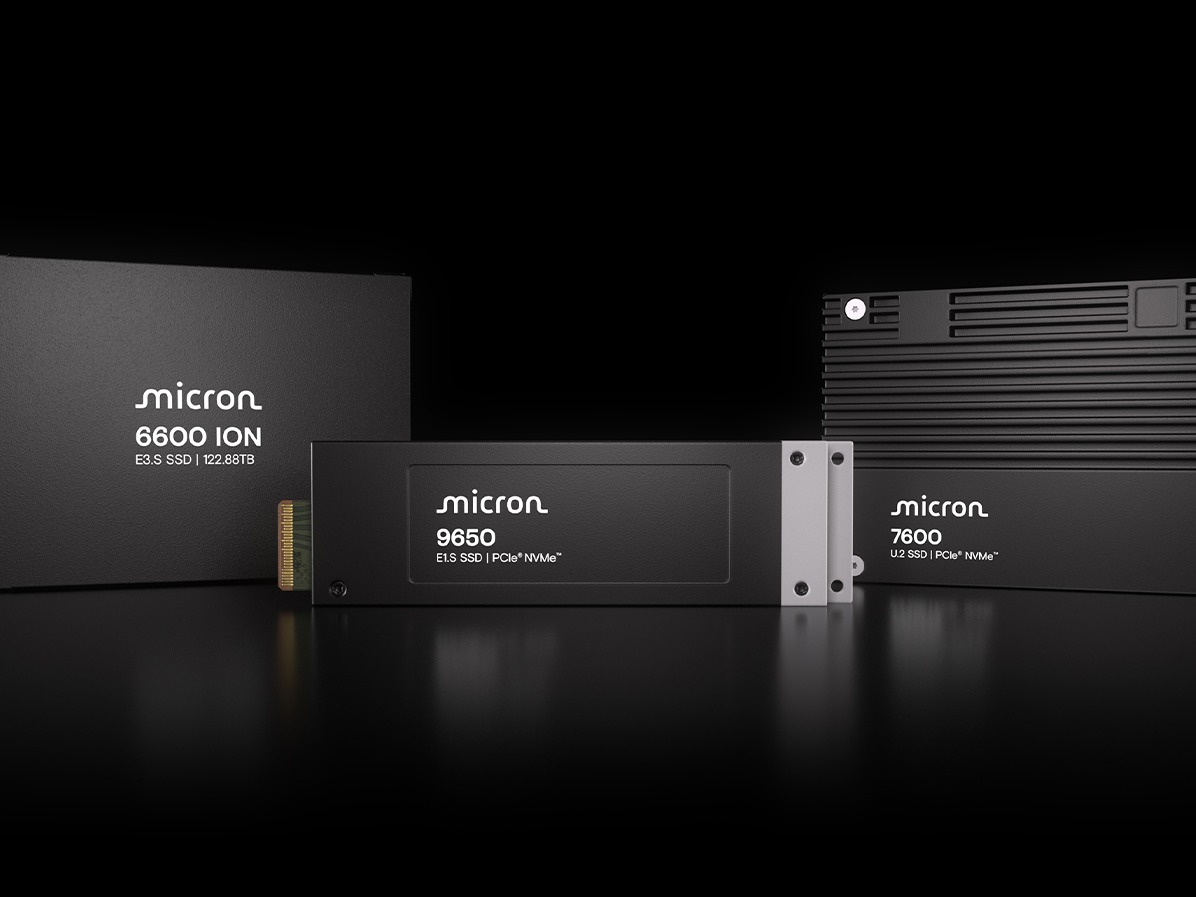
Micron Technology has taken a significant leap forward in the world of SSDs with the introduction of its cutting-edge G9-NAND portfolio. This new lineup features three standout models: the 9650 PCIe Gen 6 NVMe flagship, the capacity-driven 6600 ION series, and the latency-focused 7600 PCIe Gen 5 drive. Together, they offer a perfect blend of speed, capacity, and efficiency designed to meet the demands of rapidly expanding AI clusters and cloud computing environments.
Let’s dive into what makes these SSDs remarkable. Leading the charge is the 9650 SSD, boasting a four-lane PCIe 6.0 interface. It offers impressive sequential transfer speeds of up to 28 GB/s for reading and 14 GB/s for writing, along with 5.5 million random-read IOPS. Moreover, it’s engineered to be energy-efficient, boasting a 67% improvement over its Gen 5 predecessors. Specifically tailored for AI servers, the 9650 comes in E1.S and E3.S form factors and is available with air or liquid cooling options. It seamlessly transfers data to Nvidia Blackwell GPUs without burdening the host CPU, making it an ideal choice for high-performance environments.
For those prioritizing storage capacity, the 6600 ION series is a game-changer. Built on a PCIe 5.0 platform with QLC NAND, it offers launch capacities of 30.72, 61.44, and 122.88 TB, with an astonishing 245 TB model expected by early 2026. Micron highlights its efficiency, claiming 4.9 TB per watt and a 37% energy advantage over traditional HDD arrays. Just imagine, a single 1U server can now house up to 2.4 PB of flash storage, drastically reducing power consumption across data centers.
Rounding out the lineup is the 7600 series, a mainstream Gen 5 SSD that prioritizes latency. It excels with sub-1 ms response times for workloads like RocksDB, delivering 12 GB/s sequential reads, 7 GB/s writes, and up to 2.1 million random-read IOPS. This performance effectively doubles random-write throughput compared to similar drives.
Micron has wasted no time in pushing these innovations to the market, with early samples of the 9650 and 7600 already in customer hands. As for the 6600 ION, the 122 TB variant is set to ship in Q3 2025, followed by the 245 TB model in the first half of 2026.
In summary, Micron’s new SSD offerings are poised to redefine data storage for AI and cloud infrastructures. By providing faster data pathways, denser flash storage, and unwavering quality-of-service commitments, Micron is set to meet the needs of even the most demanding tech landscapes.