Meta Muse Spark Open Brings Frontier-Scale AI Performance to Apple Devices
Apple may not need to build a frontier-class artificial intelligence model entirely on its own to compete at the highest level of AI. Instead, the company appears to be leaning into a powerful strategy: working with major AI developers and optimizing advanced models for Apple hardware.
That approach is now in the spotlight with Meta AI’s newly released Muse Spark Open, an open-weight AI model designed for demanding coding, agentic workflows, long-context reasoning, and complex software engineering tasks. The model has been fine-tuned to deliver strong performance on Apple devices, making it especially relevant for developers, researchers, and professionals interested in running powerful AI locally.
Muse Spark Open is being positioned as one of the most capable open-weight AI models developed in the United States. Its focus is not just basic chatbot-style responses, but high-end workloads that require planning, reasoning, code generation, and multi-step execution over long periods.
At the center of Muse Spark Open is a massive 816-billion-parameter Mixture-of-Experts architecture. However, instead of activating the full model for every task, it uses only 42 billion active parameters at a time. This design allows the model to offer the reasoning depth of an extremely large AI system while reducing the compute burden during inference.
That balance is important. A near-trillion-parameter model would normally require enormous server-class infrastructure, but the Mixture-of-Experts approach makes Muse Spark Open more practical for advanced local and edge deployments.
Another major highlight is the model’s 1 million token context window. This gives Muse Spark Open the ability to process very large amounts of information in a single session. For developers, that could mean analyzing massive codebases, reviewing lengthy technical documentation, or maintaining context across extended agentic workflows.
The model is also natively multimodal. Rather than relying on separate adapters or late-stage fusion techniques to interpret non-text data, Muse Spark Open is built to handle multiple forms of input more directly. It can work with long-form text and frame-by-frame raw video sequences, opening the door to more advanced AI applications involving visual reasoning, video analysis, and complex contextual understanding.
A major part of the announcement centers on how well Muse Spark Open can run on Apple Silicon, particularly high-end Apple M5 Ultra systems.
The model takes advantage of Apple’s unified memory architecture. A single Apple M5 Ultra chip can access up to 512 GB of unified memory, and when two compatible systems are connected through Apple’s MLX framework, they can effectively operate as a 1 TB unified memory cluster. That makes it possible for the full 816-billion-parameter weight file to remain on-device, reducing dependency on remote cloud infrastructure.
This is significant for on-device AI performance, privacy, and latency. Keeping model weights local can help developers run advanced AI workloads without sending sensitive data to external servers.
Muse Spark Open also benefits from the Apple M5 Ultra’s memory bandwidth, which reaches up to 1.2 TB/s. Since Mixture-of-Experts models must quickly route active tokens to the right expert layers, fast memory access is essential. The architecture is designed to reduce bottlenecks when pulling the 42-billion-parameter active slice needed for each token layer.
Meta has also implemented dynamic weight pulling through an integrated MLX adapter. This allows the model to communicate directly with common model repository structures and map weights into Apple Silicon memory spaces without requiring heavy local conversion steps. For developers, that could mean a smoother setup process and faster experimentation.
While Apple devices are a major focus, Muse Spark Open is not limited to Apple hardware. The model has also been optimized for other high-performance edge and workstation-class systems.
On discrete GPU hardware, the architecture uses custom Helion GPU kernels integrated into SGLang. These auto-tunable kernels are designed to improve performance on NVIDIA and AMD hardware. Depending on the workload and configuration, kernel-level speedups reportedly range from 1.03x to 3.95x, with an additional 3 percent end-to-end performance boost noted for AMD MI350 hardware.
For developers who want to fine-tune or customize the model, Muse Spark Open is built to work natively with PyTorch’s TorchTitan framework. That should make distributed training, fine-tuning, and architectural experimentation more accessible for teams working on specialized AI systems.
Benchmark claims around Muse Spark Open are also ambitious. The model is said to outperform other major open-weight large language models from the United States across most tests while remaining competitive with strong international alternatives. Its combination of scale, efficiency, long-context support, and multimodal capability could make it a serious option for developers building advanced AI agents and coding tools.
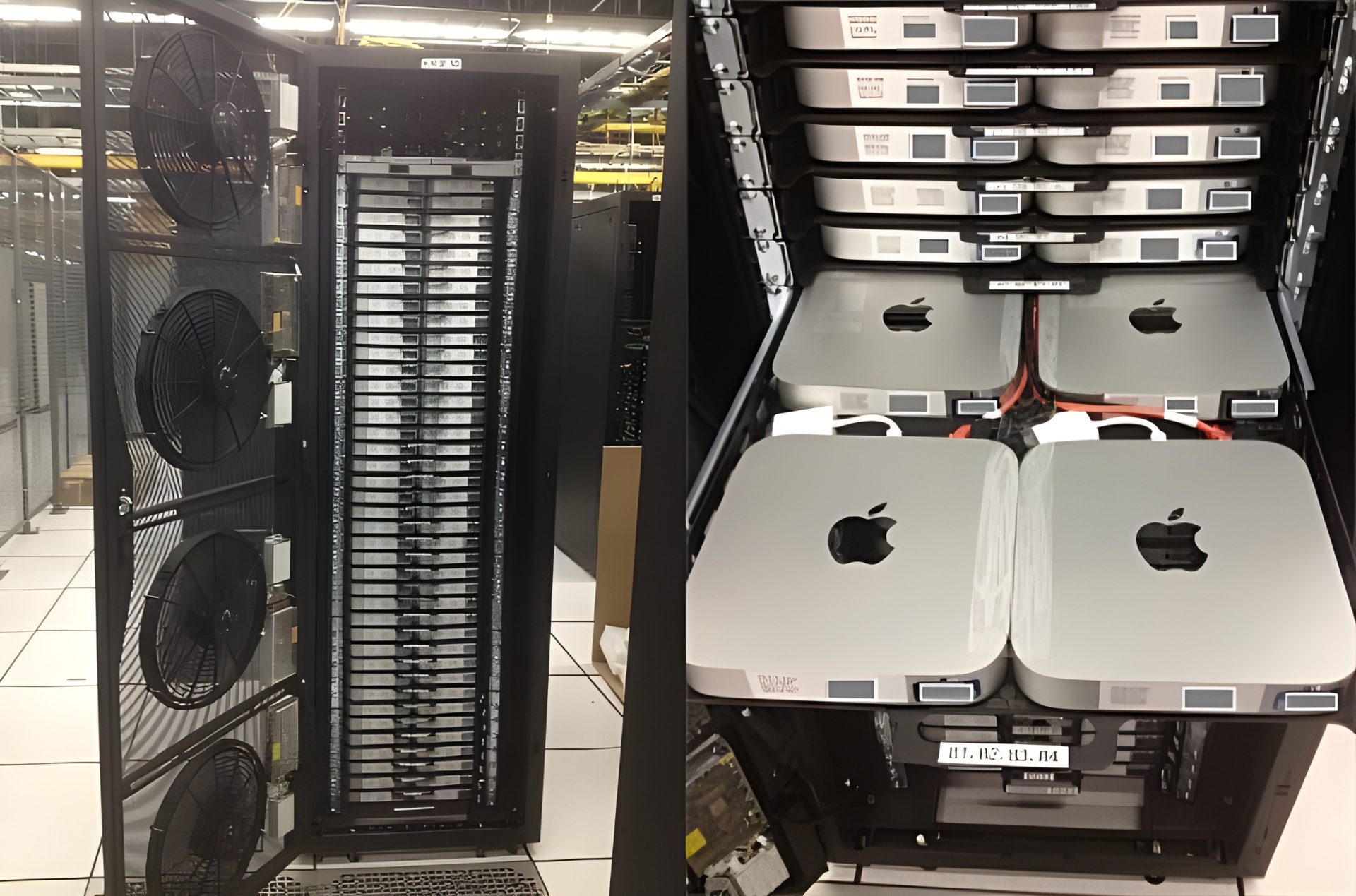
Throughput numbers on Apple hardware are especially interesting. When two Apple M5 Ultra Mac Studio systems are connected over Thunderbolt, Muse Spark Open can reportedly generate around 20 tokens per second. With four connected systems, that figure rises to approximately 36 tokens per second. Support for multiple Thunderbolt cables between Macs may further improve cluster bandwidth, suggesting performance could increase with future tuning and hardware configurations.
The broader takeaway is clear: Apple’s AI strategy may not depend solely on building every frontier model in-house. By enabling powerful open-weight models like Muse Spark Open to run efficiently on Apple Silicon, Apple can strengthen its position in local AI, developer workflows, and privacy-focused machine learning.
For users and developers, Muse Spark Open could represent a major step toward running frontier-scale AI models outside traditional cloud data centers. With its 816-billion-parameter Mixture-of-Experts design, 1 million token context window, native multimodal capabilities, and Apple Silicon optimization, Meta’s new model may become one of the most important open-weight AI releases for on-device artificial intelligence.


