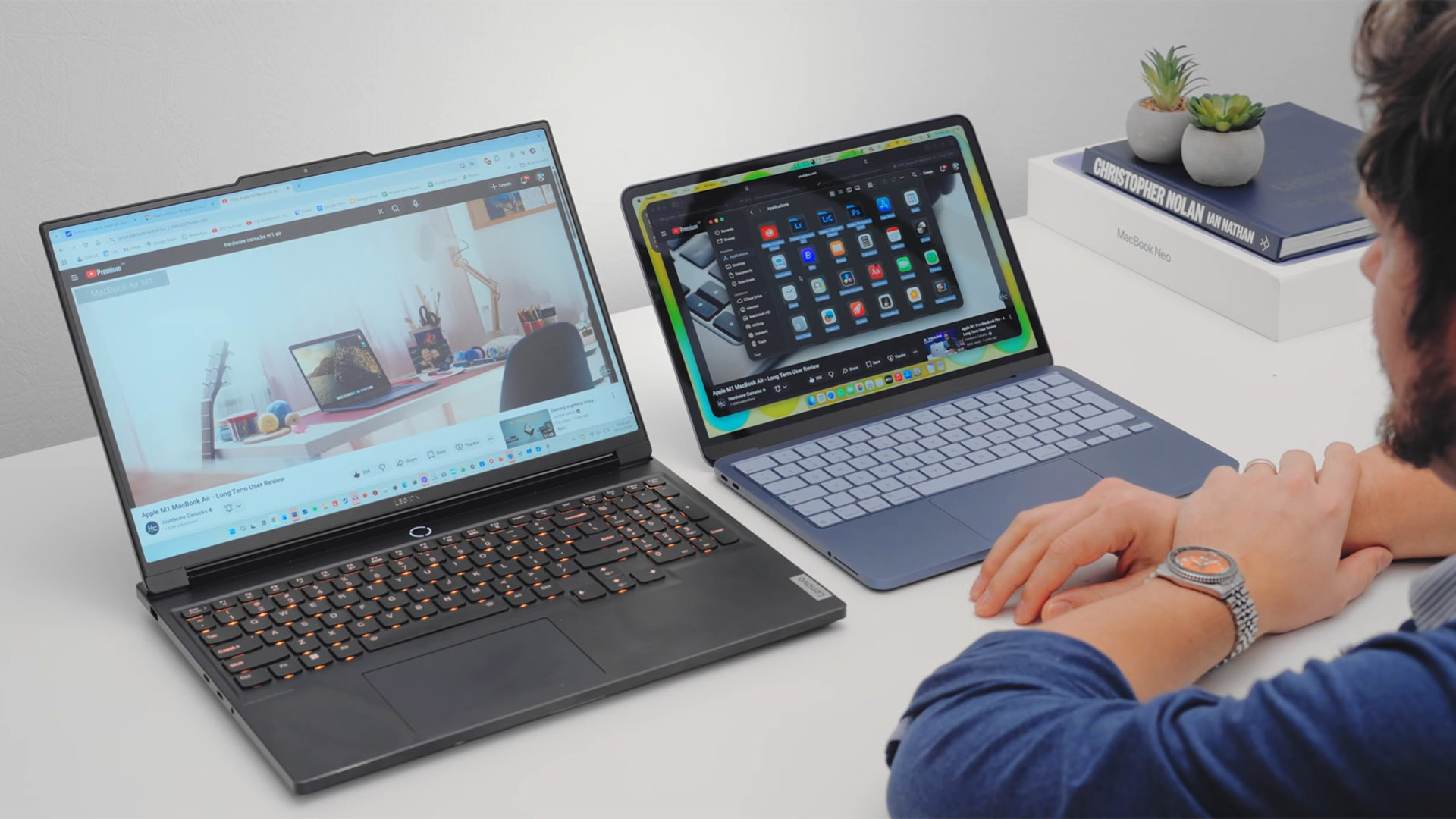
Apple’s unified memory approach is at the center of the MacBook Neo’s most talked-about limitation: RAM. Because the MacBook Neo uses the A18 Pro chip, its memory is integrated into the chipset package, meaning you’re working with a fixed pool of 8GB unified memory. That design choice naturally raises a big question for shoppers: how well can an 8GB Mac handle real multitasking in 2026?
A recent stress test set out to answer that in the most extreme way possible. Instead of the usual “a few apps and a browser” routine, the YouTube channel Hardware Canucks pushed the MacBook Neo into full chaos mode by launching 60 apps back-to-back. The surprising part wasn’t just that macOS kept going—it’s that a larger, more powerful-looking Windows laptop (appearing to be a Lenovo Legion model) shut down while attempting a similar workload.
Despite the internet’s long-running debate over whether 8GB RAM is “enough,” the MacBook Neo didn’t crash, didn’t freeze, and didn’t power off during the app-launch marathon. The test didn’t stop there, either. Video playback and streaming were added on top of the already-packed workload, and the system still stayed responsive. According to the host, the cursor remained smooth with no obvious lag, though heavy multitasking did bring noticeable battery drain—an expected trade-off when you’re forcing a thin-and-light laptop to juggle far more than typical daily use.
The Windows laptop shutdown quickly turned into its own controversy. On X, a creator named Beyond FPS criticized the comparison and questioned how fair the test was. Hardware Canucks responded by saying the Windows laptop didn’t enter Sleep or Hibernate mode, but instead “black screened.” The discussion escalated further when a Reddit thread was cited, pointing to reports that the Legion Slim 5 and some related machines have experienced similar black-screen behavior under load or even while idle.
Platform debates aside, the main takeaway from the stress test is clear: the MacBook Neo’s 8GB unified memory isn’t as fragile as many expect, at least in terms of stability. Even after going overboard with app launches and layering in video streaming, macOS kept running without the kind of crash or shutdown many people fear when they see “8GB” on a spec sheet.
That doesn’t mean higher-end Macs are suddenly pointless. If your workload includes demanding creative apps, large projects, intensive multitasking every day, or anything that benefits from more headroom, stepping up to a more powerful Mac still makes sense. But for the kind of customer the MacBook Neo is aimed at—people who want a portable daily driver for everyday apps, browsing, media, and light productivity—this stress test suggests the machine can handle far more than its memory figure implies.
For buyers watching prices, the 512GB storage version of the MacBook Neo has been spotted at $689.99, a small drop from its $699 MSRP.