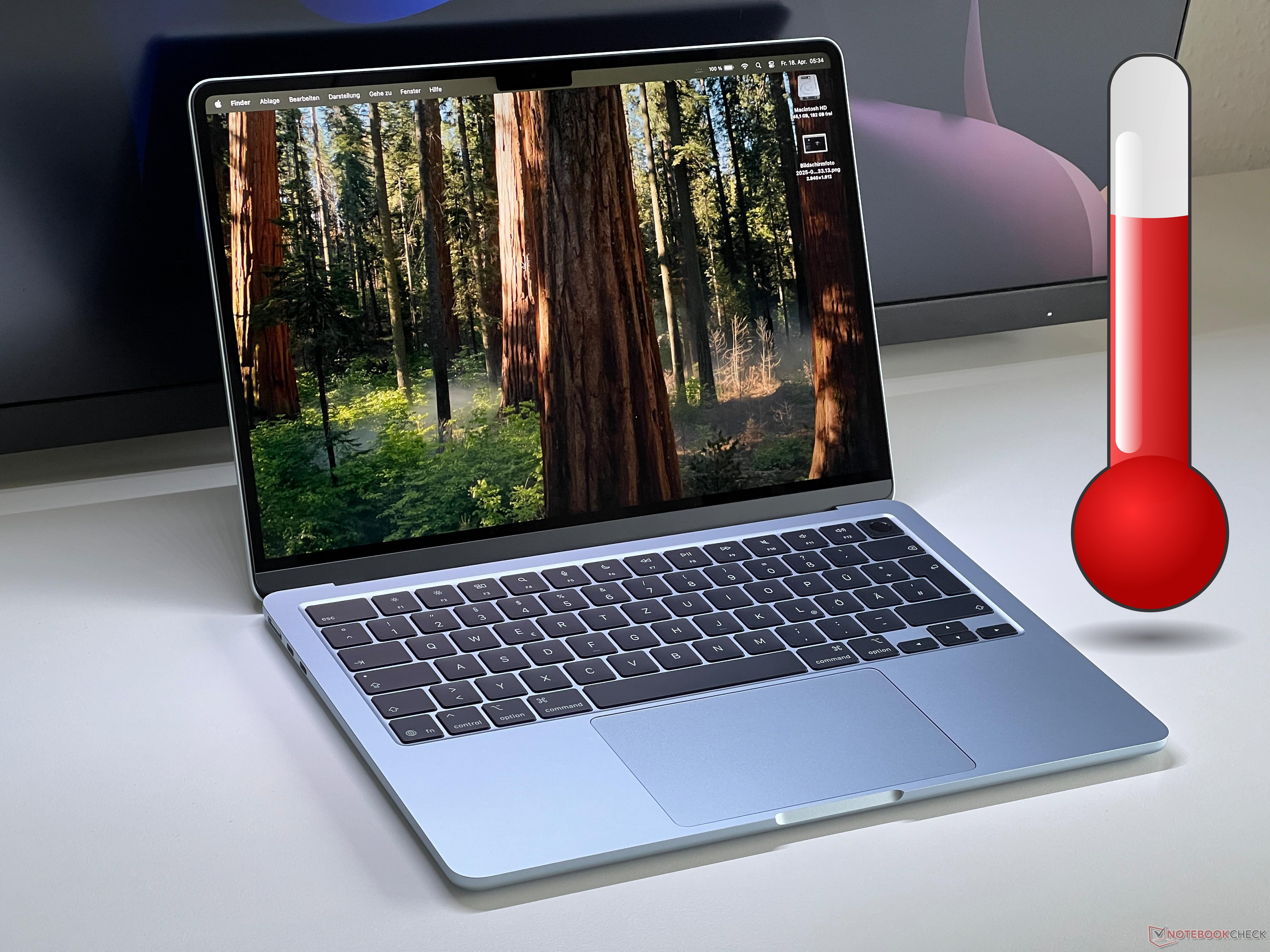
Apple’s MacBook Air 13 with the M5 chip has a reputation for doing more with less, and real-world testing backs that up. In a recent review, the M5 stood out as remarkably frugal, helping the MacBook Air 13 M5 earn a strong case as one of the most power-efficient laptops available. Under sustained load, it can level off at roughly 7 watts, yet still manage to run demanding games like Cyberpunk 2077 at 1200p using reduced settings with MetalFX upscaling.
But there’s a catch: the M5 clearly has more performance to give—if the laptop can keep it cool.
Testing that compared the MacBook Air 13 M5 to its bigger sibling, the MacBook Pro 14 with the same M5 configuration (10 CPU cores and 10 GPU cores), shows just how much cooling and power limits matter. In Cyberpunk 2077 at 1200p on low settings with MetalFX upsampling, the MacBook Air 13 reportedly used around 9 watts and delivered about 54 FPS. The MacBook Pro 14, meanwhile, reached roughly 76 FPS while consuming about 20 watts. That’s a sizable performance gap of about 40.7%, even though both machines are built around the same chip.
The difference shows up in other games too. In Elden Ring, the MacBook Pro 14 was able to hold a locked 60 FPS, while the MacBook Air 13 M5 reportedly throttled down closer to around 50 FPS once heat built up. The key reason isn’t the silicon—it’s the design. The MacBook Air relies on passive cooling and is tuned with lower power limits, which helps it stay thin, quiet, and efficient. The trade-off is that it can only sustain around 9 watts in these scenarios, while the MacBook Pro can push much higher sustained power—reported at up to 27.5 watts.
That raises an interesting question for the next generation: could Apple boost MacBook Air gaming performance and sustained workloads without abandoning the fanless design?
There’s a growing argument that the MacBook Air’s passive thermal solution is the main thing holding it back, and that even modest changes could unlock more of the M-series chip’s potential. A recent demonstration from a YouTuber suggested that a simple copper plate modification—still without adding fans—helped a passively cooled laptop achieve noticeably better sustained performance. The implication is that Apple may not need to add active cooling to future MacBook Air models to get a meaningful uplift. Instead, improving the thermal design and heat spreading could allow higher sustained power and fewer throttling dips, especially in long gaming sessions or extended creative workloads.
For buyers, the takeaway is straightforward: the MacBook Air 13 M5 is an efficiency monster and can handle modern games with the right settings, but the MacBook Pro 14 M5 shows what the same chip can do when cooling and power headroom aren’t as restricted. And if Apple chooses to refine the MacBook Air’s heat management in future 13-inch and 15-inch models, the performance gap could narrow—without sacrificing the fanless experience many people love.


