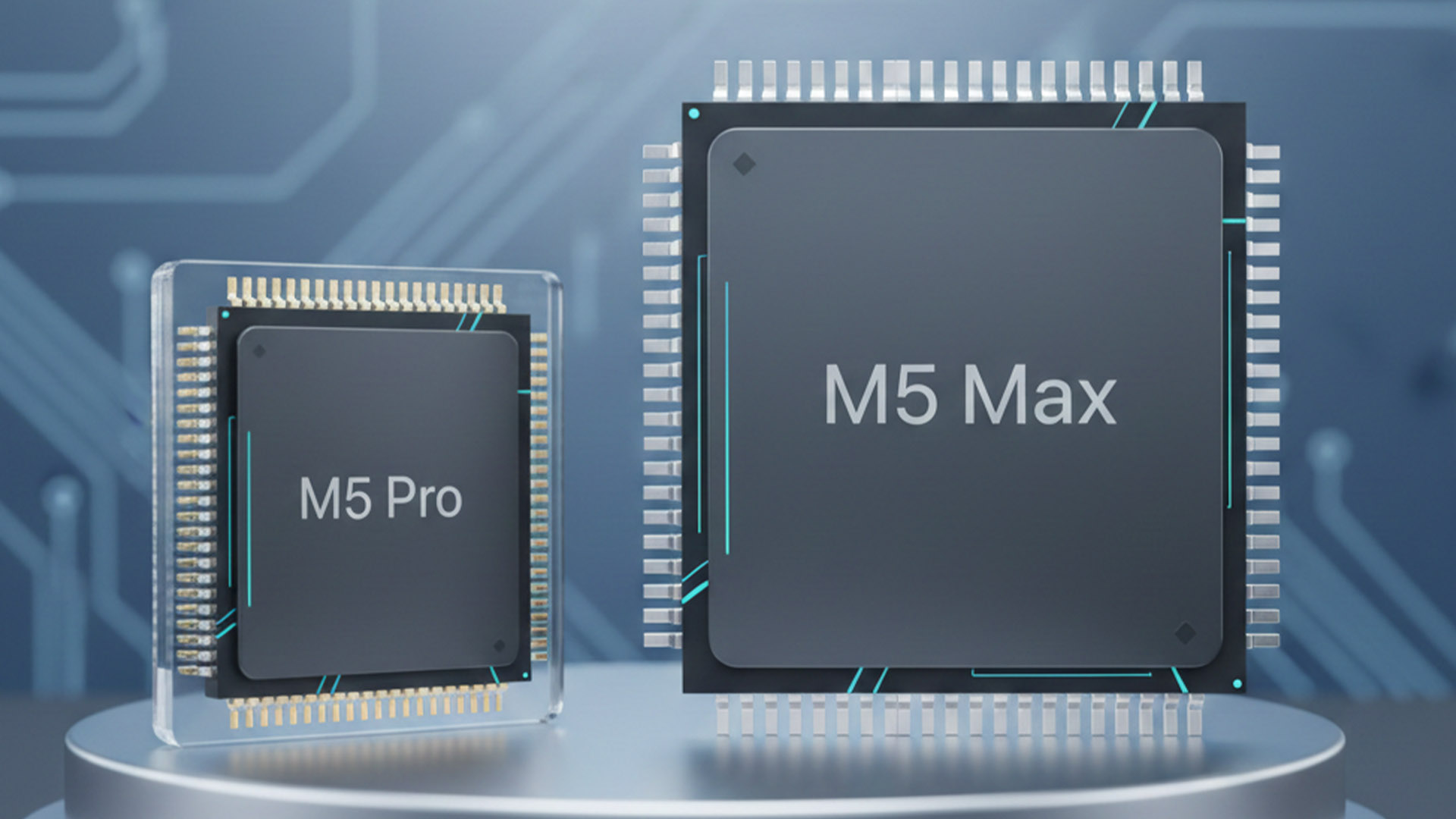
Apple has confirmed a product launch event for March 4, and it’s shaping up to be an important date for anyone watching the next wave of MacBook Pro upgrades. The big expectation is that Apple will unveil refreshed 14-inch and 16-inch MacBook Pro models powered by new M5-series chips—most notably the M5 Pro and M5 Max.
What has people talking isn’t just a routine performance bump. The standout rumor is a major packaging shift: Apple’s next high-end laptop chips could move to TSMC’s 2.5D chiplet-style design, stepping away from InFO (Integrated Fan-Out) packaging. If that happens, it could change how Apple scales performance in MacBook Pro models moving forward.
Why a chiplet-style design could matter for M5 Pro and M5 Max
Modern processors are increasingly limited not only by how advanced the manufacturing process is, but by heat, power delivery, and how much complexity can be packed into a single piece of silicon without hurting yields. A 2.5D chiplet design essentially lets different parts of the processor exist as separate “blocks,” which can then be integrated together in a more flexible way.
The practical benefits being discussed include improved heat dissipation and fewer defective chips during production—both important as chip designs grow larger and denser. This also ties into a long-running challenge: for multiple generations, Apple’s top-end laptop chips have had a tough time meaningfully increasing maximum CPU and GPU core counts.
More CPU and GPU cores may finally be easier to scale
A fresh discussion on Reddit argues that a chiplet-based layout could loosen the thermal and electrical constraints that come with packing CPU and GPU onto a single monolithic design. In simple terms: if CPU and GPU blocks are separated, they may interfere less with each other’s heat and power behavior, making it easier for Apple to push core counts higher without hitting the same ceiling.
That’s a big deal because recent MacBook Pro chips have appeared to top out at similar limits. For example, both the M3 Max and M4 Max configurations were capped at up to a 14-core CPU and up to a 40-core GPU. The suggestion is that the M5 Max might have faced those same ceilings if Apple stuck with the existing packaging approach.
If chiplets help Apple break past those limits, it could deliver noticeable gains not just in raw performance, but also in sustained performance under heavy workloads—something power users care about when exporting video, compiling code, running 3D workloads, or training models for extended periods.
Could the M5 Pro become a bigger upgrade than expected?
Another interesting implication: if CPU and GPU resources can be scaled more efficiently, the M5 Pro could potentially land in a stronger configuration than buyers typically expect—without forcing customers to jump all the way to an M5 Max system to get a meaningful leap in performance.
That could make the 14-inch and 16-inch MacBook Pro lineup more compelling across more configurations, especially for creators and professionals who want serious performance but don’t want to pay the premium traditionally tied to the highest-tier chip.
The rebranding theory: why M5 Pro might be “missing” in early software clues
Adding to the speculation, a video analysis from YouTuber Max Tech suggests that the M5 Pro not appearing in iOS 26.3 beta references could be because the M5 Pro is effectively a rebranded M5 Max enabled by the new chiplet approach. Apple hasn’t confirmed anything along these lines, but it’s one more reason the March 4 event is getting attention from MacBook Pro watchers.
For now, all of this remains in the rumor-and-analysis stage, but the direction makes sense: Apple’s silicon is growing in size and complexity, and the industry as a whole is increasingly leaning on advanced packaging to keep performance scaling. If Apple uses the March 4 launch to introduce M5 Pro and M5 Max MacBook Pro upgrades with a chiplet-based design, it could be one of the more meaningful architectural shifts we’ve seen in the Mac lineup in years.