AMD Zen 6 CPUs May Introduce a New Low-Power Core for Better Efficiency
AMD’s upcoming Zen 6 processor family could bring a major change to the company’s CPU strategy: a third type of Zen core designed specifically for low-power operation. The new core type has appeared in recent Linux kernel patches, suggesting AMD is preparing to expand beyond its current mix of standard and dense Zen cores.
Today, AMD uses two main Zen core variants across its consumer and enterprise processors. The standard Zen core focuses on performance, while the compact “C” version is designed for higher core density and better power efficiency in certain workloads. This approach began with Zen 4 and continued with Zen 5, where AMD offers both Zen 5 and Zen 5C designs.
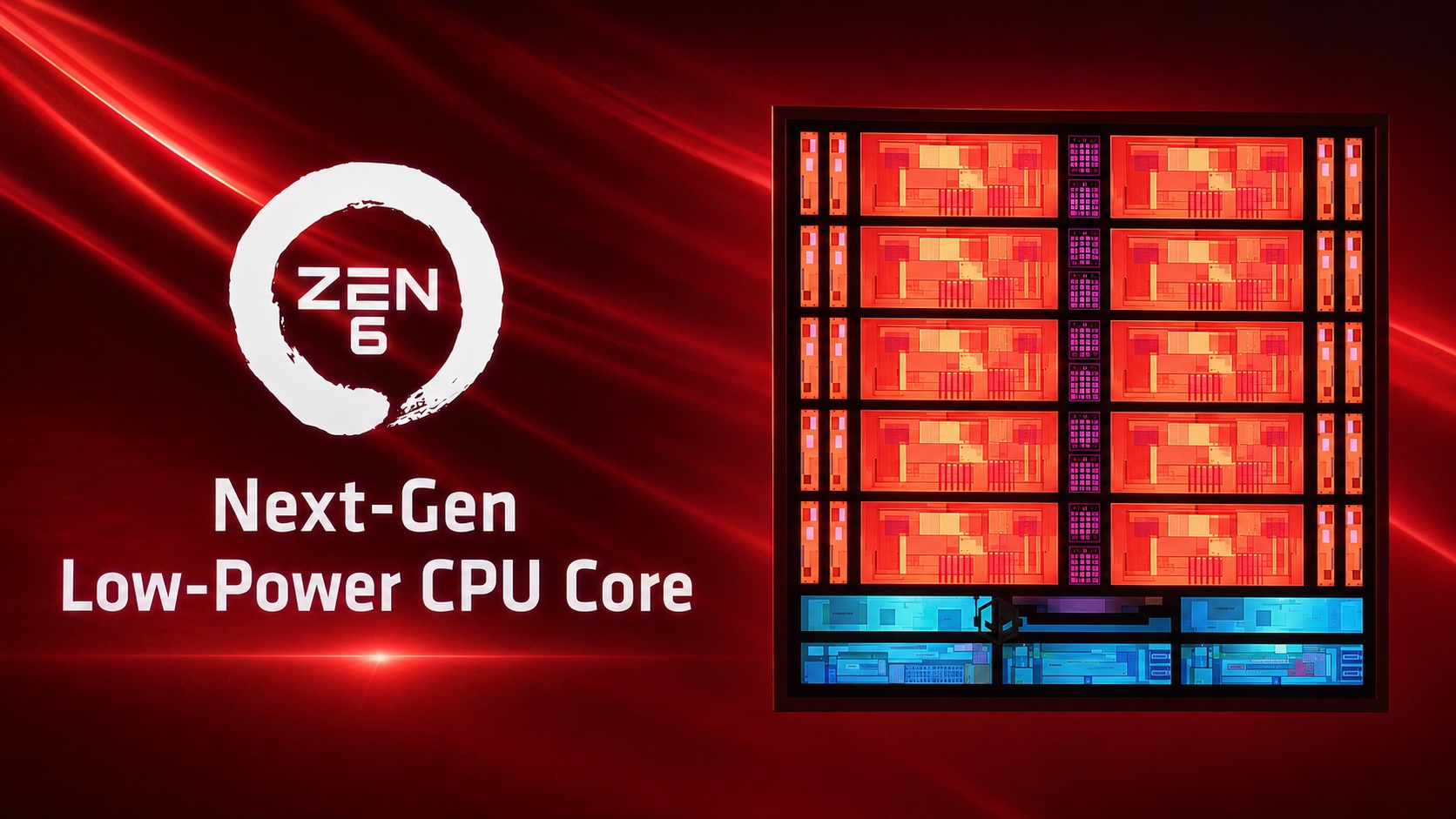
With Zen 6, AMD appears to be adding another option: a Low Power core. This new core type is expected to target background tasks, idle workloads, and scenarios where minimizing power consumption is more important than maximizing performance.
The key detail is that AMD’s approach is different from the hybrid CPU strategy used by some competitors. AMD’s Zen core variants are expected to share the same x86 instruction set architecture, meaning the cores remain fundamentally compatible while being tuned for different performance, density, and power goals.
According to the Linux kernel patch information, AMD heterogeneous processors can report core type data through CPUID topology information. The newly identified low-power core is described as a core designed for minimal power consumption during background or idle workloads. This distinction matters because the operating system needs to understand how to schedule tasks across different core types.
In simple terms, the system should know when to use a high-performance core, when to use a dense efficiency-focused core, and when to shift lighter work to an ultra-low-power core. Better scheduling could help improve battery life, reduce heat, and lower overall power draw, especially in mobile devices.
The new Zen 6 Low Power core may be especially important for AMD’s future APU lineup, reportedly known as Medusa. These next-generation chips are expected to use multiple Zen 6 core types, potentially combining standard Zen 6 cores, Zen 6C cores, and Zen 6 low-power cores in different configurations.
That could give AMD more flexibility across laptops, handheld gaming devices, mini PCs, and other compact systems where performance-per-watt is critical. A chip with several core types could handle demanding workloads on faster cores while keeping background activity on low-power cores, helping systems stay efficient when full performance is not needed.
Details about the actual design of the Zen 6 low-power core remain limited. Early information suggests it may combine ideas from previous Zen designs while using the Zen 6 architecture foundation. The most important questions are how much power it saves, how it performs compared to Zen 6C, and how effectively operating systems can use it in real-world workloads.
If AMD executes this correctly, Zen 6 could mark one of the company’s biggest architectural shifts in years. Instead of simply offering performance and density-focused cores, AMD would gain a dedicated core type for idle and background efficiency. That could help AMD compete more aggressively in laptops and mobile-focused platforms, where battery life and standby power are just as important as benchmark performance.
The Zen 6 generation is not expected to arrive immediately, with related Medusa APU products likely appearing closer to 2027. Until then, more details should emerge through firmware updates, Linux patches, platform leaks, and future AMD announcements.
For now, the appearance of a Zen 6 Low Power core strongly suggests AMD is preparing a more advanced heterogeneous CPU design. If the final products deliver on the promise, future AMD processors could become smarter, more efficient, and better optimized for modern computing workloads.