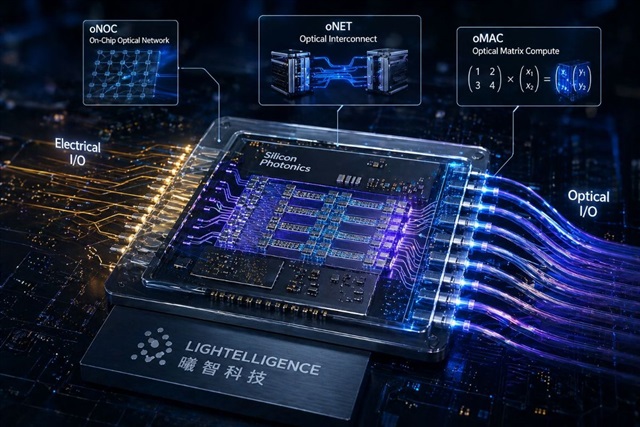
As generative AI accelerates across industries, the demand for faster, more efficient computing is surging. But behind the scenes, a growing bottleneck is holding modern AI systems back: the way data moves between chips. Traditional electrical interconnects, long the backbone of servers and high-performance computing, are running into hard limits on power consumption, heat, bandwidth, and physical density. That’s why silicon photonics and co-packaged optics (CPO) are quickly moving from “next big thing” to “must-have” technology for the future of AI infrastructure.
On April 28, 2026, China-based silicon photonics chip developer Lightelligence took a major step into the spotlight by listing in Hong Kong, drawing fresh attention to the race to commercialize co-packaged optics. The company’s move highlights how strongly the market is shifting toward optical solutions as AI workloads become heavier, model sizes grow, and data centers push to scale without exploding energy costs.
Why traditional interconnects are hitting a wall
AI training and inference aren’t just about raw compute anymore. They rely on vast volumes of data moving rapidly between GPUs, CPUs, memory, and networking hardware. As clusters scale up, the interconnect becomes a critical performance and efficiency limiter.
Electrical connections have been improved steadily over decades, but they face mounting challenges:
1) Power and heat: Moving more data at higher speeds over copper consumes more energy and generates more heat, raising operating costs and making cooling harder.
2) Density constraints: As bandwidth needs grow, cramming additional electrical lanes into the same space becomes difficult and expensive.
3) Scaling limits: With ever-larger AI clusters, the “distance problem” worsens—moving high-speed electrical signals across boards and racks becomes increasingly inefficient.
These constraints are now significant enough that many in the industry see optics not as an optional upgrade, but as a foundational shift.
How silicon photonics and CPO change the equation
Silicon photonics uses light rather than electricity to transmit data, delivering higher bandwidth with lower power over longer distances. In data centers, that can mean less energy wasted on signal integrity and amplification, fewer thermal headaches, and more headroom to scale.
Co-packaged optics takes the idea further by bringing optical components closer to the compute chips. Instead of using traditional pluggable optical modules at the edge of a switch or system, optics can be integrated more tightly into the package. This helps reduce losses, minimize power-hungry electrical pathways, and improve overall bandwidth density.
In practical terms, CPO is being pursued because it promises:
Higher bandwidth at lower power per bit
Improved scaling for AI clusters and next-gen networking
A path to continued performance growth when electrical I/O improvements slow down
Lightelligence’s listing signals rising momentum
Lightelligence’s Hong Kong listing on April 28, 2026 is a notable milestone for China’s silicon photonics ecosystem and a clear signal that commercialization efforts are accelerating. As generative AI fuels unprecedented demand for computing infrastructure, companies working on photonics-enabled interconnects are gaining attention from investors and the broader semiconductor market.
The key message is that AI’s growth is no longer limited only by how fast chips can compute—it’s also limited by how efficiently systems can move data. Silicon photonics and co-packaged optics are increasingly positioned as the technologies that can unlock the next stage of data center scaling.
What this means for the future of AI data centers
The AI boom is pushing the entire stack to evolve, from compute and memory to networking and packaging. Optical interconnects are emerging as one of the most important upgrades because they tackle the power and density challenges that traditional electrical architectures struggle to overcome.
As more companies invest in silicon photonics and CPO commercialization, the industry is moving toward a future where “optical-first” designs become standard for high-performance AI clusters. Lightelligence’s market debut is one more sign that the shift is underway—and that the next wave of AI infrastructure may be built as much on light as it is on silicon.