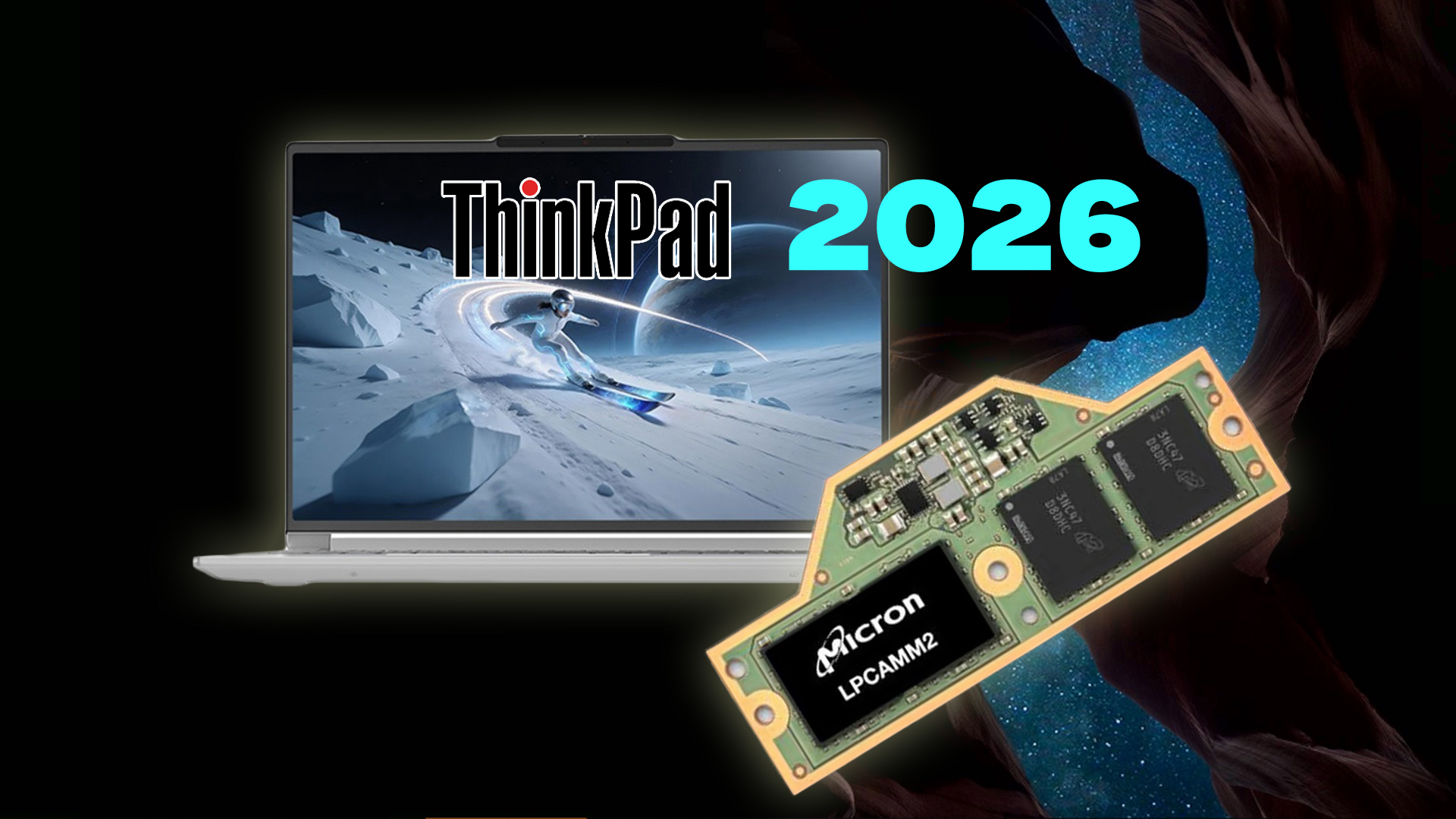
Lenovo is pushing laptop memory design in a direction many users have been waiting for: faster LPDDR5X performance without being trapped by soldered, non-upgradable RAM. After LPCAMM2 first appeared in a workstation-class machine, it’s now making its way into a mainstream consumer laptop for the first time.
The company is introducing LPCAMM2 memory in its new ThinkBook 2026 lineup in China, starting with the ThinkBook 14+ and ThinkBook 16+. These models are expected to pair Intel’s latest Core Ultra Series 3 “Panther Lake” Core Ultra 300H processors with LPCAMM2-based LPDDR5X running at up to 8533 MT/s. While Lenovo hasn’t confirmed every configuration yet, expectations based on last year’s lineup suggest options could include chips like the Core Ultra 5 338H and higher-tier Core Ultra 300H variants.
What makes this launch especially important is the memory itself. LPCAMM2 is designed to replace soldered LPDDR5X found in many thin-and-light laptops—maintaining the speed and efficiency benefits of LPDDR5X, while restoring the ability to upgrade. Instead of being permanently attached to the motherboard, LPCAMM2 modules can be installed and removed in a way that’s much closer to traditional removable laptop memory. That means buyers may no longer have to decide at checkout how much RAM they’ll need for the next five years.
There’s also a clear performance advantage. Compared with typical SO-DIMM memory used in many mainstream laptops—such as 5600 MT/s modules found in the ThinkBook 2025 series—the ThinkBook 2026 models are set to ship with substantially higher memory bandwidth thanks to LPDDR5X-8533. Combined with the new processors and their upgraded integrated graphics based on Intel’s Xe3 architecture, this should translate to smoother multitasking, faster content creation workflows, and better integrated-GPU performance in everyday workloads.
Upgradability always comes with trade-offs, and pricing could be one of them. LPCAMM2 is still new, likely more expensive than common laptop memory options, and availability could be affected by broader memory supply conditions. As a result, ThinkBook 2026 models equipped with LPCAMM2 may cost more than previous generations, especially in higher-capacity configurations.
Lenovo is also expected to improve storage flexibility. The ThinkBook 2026 series is said to offer dual M.2 2280 slots, supporting up to 8 TB total storage (4 TB + 4 TB). For users who keep large project files locally—such as video editors, developers, or anyone managing big photo libraries—this is a practical upgrade and a strong complement to the new memory approach.
If this rollout expands beyond China and other manufacturers follow suit, LPCAMM2 could mark the beginning of a meaningful shift in mainstream laptops: thinner designs and high-speed LPDDR5X performance without sacrificing the freedom to upgrade later.