You might not need a brand-new Radeon RX 9000 to experience AMD’s next-gen upscaling. Thanks to a mistakenly released set of FSR 4 INT8 model files, PC gamers are unofficially getting FSR 4 running on Windows with RDNA 3, RDNA 2, and even GeForce RTX 30 series cards—and the image quality jump over FSR 3.1 is turning heads.
Here’s the backdrop. FSR 4 is AMD’s latest upscaler, promising noticeably cleaner detail and reduced shimmering versus FSR 3.1. Officially, it’s limited to RDNA 4 GPUs through the newest Adrenalin update. That restriction exists for good reason: RDNA 3 lacks native FP8 acceleration, which FSR 4 is designed to use, leading to potential performance regressions. On Linux, tinkerers have already forced FSR 4 to run by emulating FP8 via FP16, but Windows owners were out of luck—until the community noticed that the open-source FidelityFX SDK briefly contained INT8 model files.
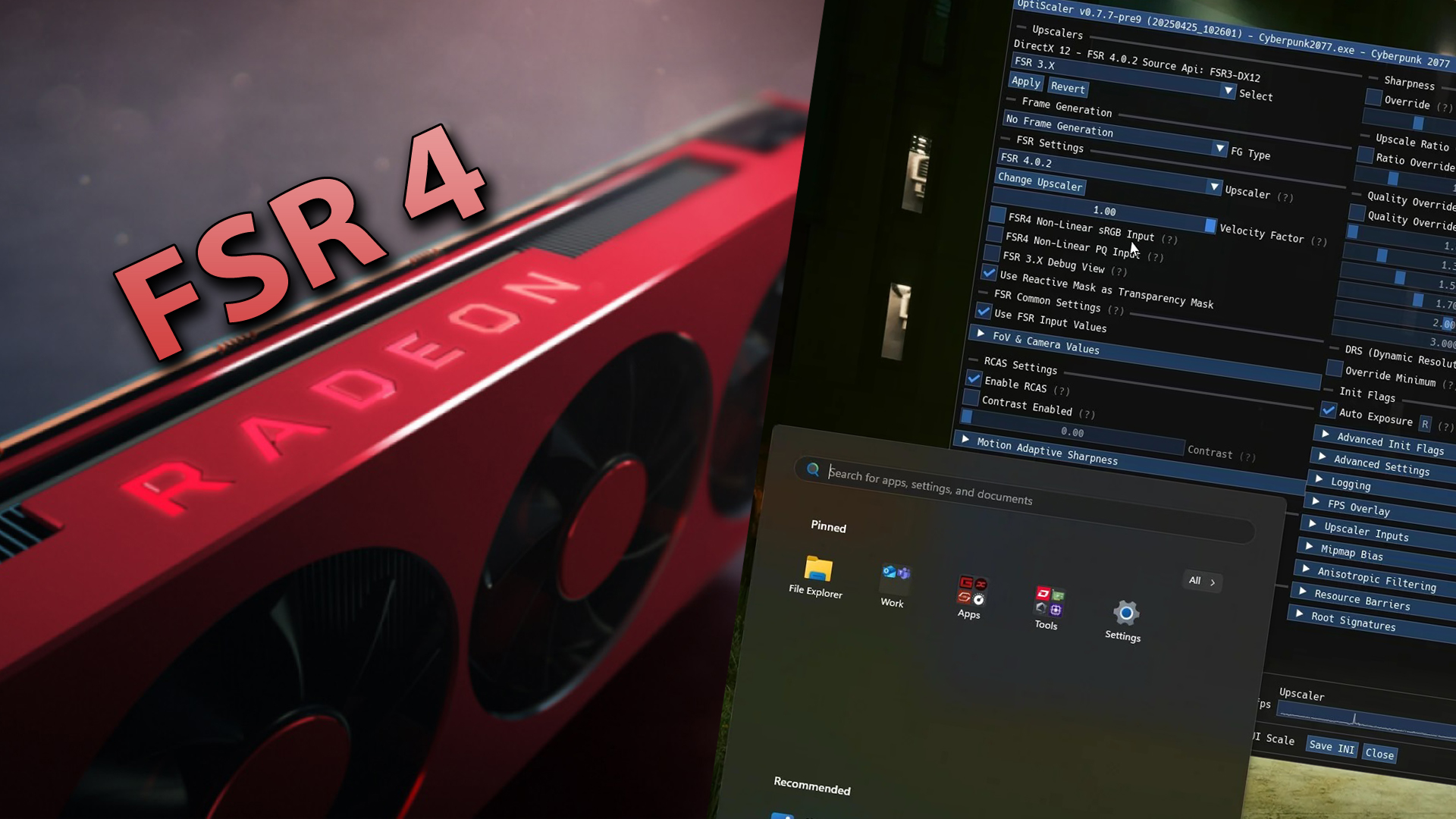
Those INT8 assets can run on older architectures. A community build of the FSR 4 DLL using the INT8 path is now being swapped in for FSR 3.1 in supported games through a third-party upscaler injector on Windows. Early testers report it works on RDNA 3 and RDNA 2, and some are even seeing success on RTX 30 series. The headline: image quality is substantially better than FSR 3.1, especially in foliage, fine patterns, and sub-pixel detail where shimmer and crawling were common.
One example making the rounds shows Cyberpunk 2077 at 1440p with max settings and ray tracing on a Radeon RX 7900 XTX. The user reports eliminating grass shimmer while only losing about 6–7 fps versus FSR 3.1. Another tester cited frame processing time increasing from roughly 0.4 ms to about 1.2 ms, which aligns with the idea that the new model is heavier on older hardware. Even so, many say the Balanced preset can claw back most of the lost frames while still looking cleaner than FSR 3.1 Quality.
Important caveats:
– This is not an official Windows release for older GPUs. Expect variability in performance, stability, and compatibility.
– The INT8 path increases frame processing overhead, so lower framerates versus FSR 3.1 are likely, even if the visual upgrade is clear.
– Tools that inject or replace DLLs typically apply to single-player games. Using them in multiplayer can trip anti-cheat or violate terms.
– There’s no guarantee AMD will extend official FSR 4 support to previous generations, and future driver or game updates could break these workarounds.
What this experiment proves is that FSR 4’s new model can offer a visible, real-world boost in clarity beyond FSR 3.1, even without RDNA 4. For players with RDNA 3, RDNA 2, or RTX 30 hardware who prioritize image quality over a handful of frames, the unofficial Windows path is promising. For everyone else, keep an eye on driver releases and game updates—if the demand stays this strong, broader support may eventually follow.


