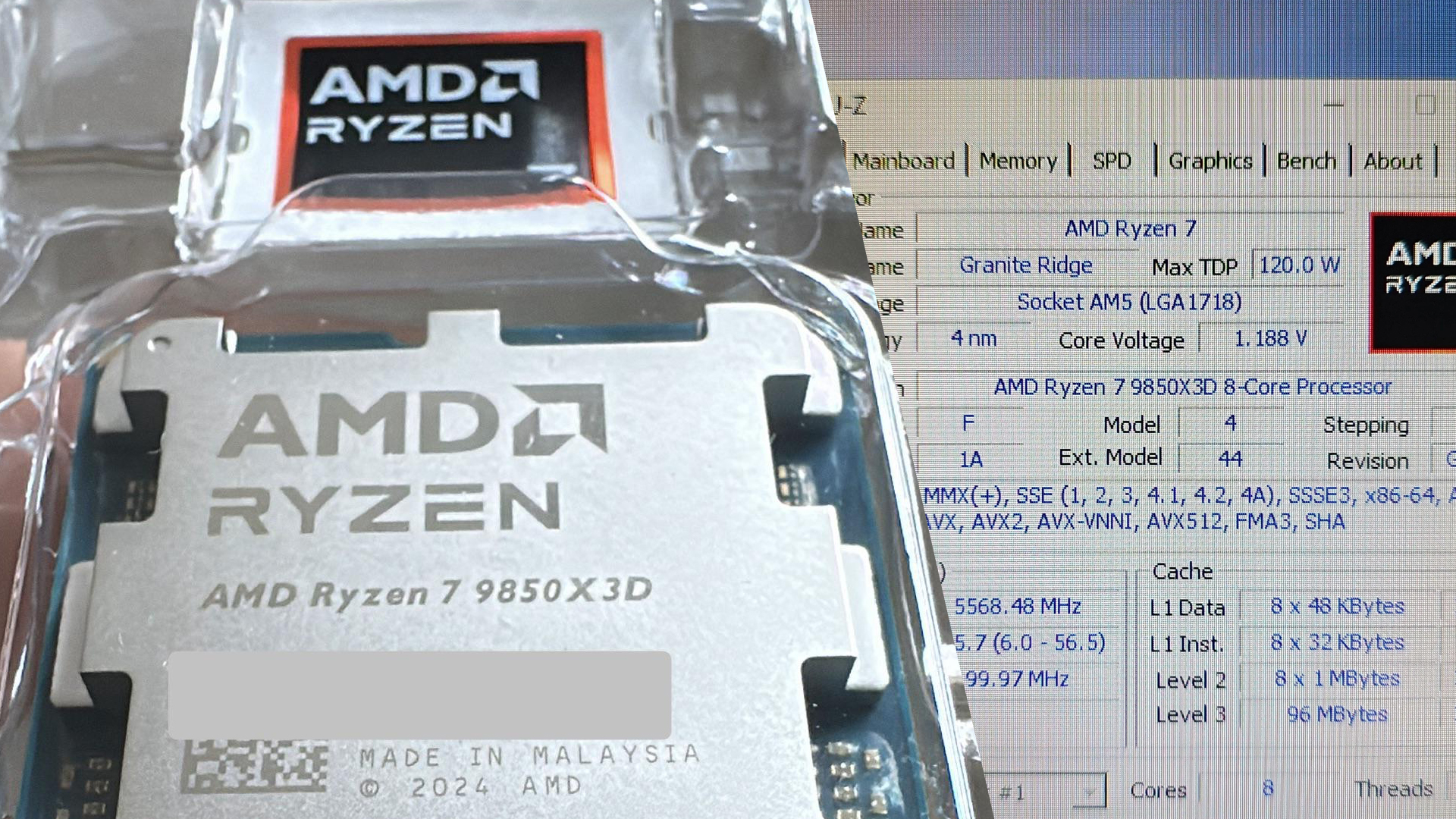
Early real-world testing of AMD’s upcoming Ryzen 7 9850X3D is starting to appear online, and the first results suggest buyers shouldn’t expect miracles from clock speed bumps alone—at least not until newer BIOS updates arrive.
The Ryzen 7 9850X3D is set to launch on January 29 with an official price of $499, but a few enthusiasts have already managed to buy one through retailers and resellers. In one case, a user reported paying around $570 and immediately began running benchmarks to see how the new X3D chip performs before the full wave of reviews lands.
One of the biggest takeaways so far is that early motherboard firmware may be holding the processor back. The user said they relied on a recent MSI BIOS (released in December 2025) to get past initial compatibility issues, which highlights a common reality with brand-new CPU launches: early adopters often depend heavily on BIOS maturity for stability, boosting behavior, and performance tuning.
In Cinebench 2026 testing, the same user reported a single-thread score of 568 points on stock settings with Precision Boost Overdrive (PBO) enabled. Interestingly, that number lines up with what many see from the Ryzen 7 9800X3D, suggesting the 9850X3D may deliver similar single-threaded performance in this specific benchmark—at least on the early firmware currently available. Other scores like multi-thread results weren’t provided, but based on what’s been shared so far, major jumps aren’t guaranteed in every workload.
Another early owner shared additional observations while using an MSI MPG X870E Carbon WiFi motherboard with an AGESA PI pre-1.3.0.0 BIOS. Despite efforts to tune performance, the user said they couldn’t sustain a 5.7 GHz boost across all cores. Since this AGESA version is described as supporting newer Ryzen chips without guaranteeing full stability, it may be limiting how consistently the CPU boosts under certain conditions. Separately, there has been at least one report of someone hitting 5.75 GHz on all cores, but without detailed settings, it’s hard to know how repeatable that result is.
Gaming numbers are also starting to circulate. In Counter-Strike 2, one user reported 900+ average FPS when pairing the Ryzen 7 9850X3D with an NVIDIA GeForce RTX 5090. Those are eye-catching results, but they’re also in the realm of what’s already achievable with other recent X3D chips like the Ryzen 7 9800X3D and 7800X3D in extremely high-FPS esports scenarios. In other words, it’s impressive, but not yet definitive proof of a meaningful generational leap—especially since ultra-high frame rates can be heavily influenced by game settings, map/test conditions, memory tuning, and BIOS behavior.
The most important theme in these early Ryzen 7 9850X3D benchmarks is that pre-launch testing can look “unfinished” until motherboard makers release additional BIOS updates with better microcode optimizations. A slight boost clock increase doesn’t automatically translate into stronger performance everywhere, and X3D chips in particular can be sensitive to firmware and tuning.
More clarity should arrive once pre-release BIOS versions mature and broader benchmarking becomes available closer to launch.