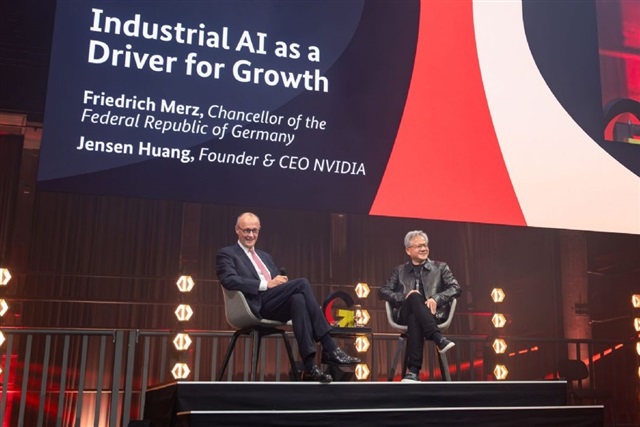
Germany’s AI Moment: Friedrich Merz and Jensen Huang Push Industry Toward a Smarter Future
German Chancellor Friedrich Merz and Nvidia CEO Jensen Huang delivered a clear message to business leaders at an industry summit in Berlin on October 19: Germany must move faster on artificial intelligence if it wants to strengthen its economy and remain a global industrial powerhouse.
The discussion focused on how AI can help modernize German industry, especially in sectors where the country already holds deep expertise, including automotive manufacturing, industrial machinery, engineering, and advanced production systems. For Germany, the opportunity is not only about adopting new software tools, but about transforming factories, supply chains, and machines into smarter, more efficient systems.
Huang highlighted the importance of “physical AI,” a term that refers to artificial intelligence systems designed to interact with the real world. Unlike AI used mainly for text, images, or data analysis, physical AI can support robotics, autonomous machines, smart factory equipment, digital twins, and intelligent manufacturing processes.
Germany, with its strong automotive sector and world-class industrial machinery base, is seen as well positioned to benefit from this next wave of AI innovation. The country has decades of manufacturing knowledge, high-quality engineering talent, and massive amounts of industrial data. According to Huang’s message, these assets could become a powerful foundation for building AI-driven factories and next-generation production systems.
For German automakers, physical AI could help speed up vehicle development, improve factory automation, optimize quality control, and support the transition toward electric and autonomous vehicles. In industrial machinery, AI-powered systems could make equipment more adaptive, predictive, and efficient, helping companies reduce downtime and increase productivity.
Merz’s presence at the summit underscored the political importance of AI adoption in Germany. The country has faced economic pressure in recent years, with concerns over slower growth, rising global competition, energy costs, and the need to modernize traditional industries. By encouraging businesses to invest in AI, German leaders hope to boost innovation, improve competitiveness, and create new opportunities across the economy.
The call to action is especially relevant for Germany’s famous “Mittelstand” companies, the small and medium-sized manufacturers that form the backbone of the country’s economy. Many of these firms have specialized technical knowledge and valuable production data, but they may need greater support, investment, and infrastructure to fully benefit from AI technologies.
The Berlin summit made one point clear: artificial intelligence is no longer a distant trend. It is becoming a central part of industrial strategy. For Germany, the challenge is to turn its engineering heritage into an AI-powered advantage.
If German companies can combine their manufacturing experience with advanced AI systems, the country could play a leading role in the future of smart factories, robotics, automotive innovation, and industrial automation. The message from Merz and Huang was direct: Germany has the tools, talent, and data to lead in physical AI, but it must act now.