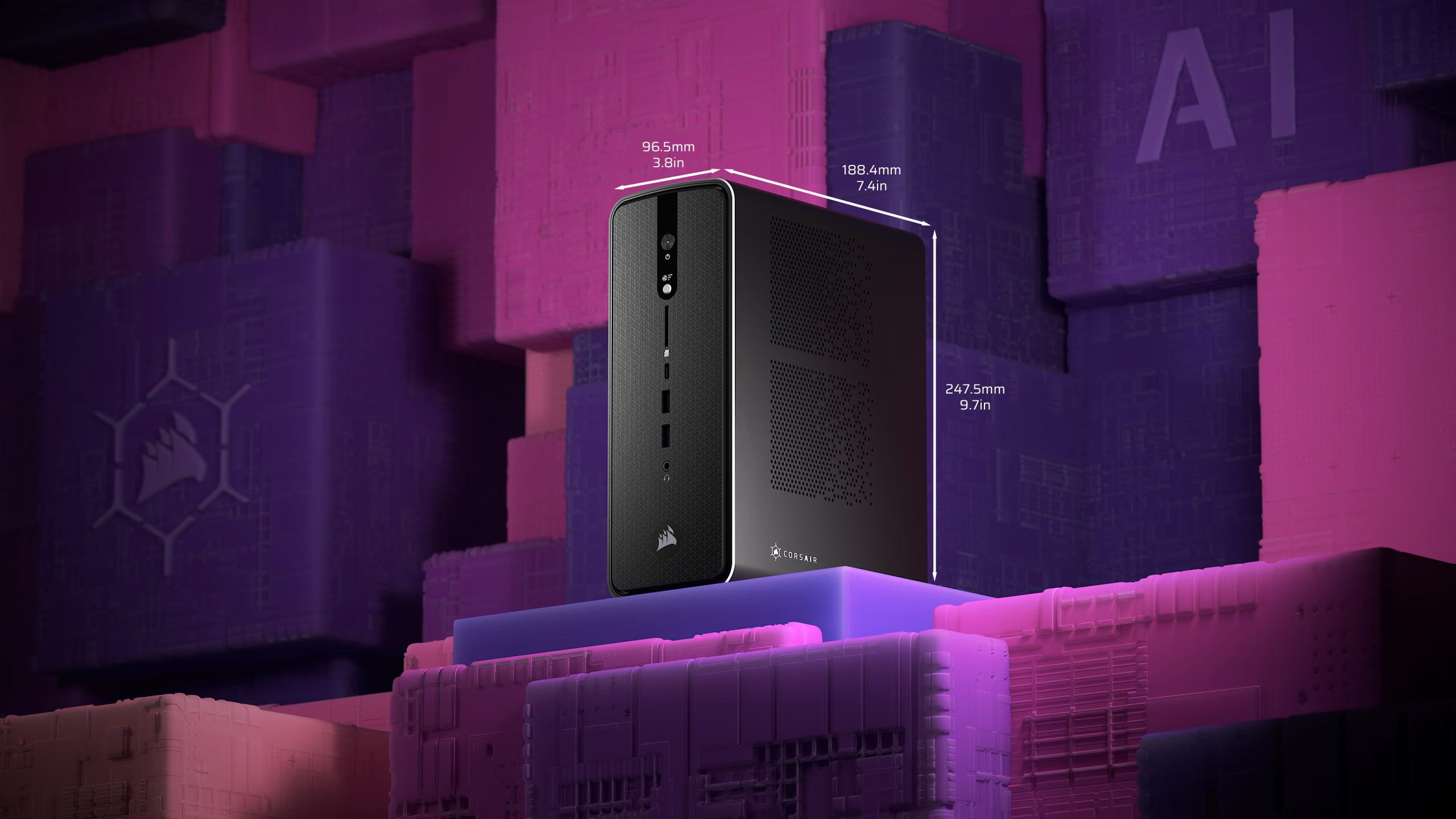
Today brings exciting news in the world of mini PCs, as two major players, CORSAIR and SIXUNITED, have both launched their sleek AI workstation mini PCs based on the cutting-edge Ryzen Strix Halo APUs. Interestingly, these machines share an identical chassis design, hinting at a shared source for the case.
AMD has just released its latest Adrenalin Edition Preview Driver, expanding support for 128B parameters and highlighting various manufacturers offering Strix Halo-based AI systems. Among these are CORSAIR, HP, ASUS, and Framework.
On its official site, CORSAIR quietly introduced its first AI Workstation PC: the CORSAIR AI Workstation 300 mini PC. This powerhouse is equipped with Zen 5-based Strix Halo APUs, offering options like the Ryzen AI Max 385 with an 8-core/16-thread setup and the Radeon 8050S iGPU, or the flagship Ryzen AI Max+ 395, featuring a 16-core/32-thread processor and the advanced RDNA 3.5-based Radeon 8060S iGPU.
The AI Workstation 300 packs a punch with up to 128 GB of LPDDR5X memory, operating at a rapid 8000 MT/s, and includes dual NVMe SSD slots. A robust 350W Flex ATX power supply ensures this workstation is ready to tackle substantial AI workloads right out of the box.
Meanwhile, SIXUNITED, a Chinese manufacturer, unveiled its own AI workstation mini PC, the XB35-H02/03-BQ, mirroring CORSAIR’s design. This suggests both companies may have sourced their cases from the same provider. The XB35 comes in two configurations: the H02, which includes the Ryzen AI Max+ 395 with the Radeon 8060S, and the 03-BQ, which adds a dedicated Radeon RX 7600 XT graphics card with a TDP of up to 175W. Both versions support dual SSDs, offering memory options in LPDDR5 and 2x DDR5 SO-DIMM.
Though branding differs, a side-by-side comparison reveals identical port arrangements and connectivity features. While SIXUNITED has yet to reveal pricing, CORSAIR’s AI Workstation 300 starts at $1599 for the Ryzen AI Max 385 with 64 GB LPDDR5X and a 1 TB configuration. Opting for the Ryzen AI Max+ 395 version with 128 GB memory raises the cost to $1999, and maxing out SSD storage to a 2+2 TB setup reaches $2299.