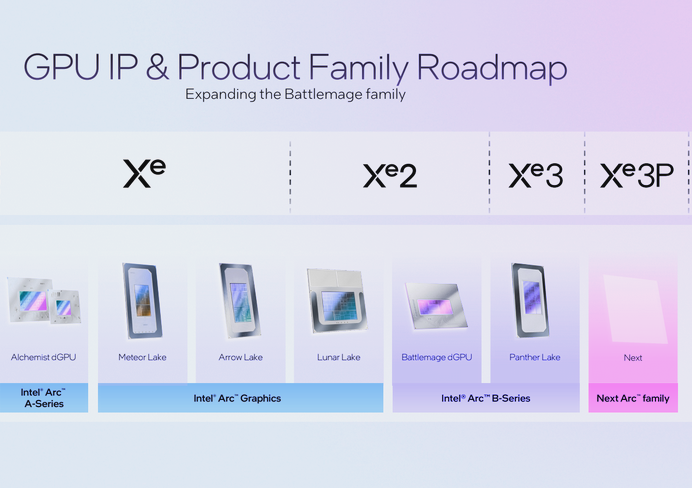
Intel’s next wave of integrated graphics for Panther Lake is starting to take shape, thanks to fresh leaks outlining four Arc B-branded iGPUs and where they’re likely to land across upcoming Core Ultra chips.
Here’s what the leaked lineup looks like:
– Arc B390: 12 EUs, up to 2.5 GHz boost
– Arc B380: 12 EUs, up to 2.3 GHz boost
– Arc B370: 10 EUs, up to 2.4 GHz boost
– Arc B360: 10 EUs, up to 2.2 GHz boost
Positioning and expected placement:
– Arc B390 is said to power Core Ultra 9 and Core Ultra 7 models.
– Arc B370 is expected on Core Ultra 5 SKUs.
– Arc B380 and Arc B360 are tipped to appear in other product tiers, suggesting they won’t be exclusive to Panther Lake.
These details follow earlier benchmark database sightings that first exposed B390 and B370. The incremental EU counts and clock speeds imply a measured refresh aimed at balancing graphics performance with efficiency, a sensible move for thin-and-light laptops and mainstream notebooks. While raw EU numbers don’t tell the full story, the clock ceilings suggest the B390 could deliver the best iGPU experience of the bunch for casual gaming, media workloads, and GPU-accelerated tasks.
On the desktop side, a separate listing points to an Arrow Lake “Plus” refresh arriving soon, likely retaining the familiar Arc Xe-LPG iGPU architecture rather than introducing a new design.
One lingering question is what happens at the high end of mobile. There’s still no clear word on HX-branded laptop CPUs. If those appear, they may reuse Arrow Lake laptop silicon, with B380 or B360-class graphics as plausible fits, but that remains speculative until official announcements.
What to watch next:
– Official Intel confirmation of Arc B390/B380/B370/B360 specs and their Core Ultra pairings
– Real-world benchmarks to clarify performance gaps between 12-EU and 10-EU parts at their listed boost clocks
– Power efficiency and media engine improvements that could matter more than peak frequency in everyday use
If the leaks hold, Panther Lake laptops should offer a tidy refresh to integrated graphics—nothing radical, but potentially smoother visuals, better media handling, and a more predictable stack across Core Ultra 5, 7, and 9 tiers.


