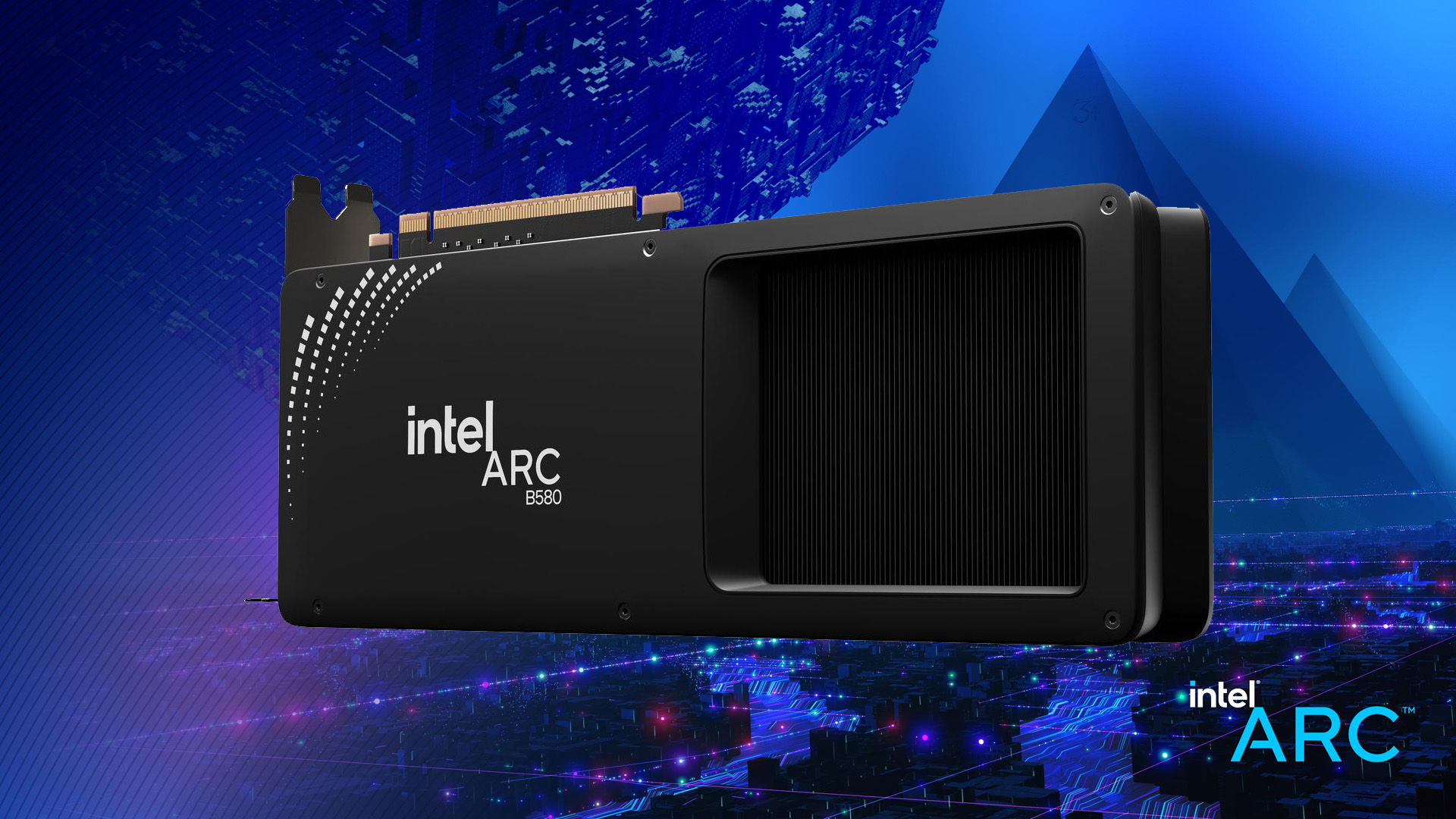
Intel may be preparing to shift its Battlemage GPU strategy away from budget gaming cards and toward more profitable professional and AI-focused products, according to a new rumor circulating in the PC hardware community.
The biggest question surrounds the Intel Arc B580, currently the fastest gaming graphics card in Intel’s Battlemage lineup. The card launched as a compelling option for budget-conscious gamers, offering 12 GB of VRAM at a $249 starting price. That made it one of the most attractive GPUs under $300, especially for players looking for more memory without spending mid-range money.
However, the Arc B580 has become difficult to find at major retailers, leading to speculation that Intel may be redirecting its BMG-G21 GPU supply toward products with higher profit margins. The same chip is also used in Intel’s professional graphics cards, including models aimed at workstation, AI inference, and creator workloads.
A hardware leaker has claimed that Intel might discontinue the Arc B580 in order to focus more heavily on Arc Pro products such as the Arc Pro B50 and Arc Pro B60. These professional GPUs are designed for business, AI, and workstation use, and they typically sell at much higher prices than consumer gaming cards. While this claim has not been confirmed by Intel, the idea is not far-fetched given current market conditions.
Professional GPUs based on the BMG-G21 chip can command stronger margins, especially as demand for AI hardware continues to rise. Higher VRAM capacities also make cards like the Arc Pro B50 and Arc Pro B60 more attractive for inference tasks, productivity applications, and professional graphics workloads. With memory prices climbing and AI demand putting pressure on supply chains, Intel may see more financial upside in prioritizing workstation products over low-cost gaming cards.
If the Arc B580 is discontinued, it would be a disappointing development for gamers. The card occupies a rare position in the market as an affordable GPU with 12 GB of memory, a specification that has become increasingly important as modern games demand more VRAM. At under $300, there are very few options that offer the same memory capacity and feature set.
That said, the Arc B580 has not been a major force in the graphics card market. Intel’s discrete GPU business still holds a relatively small share compared with its larger rivals, and the Battlemage lineup currently includes only a limited number of gaming-focused products. Removing the Arc B580 would leave Intel with an even smaller consumer GPU presence, but it may not create the same level of backlash that would follow the disappearance of a more widely adopted graphics card.
For now, this remains a rumor. Intel has not announced an end-of-life plan for the Arc B580, and there is no official confirmation that production is being reduced or halted. Poor availability alone does not prove discontinuation, but it does raise questions about Intel’s priorities for the BMG-G21 chip.
If Intel does decide to focus on Arc Pro and AI-oriented GPUs, the move would reflect a broader trend across the graphics industry. Companies are increasingly chasing demand from AI, data processing, and professional computing markets, where customers are often willing to pay more for hardware. Unfortunately for gamers, that can sometimes mean fewer affordable consumer graphics cards on store shelves.
The Arc B580 remains one of the more interesting budget GPUs Intel has released so far. Its possible disappearance would narrow the choices for PC builders looking for a low-cost graphics card with generous VRAM. Until Intel provides an official update, buyers interested in the Arc B580 may want to keep a close eye on availability while stock still appears at retailers.


