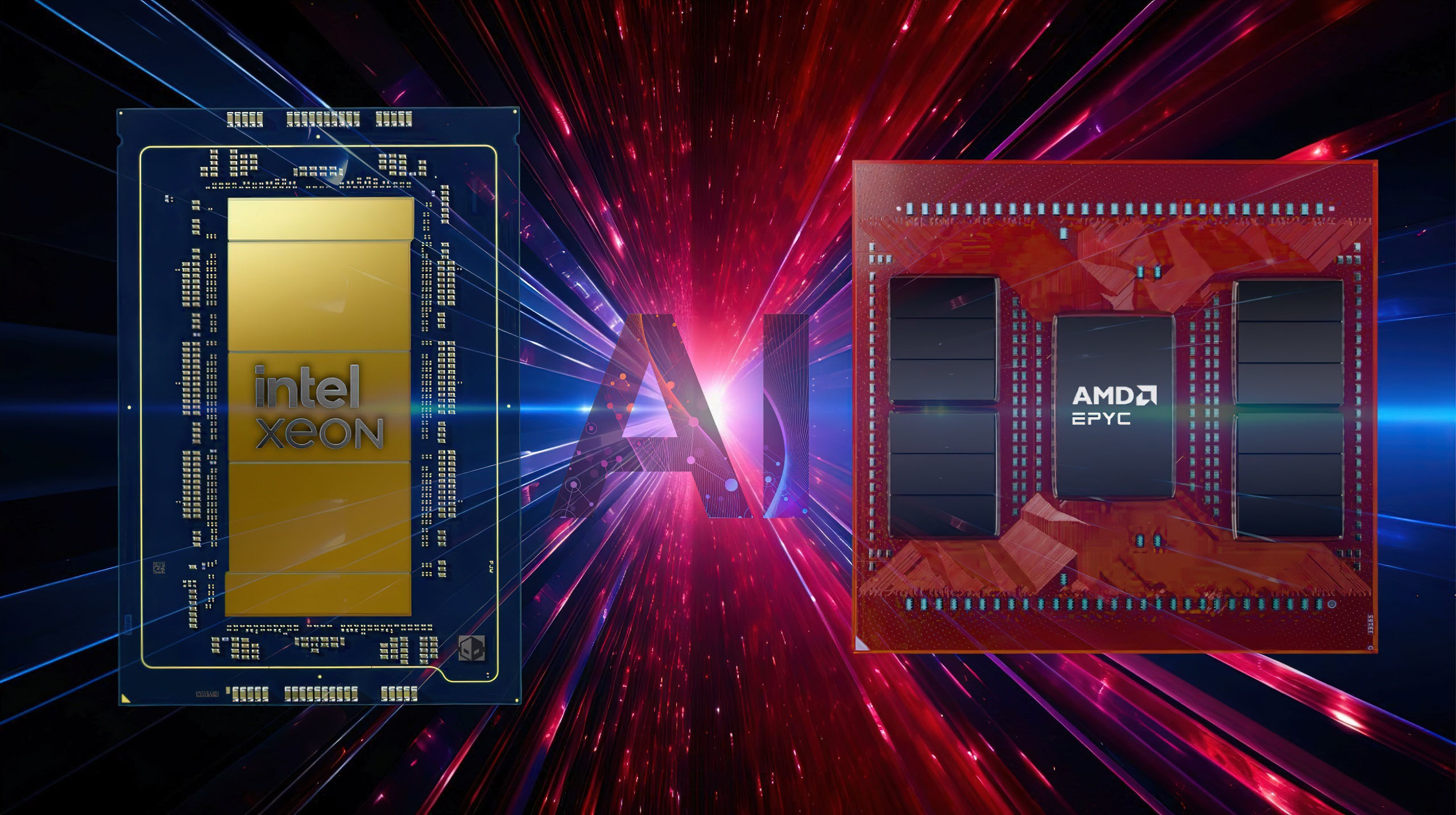
In the competitive world of AI and data center performance, the latest developments from Intel and AMD have sparked discussions and comparisons between their respective 5th generation CPUs. Reports suggest that, with the right software optimizations, Intel’s 5th Gen Xeon processors can outpace AMD’s 5th Gen EPYC Turin CPUs in AI performance benchmarks.
During a recent announcement, AMD showcased its 5th Gen EPYC CPU family, powered by the new Zen 5 core architecture, and presented comparative data suggesting superior AI throughput performance against Intel’s 5th Gen Xeon family. The demonstration particularly highlighted results from the Llano2-7B Chatbot AI workload, with AMD EPYC processors displaying significantly higher throughput when compared to Intel Xeon.
However, a response from Intel has brought a different perspective to light. According to the company, AMD’s benchmarks did not incorporate specific software optimizations critical for maximizing Xeon’s AI performance capabilities. With the correct implementation of these optimizations, Intel argues that their 5th Gen Emerald Rapids Xeon CPUs can deliver performance that not only matches but exceeds that of the 5th Gen EPYC processors.
One key aspect disclosed by Intel is the use of the Intel Extension for PyTorch in new benchmarks, which revealed a significant increase in performance. Intel’s metrics showed that their updated software suite helped their CPUs achieve a performance level that was 5.4 times higher than previously recorded by AMD. This was attributed not only to software enhancements but also to specialized AI hardware accelerators integrated within Intel’s CPUs.
As the battle between the two tech giants continues, it has been highlighted that these performance metrics are greatly influenced by the memory configurations of the processors. AMD’s EPYC Turin is set to introduce a 12-channel DDR5 interface, while Intel’s next-generation Xeon CPUs will feature the same 12-channel memory interface and will match up to 128 cores, with additional efficiency cores on certain models.
The intense competition isn’t just a matter of one-upmanship; it reflects the larger trend of increasing reliance on and demand for AI within the technology industry. Companies like AMD, Intel, Qualcomm, and NVIDIA are all pushing the envelope to attract a burgeoning customer base that requires robust, AI-capable hardware.
In conclusion, these updates from Intel suggest that while AMD’s 5th Gen EPYC CPUs are certainly formidable, the use of proper software optimizations can significantly impact performance outcomes, potentially giving Intel’s 5th Gen Xeon processors the edge in AI workloads. As the AI sector’s demands evolve, the ability of processors to scale with these needs while leveraging advances in software and hardware becomes increasingly essential.