Intel Pushes Silicon Photonics as the Future of AI and HPC Data Centers
Intel is laying out an ambitious roadmap for silicon photonics, a technology the company believes will play a major role in the next generation of AI, high-performance computing, and large-scale data center infrastructure.
During OCP 2026, Intel presented its vision for how optical interconnects could reshape modern computing systems. As artificial intelligence models continue to grow and data centers demand faster, more efficient communication between CPUs, GPUs, memory, and accelerators, traditional electrical links are starting to face serious limitations.
Intel believes silicon photonics is the answer.
Nic Dubé, Corporate Vice President of Data Center Systems and Solutions at Intel, described silicon photonics as the “Golden Hammer” for next-generation systems. According to Intel, the industry has discussed silicon photonics as a future standard for years, but the company now says it is working aggressively to turn that vision into a real, scalable platform within the next few years.
Why silicon photonics matters for AI and HPC
Today’s data center systems rely heavily on electrical interconnects, including copper-based links and other conventional fabrics. While these technologies have served the industry for decades, they are becoming increasingly difficult to scale for modern AI workloads.
The biggest challenges are reach, bandwidth density, and energy efficiency. As systems become larger and more complex, moving data across racks, pods, and full data center clusters requires more bandwidth while consuming less power. Electrical links are reaching practical limits in how far they can transmit data efficiently, how much bandwidth they can provide at the edge of a package, and how much energy they require per bit transferred.
Silicon photonics addresses these issues by using light to move data instead of relying only on electrical signaling. This can allow for longer reach, higher bandwidth, and lower power consumption, all of which are essential for future AI infrastructure and high-performance computing systems.
Intel says it has a manufacturing advantage
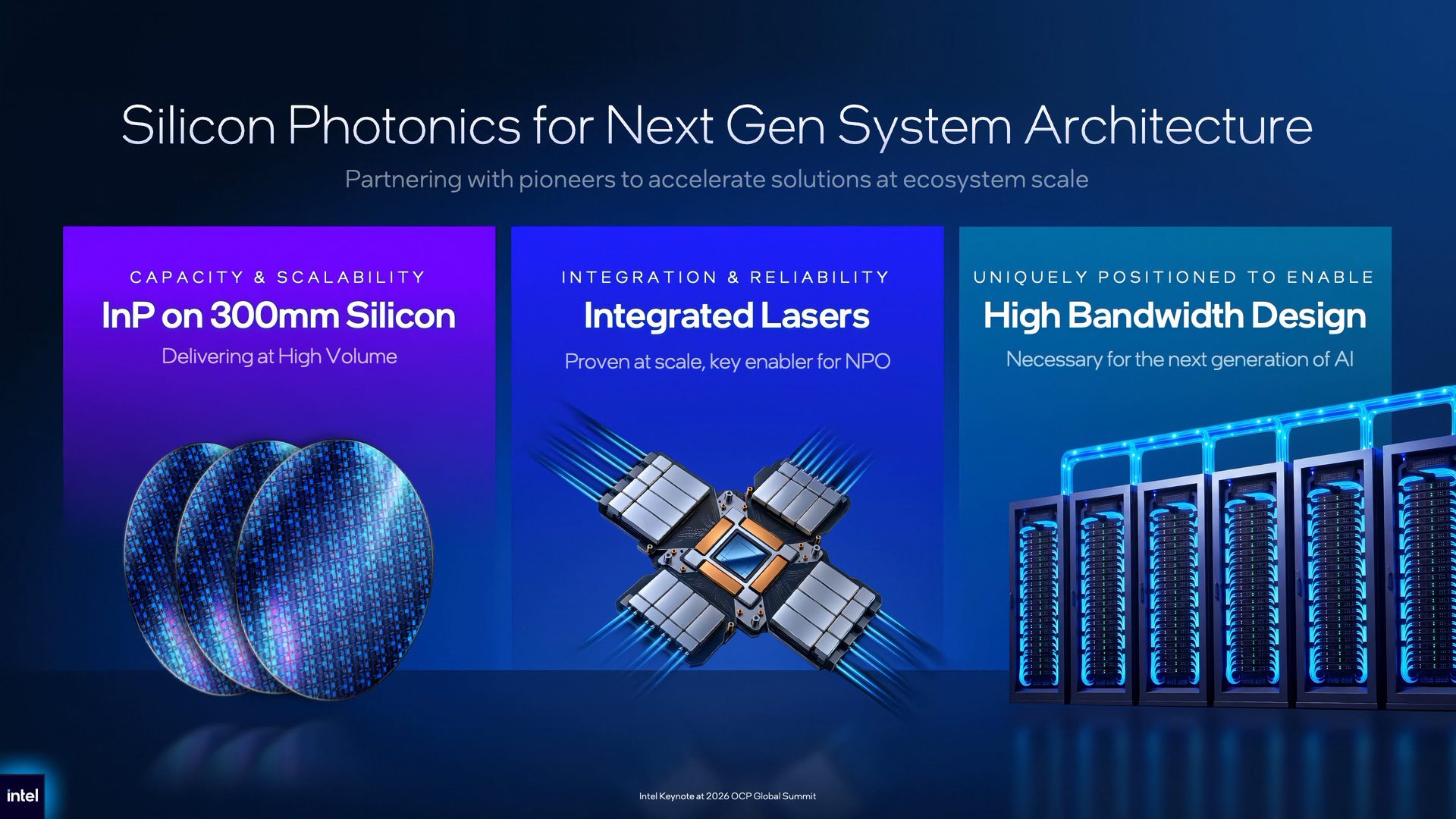
One of Intel’s key claims is that it is uniquely positioned to produce silicon photonics at industry scale. The company says it is the only high-volume fab capable of delivering 300mm indium phosphide silicon photonics for the broader market.
That matters because 300mm wafer production is critical for scaling advanced semiconductor technologies. Intel says these wafers will support the next wave of near-package optics and co-packaged optics, both of which are expected to become important in AI and HPC systems.
Near-package optics, often referred to as NPO, bring optical connections closer to the processor package. Co-packaged optics, or CPO, integrate optical interconnects even more tightly with computing silicon. Both approaches are designed to improve bandwidth density and reduce the power required to move data between components.
For AI clusters that rely on massive numbers of GPUs and accelerators, this kind of improvement could be significant.
Integrated lasers could simplify optical systems
Intel also highlighted its work on integrated laser technology. In optical communication systems, the light source is one of the most important components. By integrating reliable laser sources directly into silicon photonics platforms, Intel aims to simplify deployment and reduce maintenance needs.
The company says integrated lasers can help create optical systems that do not require frequent servicing. That is especially important in data centers, where reliability, uptime, and operational simplicity are major priorities.
Intel also plans to support external light source standards. The company says this could help create a broader supply ecosystem for multi-wavelength light sources, giving the industry more flexibility as silicon photonics adoption grows.
Beyond bandwidth: a new system architecture
Intel is not presenting silicon photonics as just a faster cable replacement. Instead, the company sees it as part of a broader shift in system architecture.
As AI models become larger, systems will need more flexible ways to share resources across different types of processors, graphics chips, accelerators, and memory pools. Intel says silicon photonics can help enable advanced interconnect topologies where resources are coordinated dynamically at runtime.
In practical terms, this could allow future data centers to allocate computing and memory resources more efficiently, depending on workload demand. Instead of being locked into rigid system designs, infrastructure could become more flexible and scalable.
That flexibility is becoming increasingly important as AI training and inference workloads continue to grow in size and complexity.
Lower energy per bit is a major goal
Power consumption is one of the biggest concerns in modern data centers. AI systems require enormous amounts of electricity, and a significant portion of that power is used to move data between chips, memory, servers, and racks.
Intel believes silicon photonics can dramatically reduce the energy required for data transmission. The company estimates that future photonics-based systems could push energy consumption below 5 picojoules per bit.
That target has been a long-standing goal in the industry. Reaching it at scale could help data centers increase performance without driving power consumption to unsustainable levels.
For cloud providers, AI companies, research institutions, and enterprise data centers, lower energy per bit could translate into better performance per watt, reduced operating costs, and improved system density.
A path toward more efficient AI infrastructure
Intel’s silicon photonics strategy is aimed at enabling a new class of high-performance systems. The company expects the technology to deliver higher bandwidth, longer reach, better energy efficiency, and greater flexibility across rack-scale, pod-scale, and full system-scale deployments.
If Intel can deliver 300mm indium phosphide silicon photonics at volume, along with reliable integrated lasers and ecosystem support, it could become a major player in the optical interconnect market for AI and HPC.
The demand is already clear. AI models are expanding rapidly, GPU clusters are becoming larger, and data movement is now one of the biggest bottlenecks in advanced computing. Faster processors alone are not enough. The industry also needs faster and more efficient ways to connect them.
Intel is betting that silicon photonics will become one of the foundational technologies behind the next era of data center performance. While many details still need to be proven in real-world deployments, the company’s message is clear: the future of AI infrastructure will depend not only on compute power, but also on how efficiently that compute power can communicate.