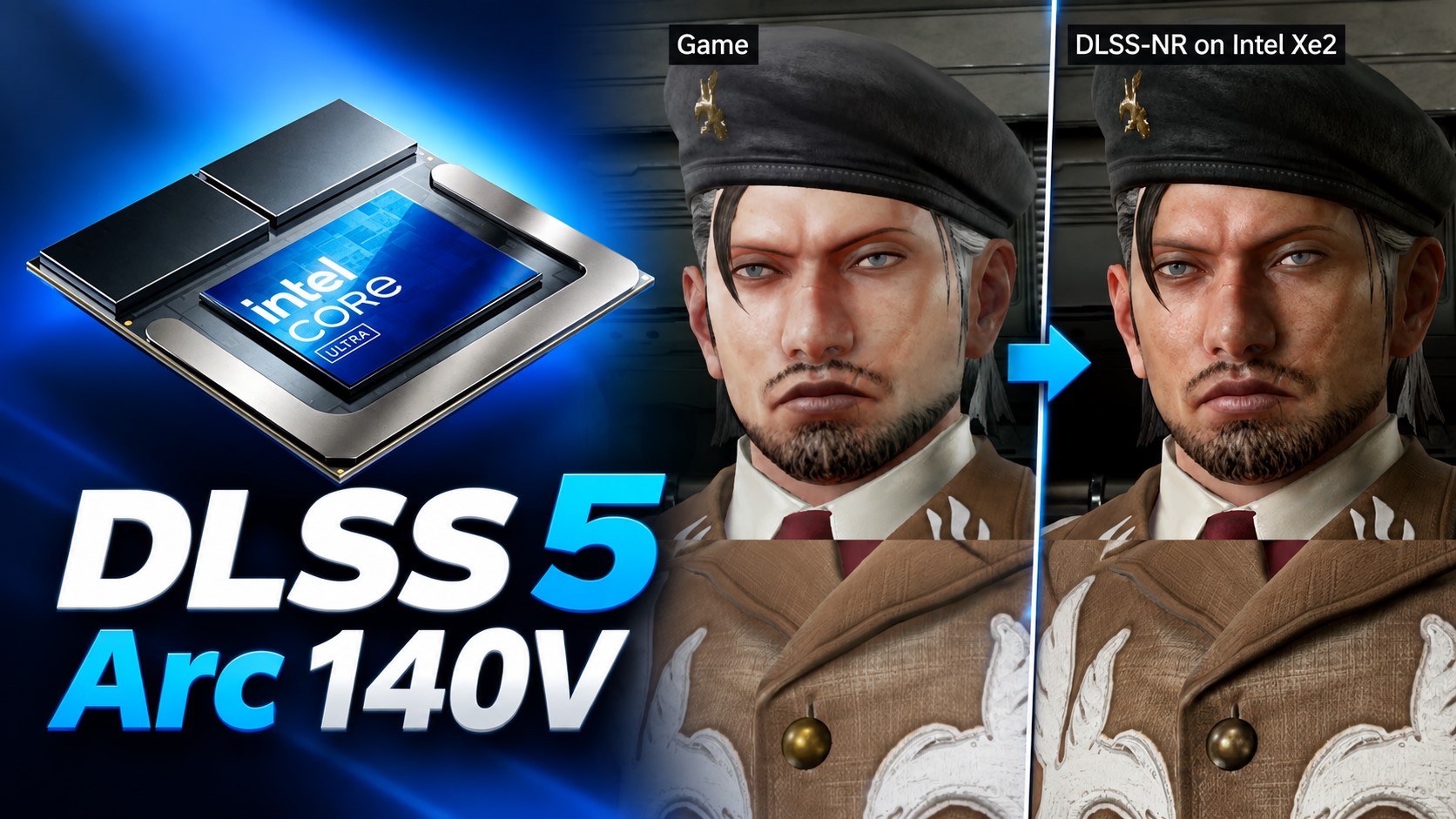
DLSS 5 Neural Rendering Runs on Intel Arc 140V iGPU in Unofficial Modding Breakthrough
Modders are moving fast, and the latest experiment shows just how far the PC graphics community is willing to push new rendering technology. After earlier efforts brought DLSS 5 Neural Rendering to older NVIDIA RTX graphics cards and AMD GPUs, a new project has now managed to get the technology running on Intel integrated graphics.
A Reddit user known as u/UzbekUnknown has successfully demonstrated DLSS 5 Neural Rendering on an Intel Core Ultra 7 256V processor, which features the Intel Arc 140V integrated GPU based on the Xe2 architecture. The project, called “dlss-nr-on-intel,” is designed specifically for Intel Lunar Lake chips and runs the neural rendering pipeline through a Vulkan layer on Linux.
What makes this especially interesting is that the implementation does not rely on NVIDIA’s CUDA, NGX, or proprietary execution libraries. Instead, the modder rebuilt the neural rendering pipeline to run on Intel’s XMX matrix engines, showing that the core idea behind DLSS-style neural rendering can be adapted to hardware far beyond its original ecosystem.
According to the project details, the implementation reconstructs the 71-block U-Net model used by DLSS Neural Rendering. It uses the Vulkan “VK_KHR_cooperative_matrix” extension and supports FP16 and FP32 accumulation. The mod works by hooking into “vkQueuePresentKHR,” allowing it to apply a neural rendering pass to applications that present frames through Vulkan.
The modder tested the project in several games, including Dead or Alive 5 Last Round, Tekken 7, and Mortal Kombat 1. The fact that it works at all on Intel integrated graphics is impressive, but performance is still far from practical.
On the Intel Arc 140V iGPU, the frame rate reportedly drops heavily. At 720p, games were running at only around 3 to 5 FPS. Dropping the resolution to 640 x 360 allowed Tekken 7 to reach around 10.5 FPS, but processing a 1920 x 1080 frame can take hundreds of milliseconds. That makes the current implementation more of a technical proof of concept than something gamers would realistically use today.
The memory requirements are also significant. The project needs roughly 2.3 GB of memory for device buffers at 720p, which is particularly important because the Arc 140V uses shared system memory rather than dedicated VRAM.
Still, this experiment is a major showcase of what is possible with modern GPU compute features. Intel’s XMX engines were built to accelerate AI and matrix workloads, and this project demonstrates that they can be used for complex neural rendering tasks when paired with the right software approach.
It is important to note that this is an unofficial implementation. Users interested in testing it would need to provide their own compatible DLSS files to extract the required model weights. It is not an official Intel or NVIDIA feature, and performance is currently too low for normal gameplay.
Even so, the achievement is significant. DLSS 5 Neural Rendering is a demanding technology, and seeing it run on an Intel Arc 140V integrated GPU highlights how quickly modders are expanding the boundaries of AI-driven graphics. While it may not be playable yet, this project suggests that neural rendering techniques could eventually become more flexible, more open, and more widely supported across different GPU architectures.


