Inside an Anker GaN Charger: A Rare Look at How Compact Fast Chargers Are Built
A recent teardown by YouTuber Zerobrain offers a fascinating look inside a failed Anker GaN charger, revealing just how much engineering is packed into today’s compact fast-charging devices. The charger in question features USB Power Delivery support, with two USB-C ports and one USB-A port, making it the kind of multi-port charging brick many people use daily for phones, tablets, earbuds, handheld gaming devices, and laptops.
GaN chargers, short for gallium nitride chargers, have become popular because they can deliver high power output in a much smaller body than traditional silicon-based chargers. They are efficient, compact, and convenient, but they also operate in a demanding environment. High power density means heat management, electrical isolation, and internal layout all become extremely important.
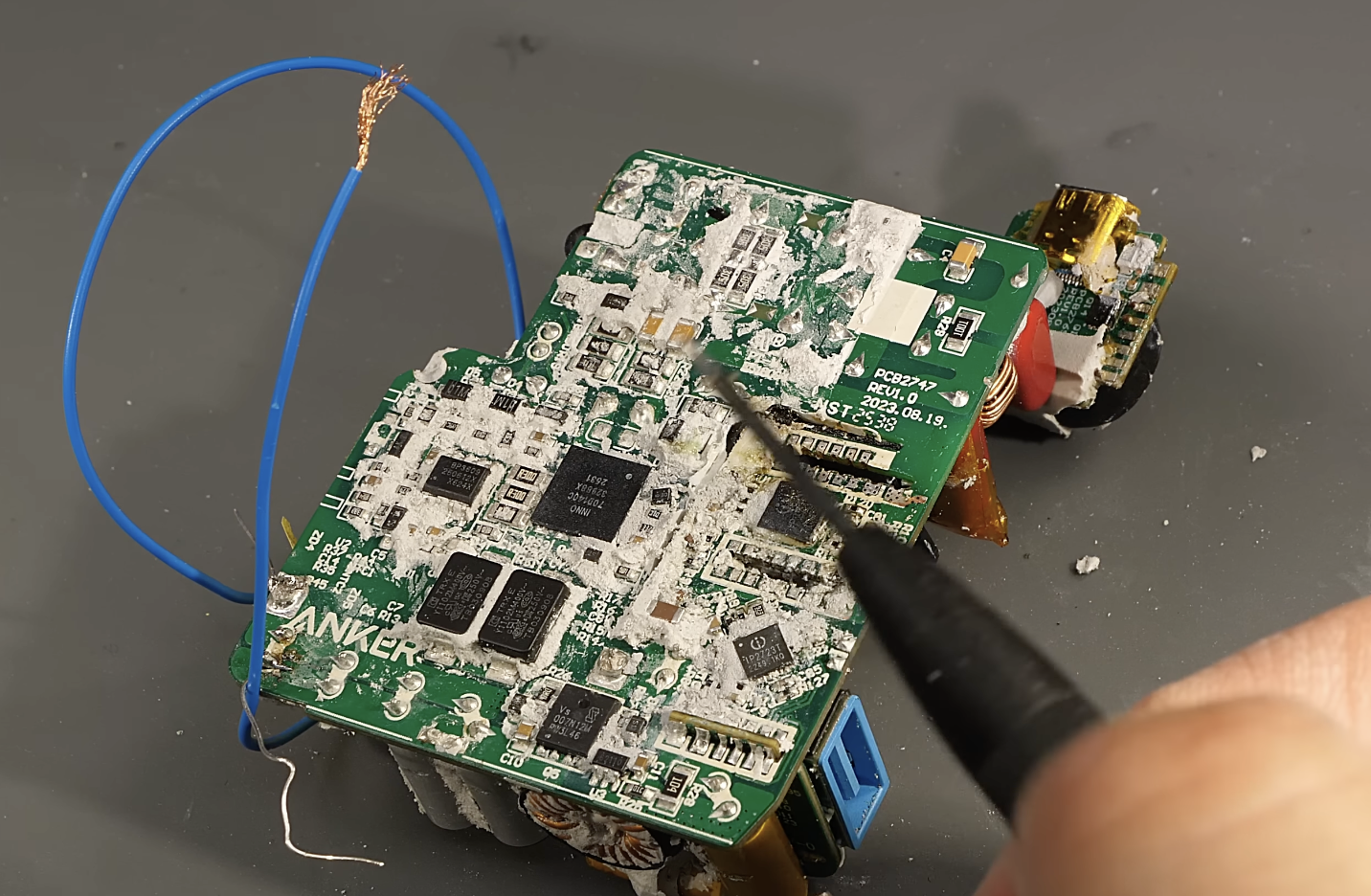
Zerobrain set out to investigate why this particular Anker charger had stopped working. While the exact cause of the failure could not be confirmed with complete certainty, the teardown still provides a rare and highly detailed view of the internal design. Modern chargers like this are not simple devices. Inside the small shell is a tightly packed arrangement of components, circuit boards, insulation, shielding, adhesives, and safety features.
One of the most striking details from the teardown is how dense the construction is. There is very little empty space inside the charger. Every millimeter appears to be used carefully, which helps explain how manufacturers are able to fit high-speed charging hardware into such small cases. However, that same compact design also makes repairs extremely difficult.
The internal components are heavily secured with glue and other materials. While this can be frustrating for anyone hoping to repair the charger, it serves an important purpose. Adhesives help keep parts from shifting due to vibration, drops, or long-term use. In a power adapter that handles mains voltage, keeping components fixed in place is critical. A loose part could create a dangerous situation if high-voltage sections were to come into contact with the low-voltage USB output side.
The teardown also highlights why opening a charger is not something most users should attempt. Even when unplugged, power adapters can retain dangerous residual voltage in internal capacitors. A charger may look harmless from the outside, but inside it contains circuitry connected to mains power. Without the right tools, experience, and safety precautions, disassembling one can be risky.
As Zerobrain works through the device, much of the circuit board becomes visible. The board itself appears to date from September 2023, suggesting that the charger is based on a slightly older design. That does not necessarily mean the product reached shelves at that exact time, since there is typically a delay between circuit board production, final assembly, distribution, and retail availability.
Despite the charger being defective, the teardown gives a positive impression of the engineering behind it. The layout shows attention to safety, separation between voltage zones, and mechanical stability. The design appears to prioritize reliability and protection, even if that means the charger is not repair-friendly.
This is a common trade-off in modern compact electronics. Consumers want smaller, lighter, more powerful accessories, especially when it comes to USB-C fast chargers. To achieve that, manufacturers rely on advanced materials like gallium nitride, dense circuit layouts, and tightly integrated construction. The result is a charger that is convenient to carry and capable of powering multiple devices, but difficult to service once something goes wrong.
For anyone interested in consumer electronics, the teardown is a reminder that even everyday accessories contain impressive engineering. A small GaN charger may seem simple from the outside, but inside it is a carefully designed power conversion system built to handle heat, voltage, efficiency, and safety in a very limited space.
While the exact failure point remains uncertain, the inside view of this Anker GaN charger is valuable on its own. It shows why these compact fast chargers are so capable, why they can run warm during use, and why repairing them is rarely practical. Most importantly, it underlines the importance of treating power adapters with care and replacing damaged or faulty chargers rather than attempting unsafe repairs at home.