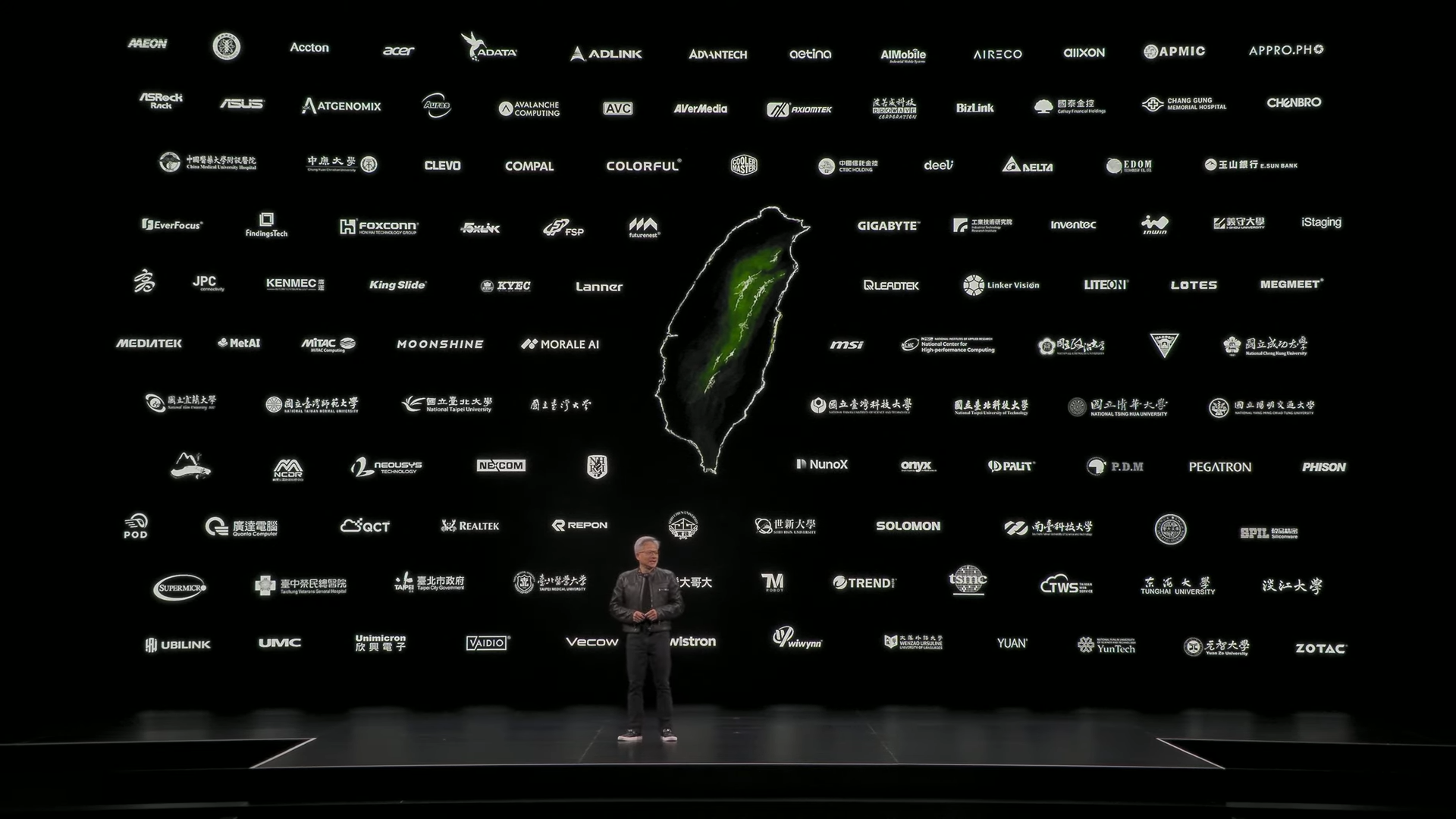
NVIDIA’s Made-in-America AI Chips Are Powered by a Global Team Effort Led by Taiwan’s Tech Giants
NVIDIA’s ambitious move to build its most advanced AI chips on U.S. soil is gaining momentum—and it’s not happening in isolation. While the company’s Blackwell generation represents a major leap in semiconductor design, the actual ability to manufacture these chips in America has been made possible by a tight network of Taiwanese partners and a tireless U.S. workforce.
Jensen Huang has been clear about it: this milestone rests on collaboration. In a recent interview, he credited companies like TSMC, Foxconn, Wistron, Amkor, and SPIL for helping bring the Blackwell platform from plan to production inside the United States. In under nine months, these partnerships enabled the ramp-up of what NVIDIA describes as the world’s most advanced AI chip—manufactured entirely in America, with Arizona as a key hub. The recognition also extends to the electricians, plumbers, mechanics, engineers, and construction teams who worked around the clock to get capacity online and into volume production.
The broader vision is equally compelling. If the U.S. is to become a global manufacturing center for next-generation computing, it needs not just fabs but a full ecosystem: advanced packaging, assembly, testing, and reliable supply chain logistics. That’s where Taiwan’s long-standing semiconductor leadership becomes indispensable.
TSMC has been central to this shift. Its rapid expansion in Arizona is helping transform America’s chip landscape from aspiration to reality, enabling the fabrication of highly complex wafers used in cutting-edge AI accelerators. Just as important, other Taiwanese tech leaders have followed suit with significant commitments. Foxconn and Wistron have announced multi-billion-dollar investments to expand assembly and production lines in the U.S., while Amkor is building advanced packaging capacity—crucial infrastructure that has been a global bottleneck for high-performance AI chips. SPIL’s role in packaging and testing further strengthens the chain, bringing critical downstream processes closer to home.
This alliance-driven approach does more than accelerate production. It diversifies risk, improves supply chain resilience, and shortens time to market for data center hardware at a moment when demand for AI compute is skyrocketing. For enterprises scaling AI workloads, faster delivery of high-performance silicon means real competitive advantage. For the U.S., it means more high-value jobs, faster innovation cycles, and a stronger foundation for strategic technologies.
The pace is striking. In less than a year, the combination of U.S. infrastructure and Taiwanese know-how has moved from groundwork to volume output on Blackwell-class chips—devices engineered for massive throughput, efficiency, and advanced AI workloads. Political leaders have taken notice, with public praise underscoring the national significance of rebuilding semiconductor manufacturing capacity at home.
What’s next is scaling. As more facilities come online and advanced packaging grows in lockstep with wafer production, the U.S. is positioned to capture a larger share of the AI hardware stack. Continued investment from TSMC, Foxconn, Wistron, Amkor, and SPIL suggests that the momentum won’t slow anytime soon. The strategy is clear: unite best-in-class design from NVIDIA with world-leading manufacturing expertise, and anchor it in a geographically resilient U.S. base.
The takeaway is simple but powerful. “Made in USA” for AI chips isn’t just a label—it’s a model of global collaboration. Without the deep engagement of Taiwan’s semiconductor ecosystem, this rapid progress would have been far harder to achieve. Together, these partners are turning America into a critical node for next-generation AI manufacturing, with Blackwell leading the charge and an ever-growing supply chain ready to support what comes next.