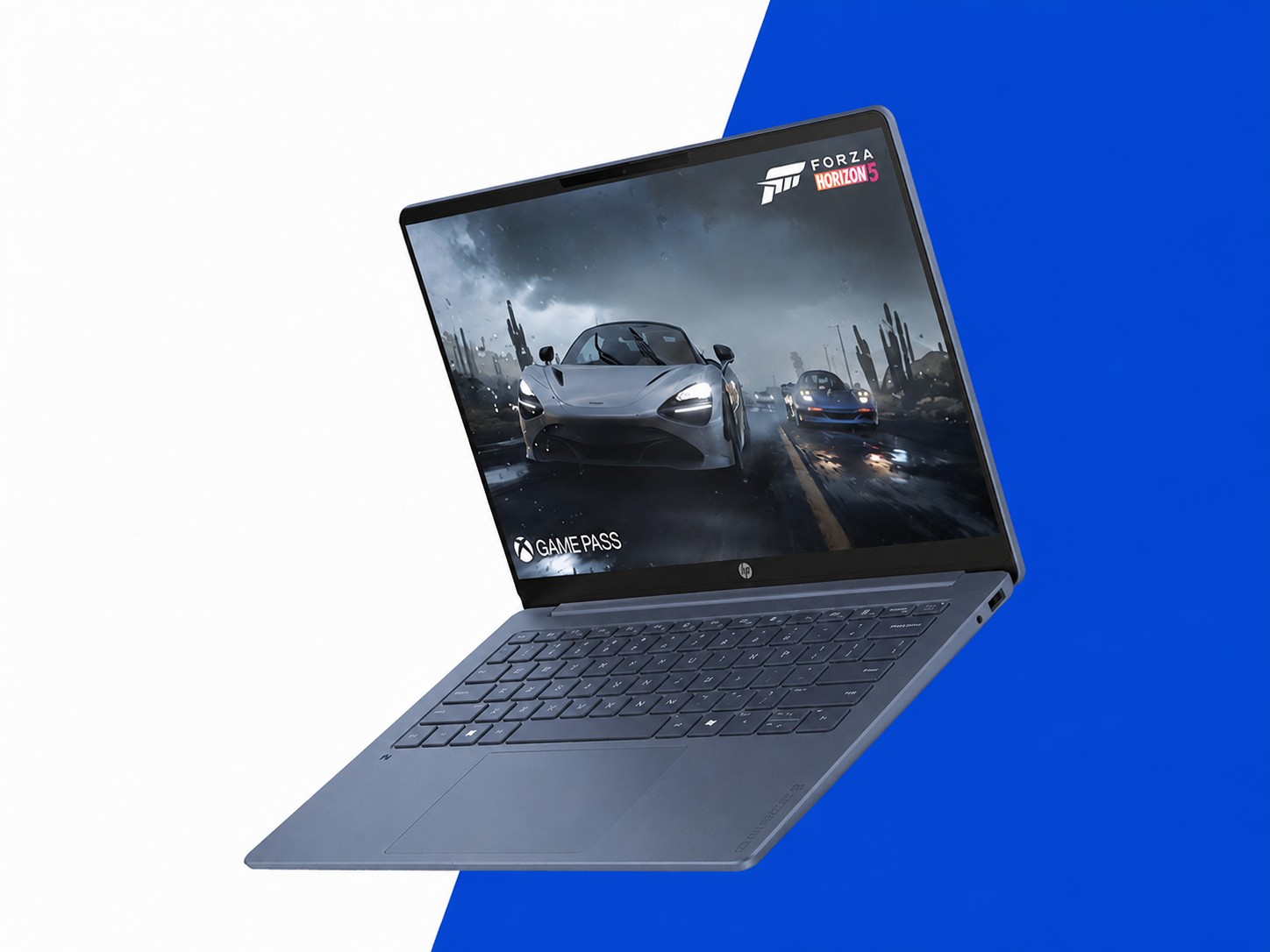
HP OmniBook 3 14 arrives as a $599 MacBook Neo rival with OLED display and huge battery life
HP’s new OmniBook 3 14 is now available in the United States, and it is shaping up to be a strong budget-friendly alternative to the MacBook Neo. The 14-inch laptop, listed as model HP OmniBook 3 14-hz0488nr, starts at $599.99 and brings several premium features that are not always common in this price range, including an OLED screen, a large battery, and a generous port selection.
The laptop is currently available through major retailers, with Best Buy offering it at a discounted price of $499.99 at the time of listing. Amazon has it available for preorder at $599.99, while HP’s own store lists the same configuration at $749.99. That price difference makes the retail discounts especially appealing for buyers looking for an affordable Windows laptop with modern hardware.
Like the MacBook Neo, the base HP OmniBook 3 14 comes with 8 GB of RAM and 256 GB of storage. While that is enough for everyday tasks such as web browsing, streaming, writing, video calls, and light productivity, users who regularly multitask heavily may find 8 GB of RAM more restrictive on Windows. Still, for students, remote workers, and casual users, the configuration should cover the basics well.
Powering the HP OmniBook 3 14 is the Snapdragon X X1-26-100 processor. This is the entry-level chip in Qualcomm’s Snapdragon X lineup, featuring eight Oryon CPU cores with speeds of up to 2.98 GHz, 30 MB of cache, and a 45 TOPS NPU for AI-related workloads. Compared with the A18 Pro chip used in the MacBook Neo, HP’s Snapdragon-powered laptop is expected to perform better in multi-core CPU tasks, though it trails in single-core performance and graphics power.
One of the biggest highlights of the OmniBook 3 14 is its display. HP has equipped the laptop with a 14-inch OLED panel featuring a 1920 x 1200 resolution and 100% DCI-P3 color coverage. That makes it a potentially attractive choice for users who value rich colors, deep contrast, and a sharper visual experience for movies, creative work, and everyday use. However, brightness is more modest at 300 nits, while the MacBook Neo’s IPS display reaches up to 500 nits, making Apple’s option better suited for bright environments.
Battery life is another major selling point. The HP OmniBook 3 14 includes a large 60 Wh battery, and HP claims it can last up to 41 hours and 45 minutes under its official testing conditions. Real-world battery life will vary depending on screen brightness, workload, apps, and wireless usage, but the combination of a Snapdragon chip and a large battery should make this laptop appealing to users who need all-day portability.
Connectivity is also stronger than expected for a thin and light laptop at this price. The HP OmniBook 3 14 includes two USB-A ports, HDMI 2.1, a headphone jack, and two full-function USB-C ports with 10 Gbps support. This gives users more flexibility when connecting accessories, external displays, storage drives, and peripherals without immediately needing a dock or adapter.
Other useful features include a 1080p webcam with a built-in privacy shutter and Wi-Fi 6E support for faster and more reliable wireless connectivity on compatible networks. The laptop measures 12.38 x 8.90 x 0.58 inches and weighs 3.13 pounds, making it compact enough for backpacks, classrooms, coffee shops, and frequent travel.
Overall, the HP OmniBook 3 14-hz0488nr is a compelling option for anyone shopping for an affordable 14-inch laptop with an OLED display, long battery life, and modern connectivity. While its 8 GB of RAM and entry-level Snapdragon X chip may not satisfy power users, its current retail pricing makes it one of the more interesting lightweight Windows laptops in the $500 to $600 range.