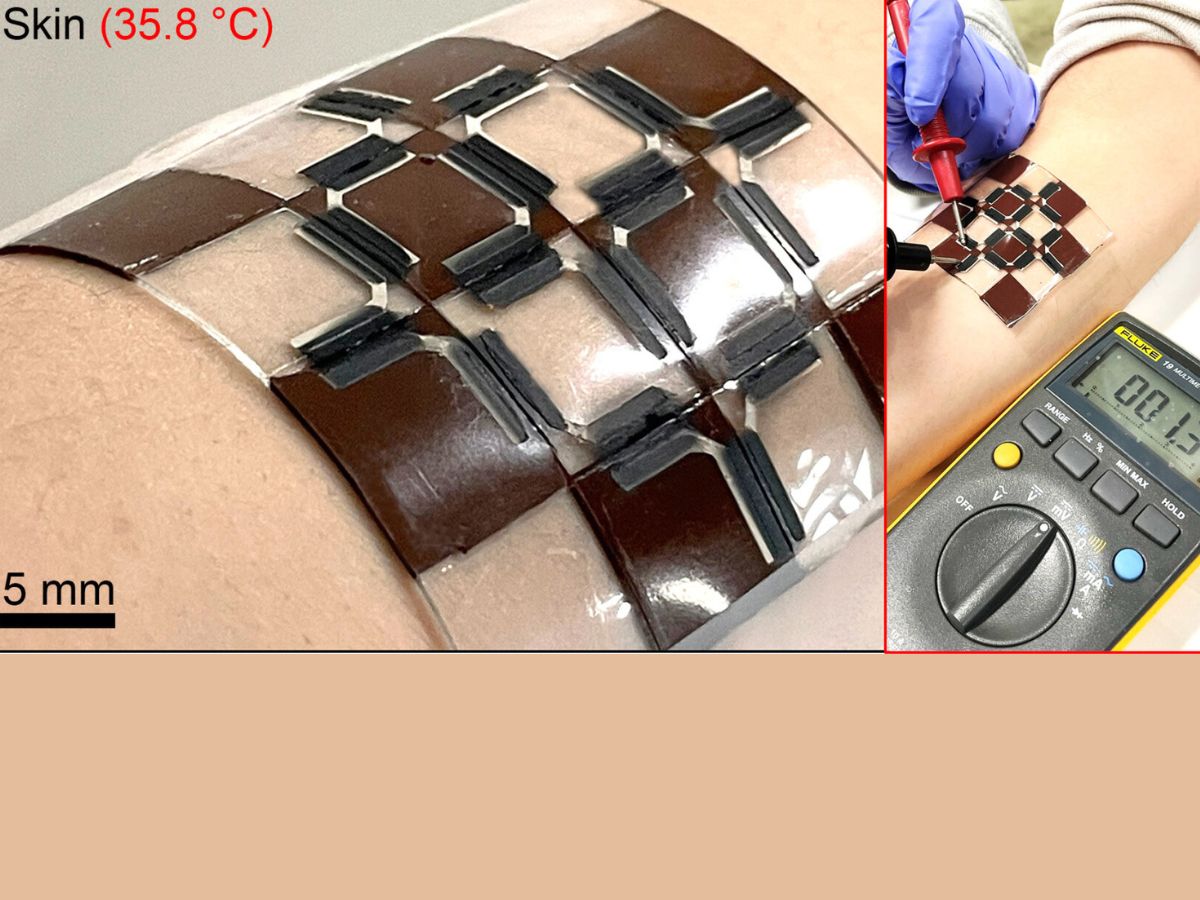
Thermoelectric generators turn heat differences into electricity by capturing the gap between a warm surface and a cooler surrounding environment. That’s why they’ve long been viewed as a potential game-changer for self-powered wearables: in theory, your body heat could continuously top up smartwatches, fitness trackers, medical sensors, and other skin-worn electronics without daily charging.
The problem is comfort and practicality. To make thermoelectric tech suitable for wearables, the power-generating material needs to be extremely thin, light, and flexible—more like a soft film than a rigid gadget. But when these generators are made as ultra-thin films, the physics works against them. Heat from the skin tends to travel straight through the material and escape into the air almost immediately, leaving little chance for the device to maintain distinct “hot” and “cool” regions. Without that temperature gradient, electricity generation drops sharply.
In the past, engineers tried to work around this limitation by folding the material or building thicker 3D structures such as pillar-like designs. Those approaches can improve performance, but they also add bulk and stiffness—exactly what designers don’t want for something meant to sit comfortably on the body all day.
A research team at Seoul National University has now introduced a promising alternative: a fully flat design that still creates the temperature differences thermoelectric devices need. Their approach, described as a “pseudo-transverse thermoelectric generator,” changes how heat moves through the device. Instead of letting warmth shoot straight upward and dissipate, their design encourages heat to travel sideways across the surface. That lateral heat flow creates neighboring warm and cool zones across the same thin layer, enabling power generation while keeping the overall structure flat and wearable-friendly.
The key innovation is a specialized stretchable silicone base. The researchers embedded heat-conducting copper nanoparticles only in selected areas of that silicone, essentially “guiding” heat along specific paths. By controlling where heat can move efficiently and where it can’t, the device produces usable temperature gradients across a thin film—achieved through smart structural engineering rather than adding thickness.
Just as important for real-world wearable electronics, the device can be made using a simple ink-based printing process. That suggests it could be scalable for manufacturing, and it stays flexible enough to conform to the skin. The design is also modular, allowing components to be assembled like building blocks to match different shapes and sizes—useful for everything from watch bands to patch-style health monitors.
If the technology continues to progress, it could help unlock a new generation of comfortable, self-powered smart wearables that rely on body heat rather than constant recharging—bringing battery-free or battery-light wearable devices closer to everyday reality.