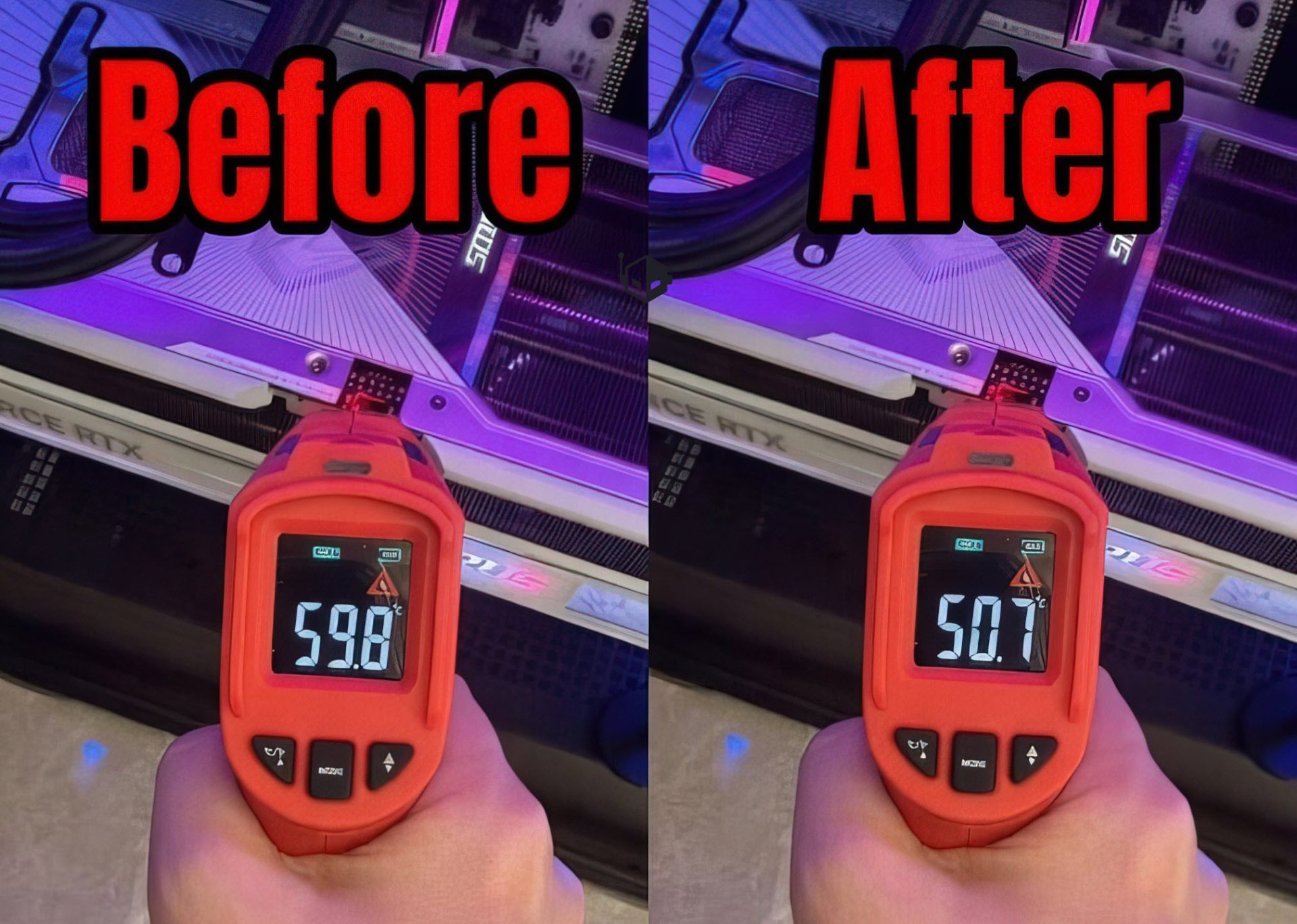
A recent user test suggests ASUS’s new ROG Equalizer 16-pin GPU power cable may be a practical upgrade for anyone running extreme-power graphics cards like an RTX 5090. In real-world stress testing, the cable appeared to reduce operating temperatures at the connector and improve voltage stability compared to a standard 16-pin (12VHPWR/12V-2×6-style) cable—two areas that matter a lot when a GPU is pulling hundreds of watts for long periods.
The cable was tested after being bundled with an ASUS ROG STRIX 1200W power supply. ASUS is rolling it into select ROG Thor and ROG Strix PSUs, including models such as the ROG Thor 1000W Platinum III, ROG Thor 1200W Platinum III (plus special editions), the ROG Thor 1600W Titanium III, and multiple ROG Strix units like the 850W, 1000W, and 1200W variants.
For the benchmark, the tester paired the cable with a Gigabyte RTX 5090D AORUS Master Ice and used FurMark to drive the graphics card into its 600W power limit. The same card was also tested using a different high-end PSU setup with a typical stock 16-pin cable to provide a direct comparison.
The most noticeable change showed up quickly on a thermal camera. Under load, the standard cable reached 59.8°C, while the ASUS ROG Equalizer cable ran at 50.7°C—nearly a 10°C drop at the connector area. Lower temperatures at the plug and cable can be important over time, especially for high-wattage GPUs where heat, resistance, and connection quality all play into long-term stability.
ASUS’s core idea with the ROG Equalizer cable is more consistent power distribution across all pins. By balancing delivery, the cable aims to reduce the risk of current or power imbalance—something that can happen if a 16-pin connector isn’t perfectly seated, is stressed by tight cable bends, or has gone through extended heavy use. In short, the design is meant to keep the cable operating comfortably below the 105°C tolerance target associated with these cables.
Voltage behavior also improved in the user’s results. With the stock 16-pin cable, voltage drop ranged from about 0.08V to 0.14V. With the ROG Equalizer cable, the reading stayed much closer to 12V, showing a smaller difference of roughly 0.005V to 0.04V. That’s well within what’s generally considered safe for 16-pin GPU power, where staying above about 11.6V (within +5%) is typically the goal.
On pricing, ASUS has already indicated that power supplies bundled with the ROG Equalizer cable will cost more. However, the company is also planning to sell the cable separately through a preferential purchase option for existing ROG PSU owners. The expected standalone price is around 100 RMB (roughly $15), which could make it an easy add-on for users who want extra peace of mind when powering power-hungry GPUs.
If these early results hold up across broader testing, cables designed specifically to reduce heat and stabilize voltage at 600W-class loads could become a new expectation for future flagship graphics cards—especially as next-generation GPUs continue pushing power limits.