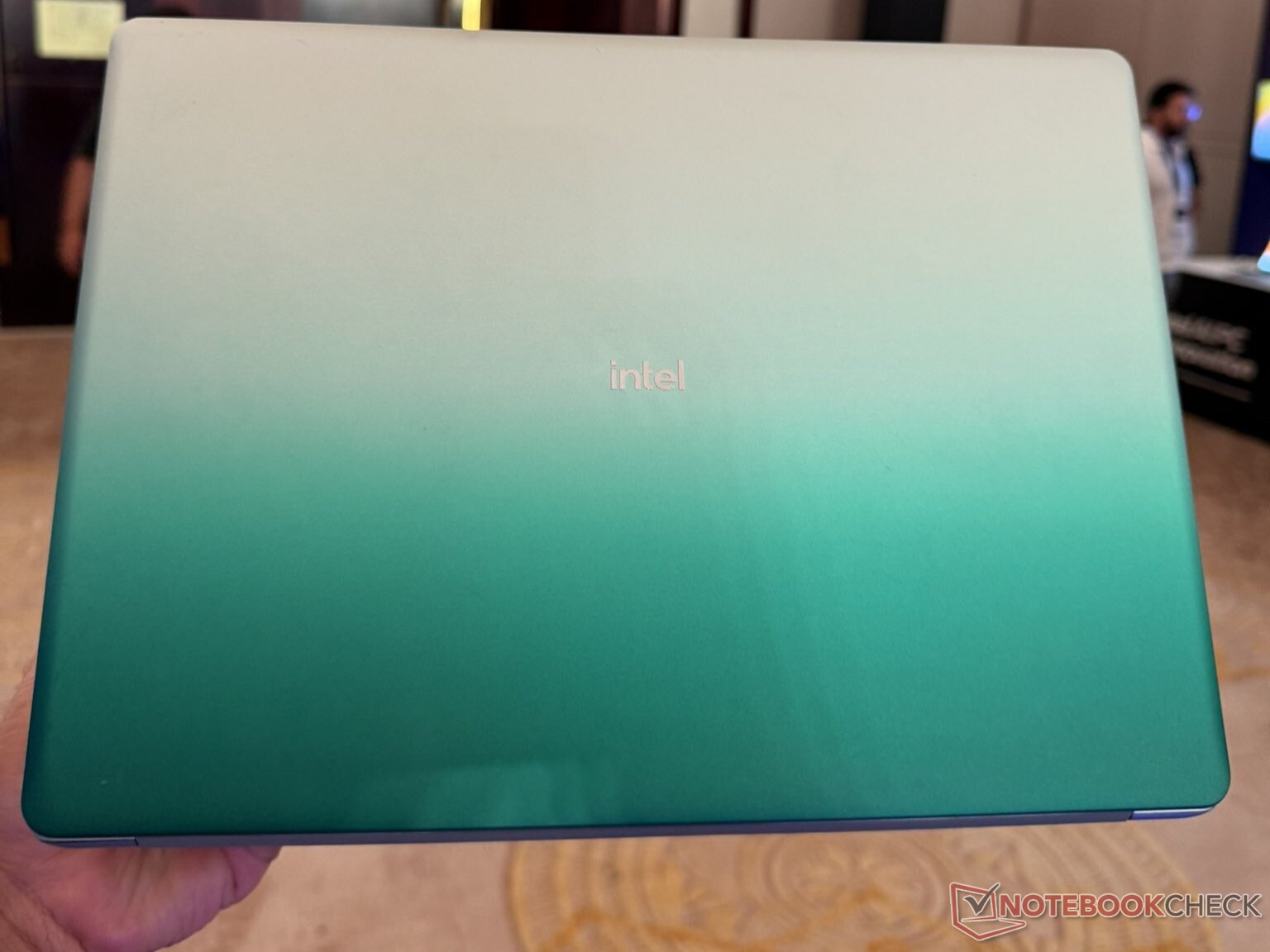
Intel has quietly started showing off a new family of laptop processors called Wildcat Lake, and an early reference laptop powered by one of these chips has already been spotted at a recent Intel event. While the company revealed several Wildcat Lake CPUs only days ago, seeing one running inside a real thin-and-light laptop offers a clearer idea of what Intel is aiming for with this lineup: everyday portability, reasonable efficiency, and lower power targets than its more premium mobile platforms.
Wildcat Lake is closely related to Intel’s Panther Lake laptop parts, but it’s positioned as a more modest option. These chips drop the “Ultra” branding and come with noticeable compromises, including fewer CPU cores, weaker integrated graphics, and more conservative power limits. In other words, Wildcat Lake looks designed for slim laptops that prioritize battery life and thermals over maximum performance—machines meant for productivity, web work, streaming, and light multitasking rather than heavy content creation or demanding gaming.
The laptop shown was an Intel reference design, featuring an aluminum chassis and a keyboard layout that reportedly resembles a MacBook-style setup. Inside was an unidentified six-core Wildcat Lake processor paired with 16 GB of soldered memory. The CPU configuration was listed as two Cougar Cove performance cores alongside four Darkmont low-power efficiency cores, reflecting Intel’s continuing push toward hybrid designs that balance snappy responsiveness with better efficiency during lighter workloads.
Power behavior is one of the most telling details here. The processor was shown with a 17-watt base power (PL1), up to 22 watts in its maximum sustained setting, and a 35-watt boost limit (PL2). Intel also indicated that in fanless systems, the same chip could be limited to 11 watts—and an Intel representative suggested it would still be usable without active cooling. If that holds true in shipping laptops, Wildcat Lake could end up in ultra-thin, quiet designs where heat and battery life matter more than raw speed.
On the AI side, this reference device was said to include a 17 TOPS NPU, which helps narrow down which specific processor it might be. That level of neural processing suggests it’s likely one of the Core 7 360 or Core 7 350 models, as those are the ones known to ship with a 17 TOPS NPU. AI performance has become an increasingly important spec for laptop buyers thanks to on-device features like background effects on video calls, voice tools, offline transcription, and other productivity enhancements that benefit from dedicated neural hardware.
Graphics appear to be very much on the “basic” end, with the laptop listed as having a 2-EU integrated GPU. That points to Wildcat Lake being focused on efficiency and core laptop duties rather than graphical horsepower. It should be fine for desktops, video playback, and simple creative tasks, but expectations for gaming or GPU-accelerated workloads should be kept in check.
The system’s 16 GB of soldered RAM was shown running at an unspecified speed, though it’s believed to be in the neighborhood of 7467 MT/s. Soldered memory is common in thin-and-light laptops because it saves space and can improve efficiency, but it also means buyers will need to choose their memory capacity carefully up front since upgrades typically won’t be possible later.
No benchmarks or performance tests were run on the device during the brief hands-on time, so the real-world speed, battery life, and thermals remain unanswered for now. Still, this early look suggests Intel’s Wildcat Lake laptops will target the mainstream ultraportable space—where a cooler, quieter design and steady everyday performance can matter more than chasing top-end specs.
As more Wildcat Lake laptops appear, buyers should watch for details like sustained power limits, cooling design (fanless vs. actively cooled), and how the NPU and hybrid cores translate into real battery life and responsiveness. Those factors will likely define whether Wildcat Lake becomes a go-to choice for affordable thin-and-light laptops in 2026.