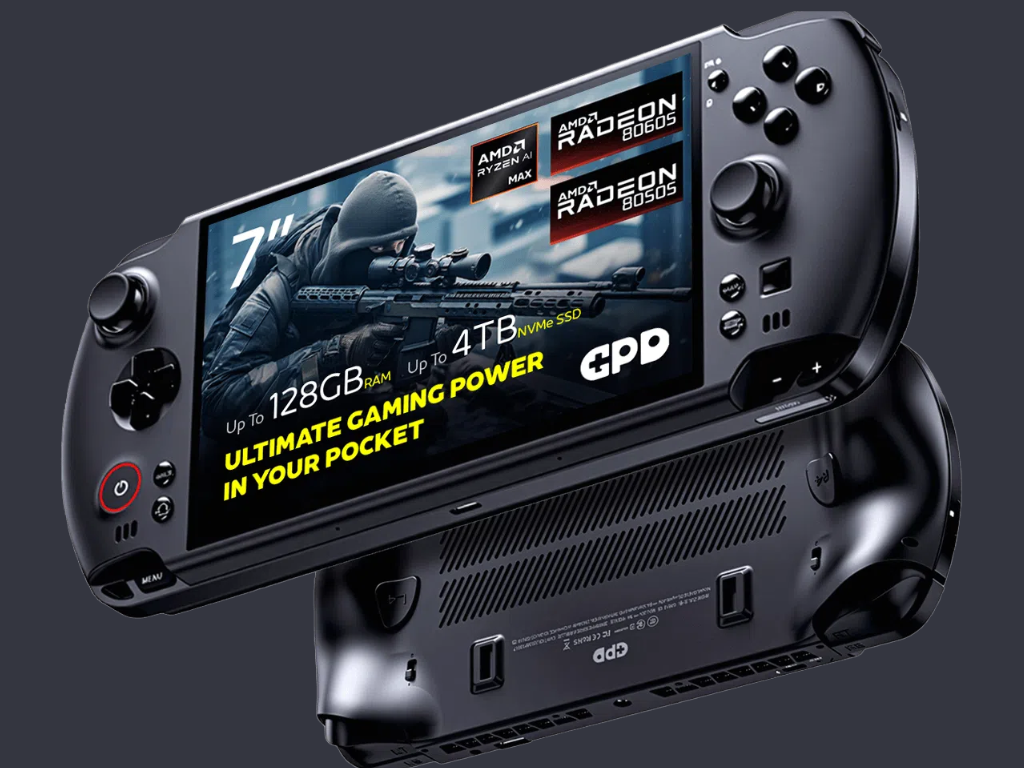
The GPD Win 5, released on October 17, 2025, is quickly earning a reputation as one of the most powerful handheld gaming PCs ever made. In fact, new performance testing suggests it can come surprisingly close to matching the PlayStation 5 in demanding modern games—an impressive milestone for a device you can hold in your hands.
What makes the GPD Win 5 stand out is its use of AMD’s Ryzen 9 AI Max+ 395 processor, better known by its codename “Strix Halo.” On paper, it almost sounds unrealistic for a handheld: a high-end chip featuring 16 CPU cores, 40 RDNA 3.5 compute units, and a 256-bit memory interface delivering up to 256 GB/s of memory bandwidth. The silicon itself is massive too, with a die size reported at 440 mm²—larger than the chip used in the PS5 Pro, which underscores just how ambitious this handheld design really is.
Strix Halo was originally aimed at laptops and mini PCs and is typically associated with much higher power targets—around 140 watts. The GPD Win 5, however, scales the processor across a wide power range, reportedly running anywhere from 7W up to 85W depending on the mode and workload. The practical “sweet spot” appears to be around 50W, where the device can deliver strong performance without pushing the limits too aggressively.
In a head-to-head style comparison using Alan Wake 2, a game known for being visually intensive, testing showed just how close this handheld can get to console-level results. Using “Tweaked Low” settings on the GPD Win 5, a stress test aligned with the PS5’s settings at 1440p produced an eye-catching result: the handheld reached about 93.5% of the PS5’s frame rate. That works out to roughly 51.65 FPS on the GPD Win 5 versus 55.25 FPS on the PS5.
Even more interesting is how well it holds up when unplugged. In a 30W battery mode at the same resolution, the GPD Win 5 still managed around 39 FPS, which is about 69.6% of the PS5’s performance in that specific test. For a portable system trying to balance heat, battery life, and performance, that’s a meaningful number—especially in a game as heavy as Alan Wake 2.
Dropping the resolution to 1080p improves the handheld’s relative standing even further. At 1080p, the GPD Win 5 delivered about 85.6% of PS5 performance, landing near 47.3 FPS. Turn on FSR 2 Performance Mode, and that result rises to around 51.47 FPS. In the same stress scenario, the PS5 recorded about 53 FPS at 1440p in Performance Mode, helping contextualize just how competitive this handheld can be with smart settings.
This is also a sign of where the portable PC gaming market is heading. Other handheld makers are reportedly exploring Strix Halo-based designs as well, but GPD currently appears to be ahead of the pack by shipping the first handheld built around this APU.
There is a catch, though: price. The GPD Win 5 sits firmly in premium territory, crossing the $2,000 mark. One listed configuration includes 32GB of LPDDR5X memory and a 2TB NVMe SSD for $2,179, with the high cost tied to broader pricing pressure affecting storage and RAM. Still, if you’re looking at it as a glimpse into the future of handheld gaming performance, the GPD Win 5 makes a strong case—especially if battery technology continues to evolve fast enough to keep up with increasingly powerful silicon.