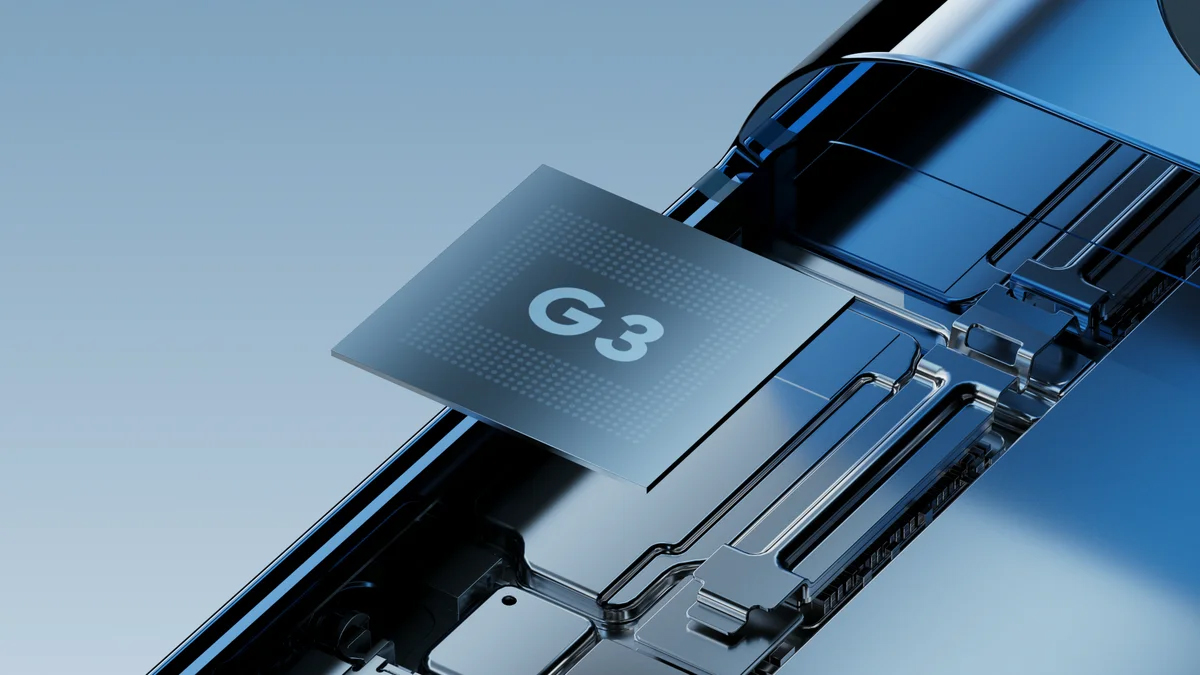
Google’s latest Tensor G3 chipset, featured in the recently launched Pixel 8 and Pixel 8 Pro smartphones, offers a significant enhancement over its forerunners. Although it may not reach the performance benchmarks set by rivals such as the Snapdragon 8 Gen 3, MediaTek Dimensity 9300, or Apple A17 Pro, the Tensor G3 boasts an innovative edge in video encoding technology.
The Google Tensor G3 has been confirmed to support hardware-accelerated AV1 encoding, marking a milestone as the first smartphone SoC to incorporate this feature. This is a step up from the commonly used H.264 video encoding standard found in many Android devices and even the H.265 encoding employed by some flagship models. AV1 encoding delivers a more efficient data compression method, enhancing storage efficiency for high-resolution video content like 4K 60 FPS recordings. Studies conducted by Facebook (now Meta) have shown that AV1 can achieve up to 50% better data compression rates when compared to older codecs.
The discovery of AV1 encoding capabilities within the Tensor G3 chip was made by Android expert Mishaal Rahman, who uncovered the feature while reviewing code snippets. Prior to the chip’s launch, there were speculations regarding the SoC’s support for hardware-level AV1 encoding at 4K 30 FPS. Further examination revealed that just before the release of the Pixel 8 series, Google had upgraded the encoder to aim for 4K 60 FPS support.
Despite the advanced encoding support of the Tensor G3 SoC, Google’s devices featuring the new chipset are not currently utilizing the AV1 encoding due to widespread compatibility issues; H.264 remains the most commonly implemented codec across platforms. As technology continues to evolve, we may see broader adoption of the AV1 codec, which could trigger widespread compatibility across various devices and platforms, taking full advantage of the Tensor G3’s encoding prowess.