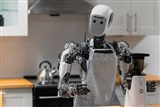
Google-Backed Humanoid Robot Startup Tests Electronic Paper for the Future of Robot Design
Humanoid robots are no longer evolving only through stronger motors, better balance, or more advanced artificial intelligence. The next major shift in robotics may come from something far less obvious: the materials used to build the machines themselves.
A Google-backed humanoid robot startup is reportedly experimenting with electronic paper, also known as e-paper, as part of its efforts to rethink how robots look, communicate, and interact with the world around them. While most attention in the humanoid robotics industry focuses on movement, autonomy, and AI-powered decision-making, this approach suggests that the robot’s outer surface could become just as important as its internal technology.
Electronic paper is best known for its low power consumption, high visibility, and paper-like appearance. Unlike traditional screens, e-paper can display information while using very little energy, especially when the image does not need to change constantly. This makes it an attractive option for devices where battery life, readability, and lightweight design matter.
For humanoid robots, those qualities could open the door to new design possibilities. Instead of relying only on rigid plastic shells, metal frames, or conventional display panels, robots could use electronic paper as part of their exterior surfaces. These surfaces might show simple expressions, status updates, visual signals, branding, instructions, or other useful information without draining the robot’s battery.
This could be especially valuable as humanoid robots move closer to real-world environments such as warehouses, hospitals, retail spaces, homes, and public service areas. In these settings, a robot’s ability to communicate clearly with humans is crucial. A humanoid machine that can display readable messages or visual cues directly on its body may feel more approachable, more useful, and easier to understand.
The use of e-paper could also help solve one of the biggest challenges in robotics: energy efficiency. Humanoid robots require power for walking, balancing, lifting, sensing, processing data, and connecting to cloud-based systems. Every added component must justify its power demand. Traditional displays can be bright and dynamic, but they often consume more energy and generate more heat. E-paper, by contrast, can maintain an image with minimal power, making it a practical choice for robots designed to operate for long periods.
Beyond efficiency, electronic paper may also support a softer and more adaptable design language. Many humanoid robots still look mechanical, industrial, or intimidating. Materials that can visually change while remaining lightweight could allow designers to create robots with a more human-friendly appearance. A robot could display different patterns, instructions, or emotional cues depending on the task, location, or user interaction.
This does not mean electronic paper will replace advanced displays, sensors, cameras, or robotic skin technologies. Instead, it could become one more layer in the growing field of smart robotics materials. The future of humanoid robots may depend not only on how well they move, but also on how effectively they communicate intent, status, and personality through their surfaces.
The interest in e-paper also reflects a broader trend in the robotics market. Companies are searching for ways to make humanoid robots more practical, affordable, and scalable. Mechanical engineering remains essential, but materials science is becoming a new area of competition. Lightweight surfaces, flexible displays, durable coverings, and energy-saving interfaces could all play a role in determining which robots succeed commercially.
As more startups and major technology companies invest in humanoid robotics, the market is likely to see rapid experimentation with both hardware and design. Some companies will focus on AI and autonomy. Others will prioritize strength, dexterity, or mobility. But the robots that become widely adopted may be the ones that combine strong performance with intuitive, human-centered design.
Electronic paper fits neatly into that vision. It is not flashy in the same way as a high-resolution screen, but its practicality could make it extremely useful. In a busy workplace, a robot displaying a clear message such as “delivering supplies,” “charging,” or “waiting for instruction” could reduce confusion and improve safety. In customer-facing environments, e-paper surfaces could help robots provide guidance, identification, or simple interaction prompts.
The idea also raises interesting possibilities for personalization. A humanoid robot could adjust its visible appearance depending on its role or environment. In a hospital, it might display calming tones or patient-friendly instructions. In a warehouse, it could show task information or safety alerts. In a home, it could present reminders, notifications, or simple expressions that make interaction feel more natural.
While the technology is still being explored, the experiment highlights an important point: the next generation of humanoid robots will not be defined by one breakthrough alone. Progress will come from many improvements working together, including better AI, stronger hardware, smarter batteries, safer movement, and more intelligent materials.
If electronic paper proves useful in humanoid robot design, it could become a small but meaningful part of the industry’s evolution. It offers a way to make robots more communicative, energy-efficient, and visually adaptable without adding unnecessary complexity.
The humanoid robotics race is only getting started, and material innovation may become one of its most overlooked advantages. As companies continue to refine how robots move, think, and interact, the surfaces they wear could become a key part of how humans understand and trust them.


