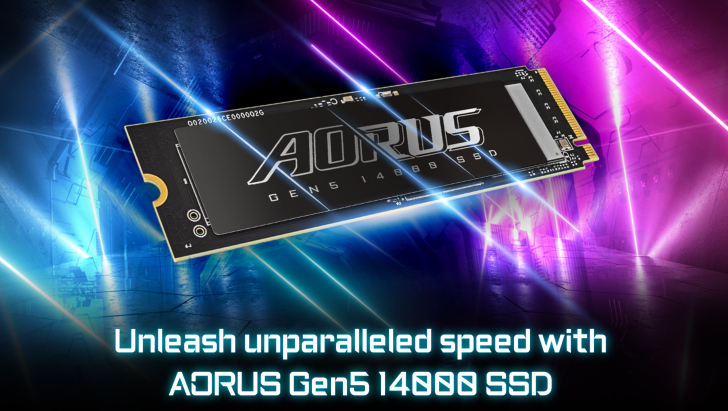
Gigabyte has recently launched its latest solid-state drive (SSD), the AORUS Gen5 14000, boasting some of the highest transfer rates in the storage market. This SSD series represents an advanced step in Gigabyte’s progressive lineup, following earlier models such as the AORUS Gen5 10000 and Gen5 12000 series. Here are some key features and specifications of the AORUS Gen5 14000 SSD:
– Form Factor: M.2 2280
– Interface: PCI-Express 5.0 x4, NVMe 2.0
– Capacity Options: 1 TB, 2 TB, and 4 TB
– Peak Sequential Read Speed: Up to 14,500 MB/s for the 2 TB variant
– Peak Sequential Write Speed: Up to 12,700 MB/s for the 2 TB variant
– Warranty: Limited 5-year coverage
– Compatibility: Requires motherboard heatsink
The AORUS Gen5 14000 SSD elevates performance with a Phison PS5026-E26 Gen5 controller, designed on a 12nm process and paired with a 232-layer 3D TLC NAND Flash. This storage solution supports 8 flash channels with 64 CEs and DDR4 caching capabilities. Adhering to the NVMe 2.0 standard, the SSD achieves transfer speeds twice as fast as top-end PCIe Gen4 SSDs, generally capped at about 7.4 GB/s.
The performance capabilities differ across each storage option. While the 2 TB version excels with speeds of 14.5 GB/s read and 12.7 GB/s write, the 1 TB and 4 TB drives provide impressive rates too, with the 1 TB drive rated at 13,600 MB/s read and 10,200 MB/s write, and the 4 TB at 14,100 MB/s read and 12,600 MB/s write.
For cache memory, the 1 TB SSD includes 2 GB of LPDDR4, the 2 TB has 4 GB, and the 4 TB model is equipped with a substantial 8 GB cache. Operating at a maximum power consumption of 11.5W, the drives boast a robust Mean Time Between Failures (MTBF) of 1.6 million hours, enhancing durability and reliability.
Considering the advanced technological design, Gigabyte advises the use of a dedicated motherboard heatsink with the AORUS Gen5 14000 SSDs given their potential to generate significant heat under maximum operating conditions. Although Gigabyte has not yet announced a specific heatsink model for this latest series, it is likely we will see appropriate cooling solutions available with the SSDs upon launch.
Pricing and availability details for the AORUS Gen5 14000 SSD series have not been disclosed, but the tech community is eagerly anticipating its market debut in the near future, looking forward to experiencing these unparalleled transfer rates.
As users await the arrival of these high-capacity, ultra-fast storage options, the anticipation builds for a step-change in performance that can significantly benefit demanding applications and enhance overall computing efficiency.