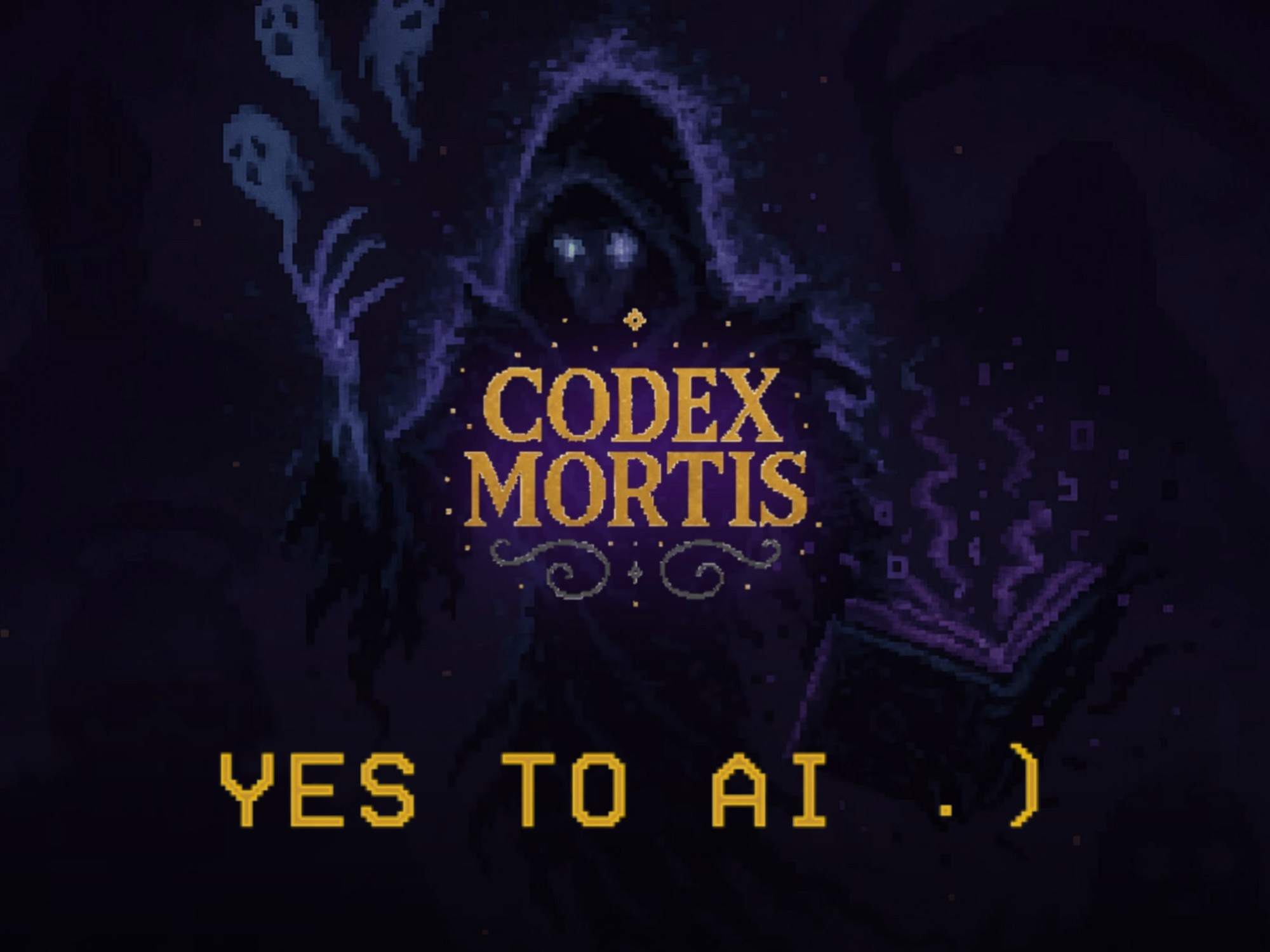
Some game studios tread carefully around generative AI, worried about how players will react or how much they should disclose. Codex Mortis is taking the opposite approach. The team behind the project is openly positioning its heavy reliance on AI as the main attraction, calling it the “world’s first fully playable game created 100% through AI.” The game, a bullet hell experience inspired by the Vampire Survivors-style formula, now has a demo available on Steam ahead of its full launch.
That “first ever” claim is likely to spark debate. Other projects have experimented with AI-generated gameplay and content in different ways, including web-based experiences that use fast-evolving generative tools to create open-world-style play. Still, Codex Mortis is being marketed as a title where AI wasn’t just used for a few assets, but for essentially every step of development.
This matters even more now that storefront policies have tightened. Valve began requiring developers to clearly disclose any use of generative AI in early 2024, and Codex Mortis spells it out in blunt terms: all of the code, art, sounds, music, and text were created using AI tools. If you watch the trailer, that approach is hard to miss—the visuals have a distinctly machine-made look. The developer also appears to have used their own faces as source material, resulting in character designs that can feel like faces were pasted onto models rather than crafted through traditional character art workflows.
The big question, of course, is whether a game built this way can actually be fun.
Codex Mortis is described as a “necromantic bullet hell,” where players mix five types of dark magic to survive waves of undead enemies. Beyond simply mowing down hordes, there’s also an army-building angle: you can gather your own forces from these doomed souls and play either solo or in co-op, which could appeal to anyone who likes chaotic, build-driven survival action.
Early impressions from the demo are mixed in terms of presentation and usability. The interface can be confusing to navigate, especially when using a controller. There’s also a noticeable difference between the trailer and the in-game look: the demo leans into a top-down perspective with retro-style visuals that don’t fully match what viewers might expect if they only saw the promotional footage. That said, this genre has never depended on cutting-edge graphics to succeed, and some of the most popular bullet heaven games keep things visually simple while focusing on build variety and moment-to-moment intensity.
Even if the gameplay hook lands, the AI angle may be a barrier for many players. Recent backlash toward games that used generative AI in a more limited way shows how sensitive the audience can be, and Codex Mortis is effectively testing the limits by handing AI full creative control. On the other hand, expectations often shift with price and scope. If the final version launches at a budget-friendly cost, it may avoid some of the outrage that tends to hit bigger, higher-priced releases.
For players curious about where generative AI might lead game development—both the promising parts and the uncomfortable ones—Codex Mortis is shaping up to be a fascinating experiment. The Steam demo will likely be the deciding factor: not whether it was made by AI, but whether it earns its place as a game people want to keep playing.


