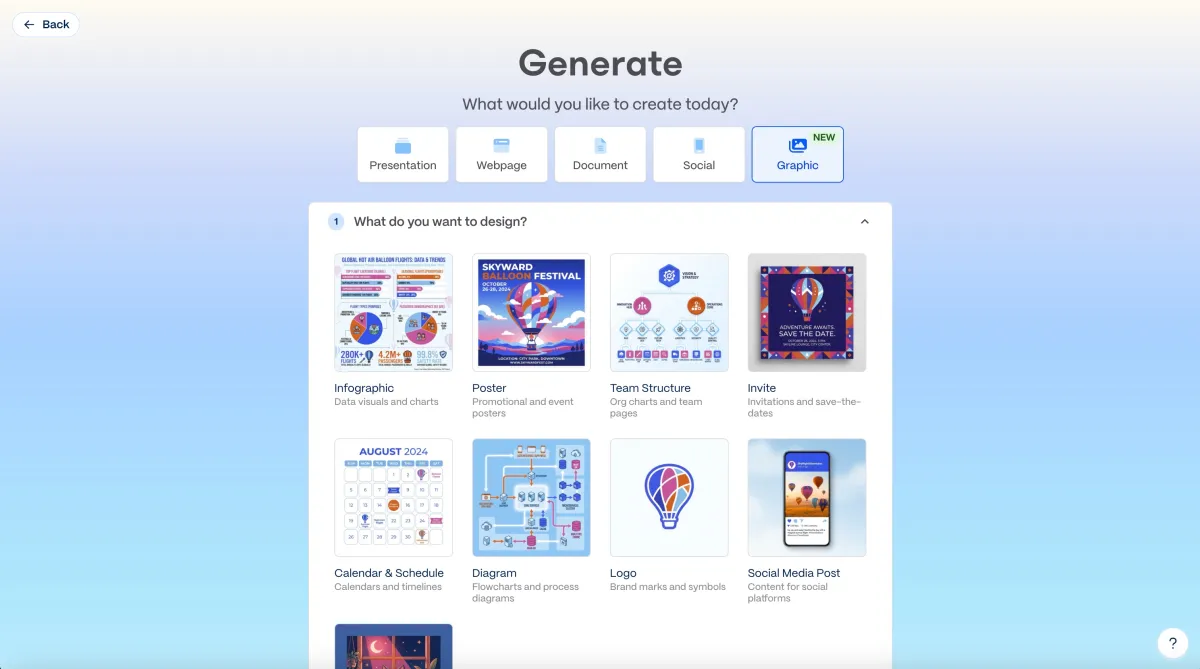
Gamma, the AI-powered platform known for helping people quickly create presentations and simple websites, is expanding into a new area: image generation for marketing and business visuals. The company has introduced Gamma Imagine, a new product designed to help teams generate polished, brand-ready creative assets using text prompts, positioning Gamma more directly against established design platforms like Canva and Adobe.
With Gamma Imagine, users can type what they need and produce a wide range of visual content tailored to their brand. That includes interactive charts and visualizations, marketing collateral, social media graphics, and infographics. The goal is to make it easier for business users to create professional-looking materials without waiting on a dedicated design team or spending hours learning complex design software.
Gamma says its broader platform already offers more than 100 templates, which can be combined with its AI features to build the exact asset a user needs, whether that’s for a pitch deck, an internal report, a product update, or external marketing campaigns. By adding a dedicated image-generation layer focused on marketing assets, the company is aiming to cover more of the everyday visual communication work that businesses rely on.
To support data-driven and workflow-friendly creation, Gamma is also integrating with a number of popular productivity and automation tools. These include ChatGPT, Claude, Make, Zapier, Atlassian, n8n, and Superhuman Go. The idea is to help users bring in information, automate repetitive steps, and generate visuals that reflect real data and context rather than generic imagery.
Gamma’s CEO and co-founder, Grant Lee, explained that the move came directly from how early users were already working. As people built presentations, they consistently ran into a broader need for graphics and design elements beyond slides alone. That insight pushed Gamma to build a new set of tools aimed at going past the traditional presentation format and into more flexible, visual-first marketing and communication assets.
Lee also framed Gamma’s place in the market as a middle ground between advanced professional tools like Adobe or Figma and legacy presentation software like Microsoft PowerPoint. In his view, there’s a large, underserved group of knowledge workers and business professionals who are expected to communicate visually as part of their job, but don’t have the right tools—or the time—to do it well. Gamma’s approach is to offer an AI-native solution that helps those users produce strong visual work without needing specialized design resources.
The company’s momentum has been growing quickly. Gamma raised $68 million in a Series B round last November at a $2.1 billion valuation. At the time, the company reported $100 million in annual recurring revenue and 70 million users. It now says it’s approaching 100 million users, signaling continued rapid adoption as interest in AI presentation tools and automated marketing asset creation increases.