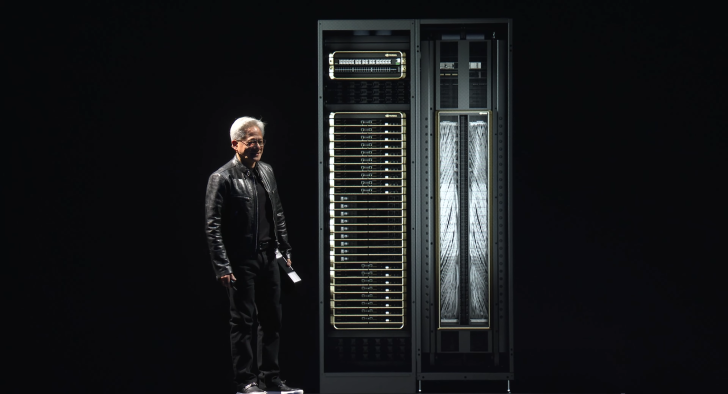
NVIDIA’s AI servers are on a power binge. In less than a decade, the company’s rack-scale platforms are projected to leap from the Ampere era to Kyber with as much as a 100x increase in energy draw—an escalation that’s forcing the entire industry to confront the sustainability of AI at hyperscale.
What’s driving the surge? The short answer is more silicon, running hotter, packed tighter, and connected faster than ever. Each generation brings more GPUs per rack and higher thermal design power per chip, compounding total demand. For context, systems built around Hopper typically ran at roughly 10 kW per chassis; with Blackwell, that figure pushes toward 120 kW due to larger GPU counts and increasingly power-hungry accelerators. Multiply that by rows upon rows of racks and you begin to see why power has become the defining constraint in AI.
The interconnect fabric is another catalyst. Advanced NVLink and NVSwitch topologies enable colossal model sizes and faster training, but that high-speed networking also eats into the energy budget. Pair those fabrics with next-gen racks running at consistently high utilization, and hyperscaler consumption explodes.
The scale of ambition is staggering. Big Tech is now measuring AI campuses in gigawatts, not megawatts, with firms like OpenAI and Meta targeting more than 10 GW of new capacity in the coming years. To put that into perspective, 1 GW of data center power—without even counting cooling and power delivery overhead—could supply around one million U.S. homes. Extend that to mega-campuses and you’re looking at facilities that can rival the energy consumption of mid-size countries or multiple large U.S. states.
That raises serious questions about grid readiness, costs, and climate impacts. Policymakers have repeatedly flagged the risk that rapid data center buildouts could outpace transmission upgrades, push up local electricity prices, and complicate decarbonization goals. The International Energy Agency’s 2025 Energy & AI research estimates AI alone could double electricity consumption by 2030—nearly four times the expected growth rate of the grid. The result could be higher household bills in regions surrounding major AI hubs, especially where new generation and transmission lag demand.
Why power is spiking so fast
– More accelerators per rack: Each generation adds GPUs, stacking demand even if per-chip efficiency improves.
– Higher TDP per GPU: Cutting-edge accelerators draw substantially more power to hit performance targets.
– Heavier fabrics: NVLink/NVSwitch and similar interconnects deliver bandwidth at a steep energy cost.
– Dense, always-on utilization: Hyperscalers are pushing racks to their limits to maximize throughput.
– Cooling and power delivery overhead: As thermal loads climb, so do the watts needed to keep systems stable.
For investors, operators, and policymakers, the takeaway is clear: AI’s compute curve is now an energy curve. Data centers are evolving from facilities that sip power to complexes that require dedicated generation, high-voltage transmission, and advanced cooling from day one. Liquid cooling, chiplet-based designs, optics-rich interconnects, and rack-level power innovations can slow the growth—but they won’t stop it as long as the industry keeps scaling model size and training duration.
The industry’s next frontier may be less about raw FLOPS and more about watts per token, joules per inference, and energy-aware scheduling. Expect to see:
– Bigger on-site power solutions, from utility-scale solar and wind to long-duration storage and potentially small modular reactors.
– Aggressive efficiency targets, including tighter power usage effectiveness (PUE), warm-liquid and immersion cooling, and smarter workload placement across time and geography.
– Grid partnerships that co-develop transmission and substation capacity alongside new campuses.
The bottom line: From Ampere to Kyber, NVIDIA’s platform roadmap mirrors the broader AI trajectory—astonishing performance gains tied to outsized jumps in energy consumption. Without a parallel revolution in power generation, grid infrastructure, and efficiency, the AI gold rush risks colliding with physical limits and consumer backlash over rising electricity costs. The race to AGI isn’t just a story about chips and algorithms anymore; it’s a story about power, and whether the world can deliver it fast enough.