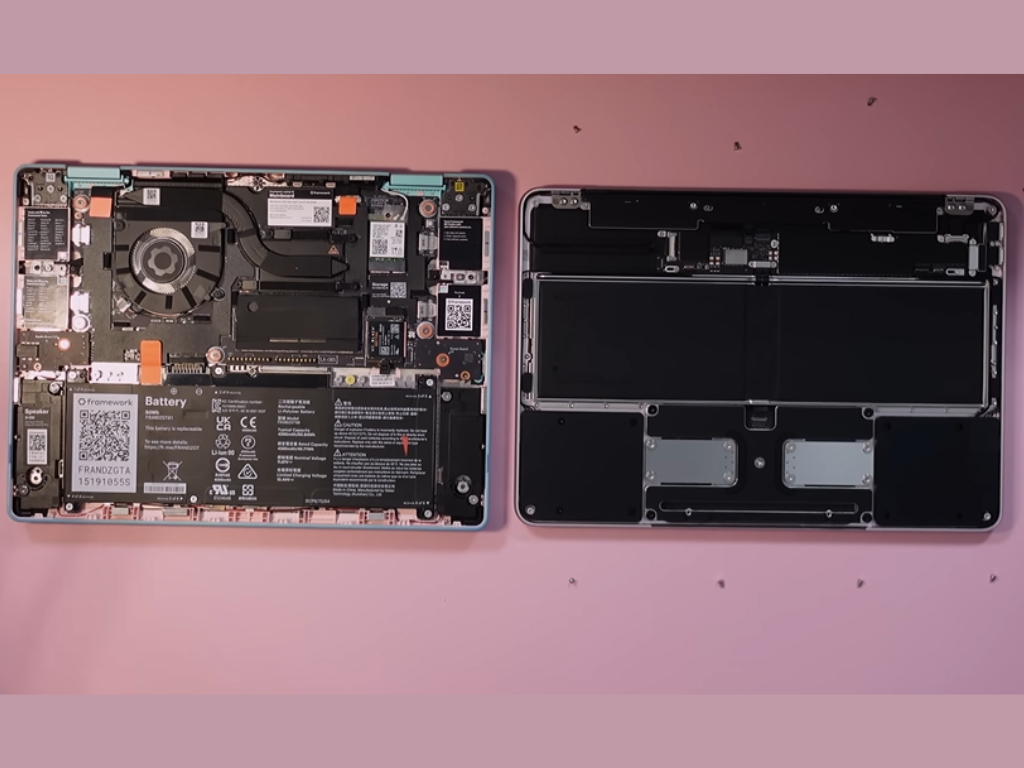
Framework founder and CEO Nirav Patel has taken aim at Apple’s new budget laptop, the MacBook Neo, after publishing a detailed teardown that puts it side by side with the Framework Laptop 12. His takeaway is a simple line with a big message behind it: “A computer should be yours.”
In a 33-minute teardown video, Patel breaks down what he sees as two completely different philosophies hidden inside two sub-$1,000 laptops designed for students and light everyday use. On paper, both machines target affordability. In practice, one is built around long-term ownership and upgrades, while the other prioritizes a more locked-down structure that limits how far you can take it after purchase.
Apple’s MacBook Neo starts at $599 and has been described as Apple’s most repairable laptop in more than a decade. It earned a 6/10 repairability score from iFixit, which suggests meaningful improvements compared to many past MacBook designs. Patel purchased a MacBook Neo directly from an Apple Store to see how it’s built, then compared its internals to Framework’s 12.2-inch convertible touchscreen Laptop 12, which begins at the same $599 entry price.
Where the gap widens is in what happens after year one, year two, and beyond. Framework’s Laptop 12 is designed to be opened, serviced, and upgraded over time, with the goal of extending lifespan and improving reliability through replaceable parts. Patel highlights clearly labeled internals and modular components that can be swapped with minimal friction, helped along by simple POGO pin connections. In Framework’s approach, users can replace the motherboard, memory, storage, cooling solution, screen, keyboard, and more as needs change or as parts wear out.
The MacBook Neo, by contrast, makes some components easier to access than many people might expect. Patel notes straightforward entry to parts like the touchpad, battery, and speakers, and he points out that ports can be replaced without excessive difficulty. But he also calls attention to the keyboard replacement process, which involves peeling back a tape layer and removing 41 Phillips screws—an example of how “repairable” can still mean “time-consuming and tedious” once you get deeper into the machine.
Patel argues the biggest long-term drawback is upgradability. With the MacBook Neo, you’re effectively locked into 8GB of RAM and whichever storage configuration you chose at checkout—256GB or 512GB—because both memory and storage are soldered to the motherboard. That means no simple upgrade path if your workload grows, if apps get heavier over the years, or if storage fills up faster than expected.
He also points to display repairs as another major difference. If the MacBook Neo screen gets damaged, he says you’ll need to replace the entire top chassis. With Framework’s design, the display can slide out and be swapped in minutes, making accidental damage less likely to turn into a large repair bill or a reason to replace the whole laptop.
Beyond screws, solder, and parts access, Patel frames the MacBook Neo as a product designed to bring first-time buyers into Apple’s ecosystem. In his view, the idea is that users start with a low-cost MacBook, then eventually hit inevitable constraints—storage, speed, port needs—while already committed to macOS, making it more likely they’ll upgrade to higher-priced Apple laptops later.
Framework positions itself as the opposite of that “stepping stone” model. Patel says the company’s goal is to reduce e-waste by making laptops that can be used and improved for as long as the owner wants, which he argues is especially important for schools and education environments where repairability and longevity can matter as much as upfront price. Rather than pushing customers toward a new computer, Framework’s pitch is that the same device can evolve through upgrades and repairs, staying useful for years.
For anyone comparing budget laptops for students, school programs, or everyday home use, Patel’s teardown is a reminder to look past the sticker price. The real cost of a laptop often shows up later—in repair difficulty, in upgrade limits, and in whether a slow-down means a simple part swap or a full replacement.