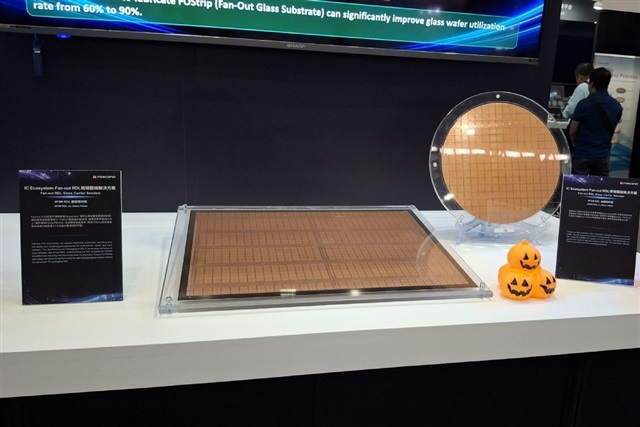
Foxconn is pushing deeper into advanced semiconductor packaging as artificial intelligence moves beyond cloud data centers and into cars, smart devices, and edge computing hardware. At Hon Hai Tech Day 2026, the company highlighted its progress in fan-out redistribution layer packaging, showcasing roughly 5µm-class fine-line circuitry aimed at supporting next-generation chiplet designs.
The move signals Foxconn’s ambition to become a stronger player in the growing advanced packaging market, where chipmakers are looking for new ways to improve performance without relying only on traditional transistor scaling. As AI workloads become more common in everyday devices, packaging technologies that can connect multiple chips efficiently are becoming increasingly important.
Fan-out RDL packaging is designed to improve the way chips communicate inside a package. By using fine redistribution layers, the technology can create denser interconnects between components while helping reduce overall package size. This makes it especially attractive for chiplet-based architectures, where different processing units, memory, sensors, or accelerators may be combined into one compact solution.
Foxconn’s 5µm-class circuitry is positioned as a practical balance between performance, cost, and manufacturability. Rather than focusing only on the most extreme packaging nodes, the company appears to be targeting high-volume applications where efficiency and affordability matter just as much as cutting-edge density.
One of the biggest target markets is automotive electronics. Modern vehicles are becoming increasingly dependent on advanced chips for driver assistance, infotainment, power management, connectivity, and AI-powered in-car systems. As electric vehicles and software-defined cars continue to evolve, demand for compact, reliable, and cost-effective chip packaging is expected to grow rapidly.
Edge AI is another major focus. Instead of sending every task to a remote cloud server, edge AI allows devices to process data locally. This can reduce latency, improve privacy, and lower power consumption. Devices such as smart cameras, industrial sensors, robots, drones, and AI-enabled consumer products could benefit from smaller and more efficient chip packages.
Consumer electronics may also be a key opportunity. Smartphones, wearables, laptops, home appliances, and smart home products are increasingly adding AI features. Advanced fan-out RDL packaging could help manufacturers fit more computing power into thinner and lighter devices while keeping production costs under control.
Foxconn’s entrance into this space also reflects a broader industry shift. As chip design becomes more modular, chiplets are becoming a preferred approach for building complex processors. Instead of manufacturing one large monolithic chip, companies can combine multiple smaller chips in a single package. This can improve yield, reduce development cost, and allow more flexible product designs.
However, chiplet packaging depends heavily on advanced interconnect technologies. The connections between chiplets must be fast, dense, and power efficient. That is where fan-out RDL can play an important role, offering a way to link components in a compact package without relying on more expensive packaging methods for every use case.
By developing 5µm-class fan-out RDL capabilities, Foxconn is positioning itself to serve markets that need scalable advanced packaging rather than only ultra-premium semiconductor solutions. The company’s manufacturing background could give it an advantage as demand rises for AI-capable hardware across automotive, industrial, and consumer sectors.
As AI continues to spread from powerful cloud servers to everyday devices, the need for better semiconductor packaging will only increase. Foxconn’s latest showcase suggests the company sees advanced packaging as a critical part of the future electronics supply chain, especially for automotive chiplets, edge AI processors, and compact consumer technology.